Jacoba Matapo, interview
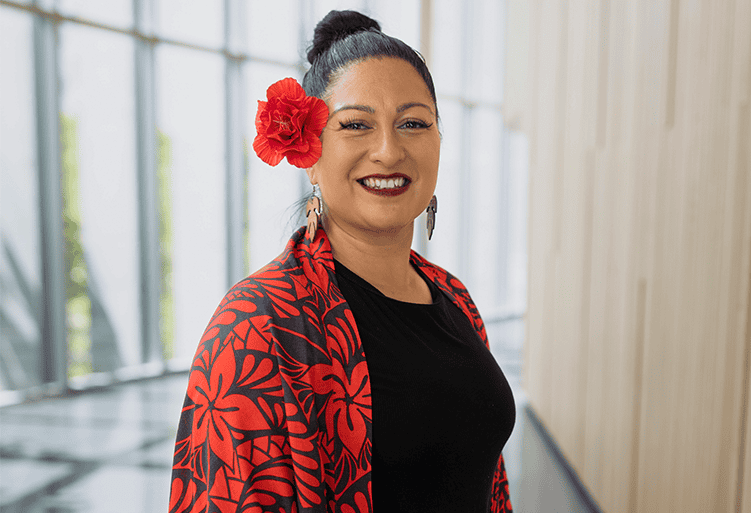
Fa’alogo Aganoa Dr Jacoba Matapo is Associate Professor and Pro Vice-Chancellor Pacific at Auckland University of Technology.
Dr Jacoba Matapo has had a long and interesting career in ECE in Aotearoa NZ and made a significant contribution to our sector. We appreciate her sharing her time and thoughts with us.
What was your early childhood like? What are your strongest and fondest memories?
I grew up in Beach Haven, where our backyard led straight into the bush and down to the estuary. My happiest childhood memories are of endless afternoons building forts from leaves and branches, digging secret hideouts, and scrambling up trees. I’d wander through the mudflats at low tide, mesmerized by the tiny crabs emerging from their burrows and the soft popping sounds they made. I loved the freedom of those outdoor adventures and the moment Mum’s voice drifted through the trees, calling me home.
It was here, beside the water and among the trees, that I first discovered my deep sense of calm.
The relationship with the environment has always been important to me and I guess over the years I have been able to strengthen a more intimate relationship with my ancestral lands in Sāmoa too, just like when I was a child walking, exploring and connecting. This carries my commitment to sustainable practices, especially from an indigenous standpoint.
Describe your career path and how you came to be in the role you’re in today.
I began my career in early childhood education as a relieving teacher, soon moving into the Under-Twos room and ultimately becoming its Head Teacher. From the start, I’ve been drawn to infants and toddlers, partly because, as a taulaseā (traditional Samoan healer), I grew up learning fōfō (baby massage) from my mother and her foremothers. By the time I started my formal qualification, I’d already spent years nurturing pepe (babies) through those cultural practices.
During my teaching degree, I wove together my Sāmoan healing traditions and professional pedagogy to support the holistic development of infants. After leading the Under-Two’s room, I stepped into centre management and completed a Master’s in Educational Leadership. That opened the door to an academic role, lecturing in Initial Teacher Education for Early Childhood. It was here that I discovered a passion for research, which led me to pursue a doctoral qualification, all driven by my deep commitment to tamariki/tamaiti. Though I now work in higher education, the foundations of early childhood practice continue to shape how I approach curriculum design and holistic pedagogy.
What is the most interesting aspect about what you currently do for mahi?
As Pro Vice Chancellor Pacific at AUT, I lead the Office of Pacific Advancement, working closely with Pacific communities. I oversee Pacific-focused research, student success initiatives, staff development, cultural competency building, and community partnerships across the university. What excites me most is how we collectively and systematically decolonise and indigenise our services and professional protocols, embedding culturally grounded practice to drive sustainable, long-term change. This involves both researching effective, innovative curriculum and pedagogies and fostering genuine allyship through collaborative engagement.
If you think about being proud, or feeling proud, is there something or someone that comes to mind?
When I think of pride, the first person who comes to mind is my mother. She faced enormous challenges migrating to New Zealand, learning a new language, being separated from her family in Sāmoa, and adapting to an entirely different culture. Yet she devoted herself to practicing our traditions and making sure we, her children, stayed connected to our heritage. I’m so proud of her resilience in keeping our language alive and for always valuing Fa’a Sāmoa within our family.
If you could start your career path again, is there anything you’d do differently?
If I could start my career again, I would seek out leadership mentorship much earlier. Leading in an early childhood setting is complex, when leadership and management blur or aren’t approached intentionally, it can affect team practice. I’ve learned that mentorship is key to building both leadership capability and capacity.
Going forward, I believe we should invest more in preparing teachers for formal leadership roles through targeted mentorship, while also fostering distributed leadership within teams.
What’s a piece of advice you’d offer to someone thinking about entering the early childhood field?
Before you embark on a career in early childhood education, take a moment to clarify your “why.” Know what drives you and the unique strengths you bring to the classroom. Passion will get you started, but long-term success depends on more, like cultivating a strong support network, developing self-care strategies, and protecting your own well-being. With that foundation in place, you’ll be ready to thrive in your teacher training.
I believe that early childhood teaching is one of society’s most noble callings; it shapes the next generation. So, if you feel that pull, dive in with confidence!
What are we doing well for children in early childhood education and care? And does anything come to mind that we could do better?
We’ve built our early childhood sector on the firmest possible foundation, Aotearoa’s dual heritage under Te Tiriti o Waitangi. Because of that commitment, we can proudly claim the world’s first bicultural early childhood curriculum. It weaves Kaupapa Māori principles and a deeply relational, place-based worldview into every aspect of learning, honouring both Tangata Whenua and Tangata Tiriti knowledge systems.
That said, there’s always room to grow. We could deepen our treaty partnership by involving iwi and whānau even more directly in curriculum design and centre governance. We can also do better at ensuring every service, whether urban, rural or in lower-decile communities has equitable funding, resources and access to high-quality professional learning in cultural competency. Finally, by diversifying our workforce to reflect Aotearoa’s full range of communities, we’ll create learning environments where all tamariki see their own identities and languages affirmed and nurtured.
Dr Jacoba Matapo, if you could have any superhero power, what would it be and why?
I love this question. If I could choose any superpower, it would be the ability to teleport through time, into both the past and the future. I’d walk beside my ancestors, learning from their experiences and better understanding the world they knew. Then I’d leap forward to meet generations yet to come, witnessing first hand how our decisions today shape their reality.
We are privileged to provide a paper on our website that is authored by Sainimili Nabou, Jacoba Matapo, and Tafili Utumapu-McBride
Nabou, S., Matapo, J., & Utumapu-McBride, T. (2024). Decolonising early childhood education: An indigenous Fijian perspective. NZ International Research in Early Childhood Education Journal, 26, pp. 45- 55.
See more best career stories in early childhood education
Go to Career Stories