Full Reference: Jahan, N. & Banu, M.S. (2026). Can risky play be safe? Educator perspectives on supporting outdoor risky play in early childhood education. NZ International Research in Early Childhood Education Journal, 28(1), 94 -108.
Log-in to read the full paper below. Or order a pdf copy of the article from the main NZIRECE Journal page.
ABSTRACT:
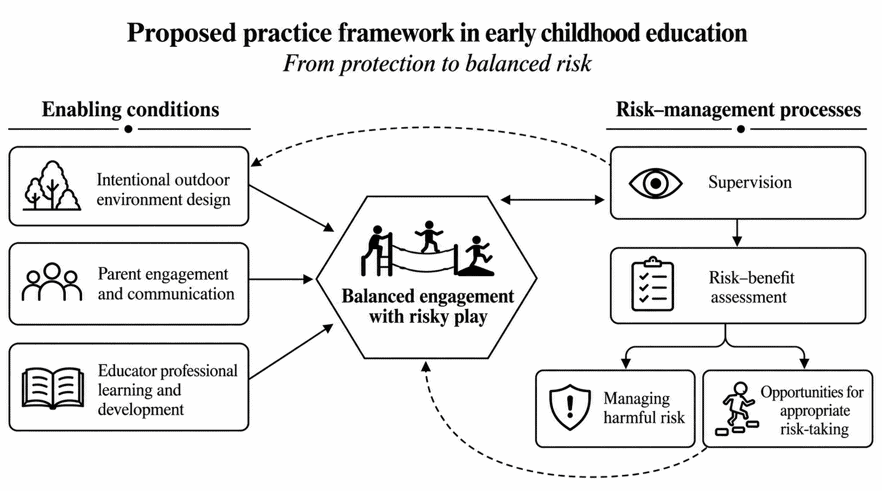
Outdoor risky play (ORP) provides important opportunities for young children to test their limits and support physical, cognitive and socio-emotional development. Despite these benefits, heightened safety concerns and risk-management practices among parents and institutions often restrict children’s opportunities for challenging outdoor play in early childhood settings. This systematic review examines educators’ perceptions and strategies for supporting ORP in Australia. Drawing on 11 peer-reviewed studies published over the past decade, the review employed reflexive thematic analysis informed by Sandseter’s risky play framework. The findings indicate that educators conceptualise ORP as a form of holistic learning and emphasise the intentional design of outdoor environments to facilitate children’s engagement with challenges, uncertainty and risks. At the same time, educators are required to mediate children’s autonomy alongside safety responsibilities, often within the constraints of regulatory expectations and parental safety concerns. The review indicates that intentional design of the outdoor environment, educator professional development and parent engagement can support ORP. Supervision and risk–benefit assessment can further manage harmful risk while preserving appropriate risk-taking. Finally, this study proposes a practice framework facilitating ORP in early childhood education, shifting from a protection-oriented perspective toward a model of balanced risk.
KEY WORDS:
Risky play; safety; outdoor play; outdoor environment; risk-taking.