
Matthew Lambert: Finding Work that Feels Right and Makes One Happy

Search Entire Website
Matthew Lambert, New Zealand

Matthew Lambert Award Winner.
June 22, 2015.

After a few jobs that did not feel like they had any purpose, 27-year-old Matthew Lambert settled on teaching as a possible career.

A first-hand look at the classroom during a period as a teacher aide showed Matthew that a school teacher wasn’t necessarily where his career path lay but the desire to work with children remained.

A girlfriend who was studying early childhood education and working in the sector gave Matthew the idea that maybe working with pre-school age children was where his skills lay so he applied for a six-month course with the New Zealand Career College including a practicum at an ECE service.
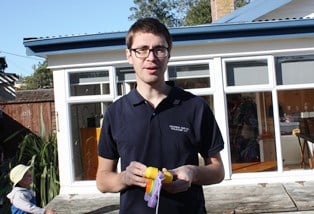
Matthew Lambert, New Zealand

The practicum confirmed to Matthew that early childhood education was where he wanted to be. He says:

“After that first practicum, I just knew that I found the career I was meant to do. A teacher at my centre always asks me: do you ever have a bad day? Do you get grumpy? Because you are always so happy and full of joy when we see you. That pretty much sums up why working in ECE appeals to me. No matter what is going, as soon as I walk into the centre, and I am greeted by the children, I am happy, and know that this is where I am supposed to be”.

Matthew is now studying for a Bachelor of Teaching degree in ECE and working as a reliever at an early childhood centre in Blockhouse Bay.

He credits the staff at the centre for encouraging him and helping him find opportunities like the Men in ECE Invitation Award. He intends to save the money to use as an emergency fund for an unforeseen expense during his studies such as needing to upgrade a computer or maintain his car so he can get to class, and says he is also looking forward to accessing the research and support that OECE membership will bring.

Matthew says he hopes to be a role model to other men to show it is possible to forge a successful career in the early childhood sector.  He is pleased to see there is support for men in the sector and delighted to know that ECE Menz for men in early childhood exists.

He says:  “If you are thinking about it, and you are worried about the stigma of a man working with children, ignore it and give it a go. My experience has been positive and I believe you too will hear a lot of positive comments along the lines of ‘it’s so good to have a male here in our centre’ because that’s what I heard the most in the beginning”.
Has this been useful?  Give us your feedback.

You are welcome to add a link to this page on your website. Copyright belongs to the OECE so please do not copy any content without our written permission.

Information provided is of a general nature. It is provided ‘as is’, and we accept no liability for its accuracy or completeness. See our Terms and Conditions.

Related Posts

teacher wages, pay scales, in childcare and early childhood education

What ECE Teachers and Workers Earn: Pay, Benefits and Conditions

Anyone thinking about getting a job in ECE working in ECE or thinking about moving to a different service will find clear, practical information in this article about pay rates, employment conditions, and what to expect in different roles. It explains everything from starting salaries and pay‑step calculations to workplace rights, benefits, and how to recognise a supportive, professional environment.

Read More »
early childhood research journal online

Visible Difference: Photostory as Capacity Building, Research and Evaluation Method

This paper presents research on the use of visual documentation – photo stories – to support reflective teaching practice, disrupt traditional power relations between educators and families, and enable teacher and researcher co-construction of knowledge.

FULL REFERENCE: Newman, L., Woodrow, C. & Arthur, L. (2016). Visible difference: Photostory as capacity building, research and evaluation method. NZ Research in ECE Journal, Special Issue: Equality and Diversity, 19, 90 – 105.

Log-in to read the full research paper below. Or order a pdf copy of the article from the main NZIRECE Journal page.

ABSTRACT: While visual documentation of learning in early childhood settings has become ubiquitous, the application of visual methodology to educational research has been relatively minor, suggesting a timeliness to investigating its application in early childhood education contexts. This paper discusses how a socioculturally informed visual methodology, and in particular photostory method, demonstrates the potential to support strengths-based participatory research and professional learning. In our study, photostory was used in conjunction with an environment rating scale to produce and document changes effected in the learning environment. We are interested in how photo story contributed to this success and discuss issues emerging from the complexity of such an endeavour in cross-national research. Findings show that the use of photostories to document processes of change facilitated the participating educators’ reflective practice, contributed to enhanced communication with families and agencies, disrupted traditional power relations such as those between the academy and the field, and educators and families, and enabled the co-construction of knowledge. These findings support our contention that visual methodologies can be usefully incorporated as robust research methodology for complex capacity building projects.

Key words: Reflective practice; evaluation; professional learning; visual documentation; photostory.

INTRODUCTION

Although visual imagery has been widely utilised in early childhood education contexts in applications such as Learning Stories (Carr 2001, 2012), and the Mosaic Approach (Clark, 2011), its use as a robust research methodology in early childhood projects is less evident. It is more visible in anthropological, sociological (Pauwels, 2011) and arts-based research than education. Prior to this project’s commencement, the use of visual methods for display, documentation, discussion, knowledge sharing or research was nonexistent in the particular research sites in Northern Chile. The work of visual ethnographers, anthropologists and sociologists including Banks (2007), Kress and van Leeuwen (1990), Pink (2005; 2013), Wang, (1999) and Rose (2012) have provided a foundation for an exploration of the use of visual methodology within one unique educational context. This exploration provides insights to inform our future research with our evolving methodologies.

This is a member/subscriber only post. To access it, please see the message below for details on access and joining.

Read More »
complaint feedback form, complaints policy, upset

Child Complaint and Parent Feedback Forms

Complaint and Parent Feedback Form. Child Feedback Form / Questionnaire.

Children’s Voice.

For a form to document children’s views on the quality of your service and understand better how to meet their individual needs and expectations click on the button below

Child feedback form

Parent and Caregiver Voice.

Does your serv

This is a member/subscriber only post. To access it, please see the message below for details on access and joining.

Read More »
job interview questions

Staff Meetings – Agenda and How to Conduct a Meeting

Staff meetings can work really well with the right Agenda and planning. Here’s how to achieve and cover what is important and make sure no meeting is a waste of valuable time.

Scroll to near the end of this page for a sample Agenda and sample planning docs.

There is no specific regulatory requirement to hold staff meetings. But services fi

This is a member/subscriber only post. To access it, please see the message below for details on access and joining.

Read More »
nappy cloth baby

Men Should Change Nappies

Men Change Nappies – Men Who Change Nappies, Change the World. By Bryan G. Nelson.

Changing the nappies of other people’s children is something that few people, men or women, usually rush to do. And nappy changing is commonly viewed as a woman’s task anyway so we shouldn’t worry if men do it or not. Or should we? 

I remember wor

This is a member/subscriber only post. To access it, please see the message below for details on access and joining.

Read More »
The Office of ECE

Share This Information

Table of Contents

Table of Contents

The Office of ECE Login

Take Action!

Help spread this vital ECE information, join our free social and email groups and become a member of OECE.

pay parity funding policy

1. Share This Information

2. Follow Our Social Pages

3. Get Regular Updates

Sign up to our free newsletters.

4. Become a Member

Public Area Categories
Categories