Big Body Play
By Frances Carlson
Researcher and Children’s Advocate
What Is Big Body Play?
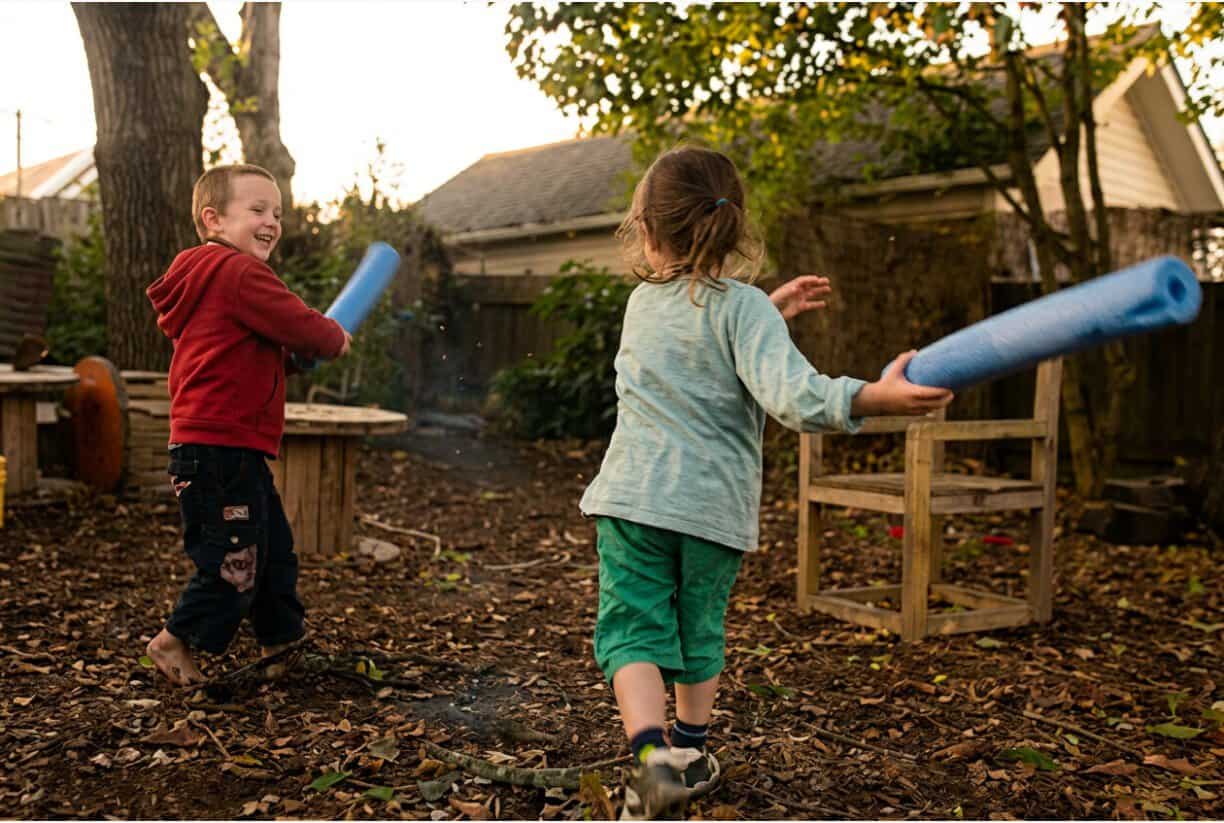
Young children naturally play vigorously with their bodies and one another. I saw this recently with my grandson and with my great-niece and four great-nephews, ages 1 to 7 as they ran, bounced, tumbled, and climbed nonstop. Watching my great-niece tumble around her grandmother’s living room, her dad said, “You must let them play this way. It’s risky, but it’s important.”
I coined big body play to describe this vigorous, boisterous, body-based play, also called rough-and-tumble play, rowdy play, roughhousing, or horseplay that all children crave and need for optimum development. Big body play is fun and essential, helping children grow stronger, happier, smarter, calmer, and better able to communicate. It includes loud, rowdy play like horseplay and play fighting, as well as twirling, dancing, leaping, swinging, and jumping.
Why it matters
Growing up in the 1960s, I rarely heard the word risk applied to rowdy play. Adults did not discourage our rough, boisterous games; my only obstacle was getting in trouble for hanging upside down from the monkey bars in a dress, until my mother had me wear shorts underneath. Today, however, children are often warned to “be careful” during big body play. When did running, jumping, climbing, wrestling, chasing, and tumbling become so risky—and when did adults shift from managing play’s inherent risks to trying to eliminate them? I worry, as many do, that adult anxieties are becoming children’s anxieties.
Fear of injury and litigation has led many U.S. early childhood programs to ban big, boisterous play. Even where recess remains, rules often emphasize what children cannot do, such as running, chasing, wrestling, climbing trees, or rough play. In Georgia, my home state, rough play is not allowed in licensed early childhood education centers.
Limiting or removing big body play because of fear may solve one issue, but it creates a much bigger one becausewhen we limit risk in play, we limit play—and when we limit play we limit learning.
Limiting big body play hampers not only physical development, but also children’s social, emotional, cognitive, and language growth. As U.S. students rank below many countries in reading, science, and math, it is worth noting that higher-performing countries often protect movement and recess. Finland gives students regular movement breaks, while children in China may spend substantial portions of the day in recess and still achieve strong academic results. In the U.S., by contrast, recess is often treated as optional, disciplinary, or secondary to seatwork, even where policies protect it.
One Atlanta superintendent argued that academic performance is not improved by “kids hanging on monkey bars.” Yet hanging, climbing, running, and other active play are among the most natural paths to learning. As Rae Pica, an award-winning American author, noted that we often separate thinking from movement, but for young children, movement, development, and learning belong together. When educators forget this, we lose a powerful teaching tool.
How to support it
Like any curriculum area, big body play requires planning and facilitation. Infants need safe, supervised freedom to explore body awareness and control; toddlers need support as they run, jump, and use stairs. As children move through preschool, kindergarten, and early primary years, educators provide boundaries, expectations, modeling, and language for successful play. With maturity, children can play roughly with supervision and gradually greater independence.
Supporting big body play has four parts:
- Establish policies
- Outline boundaries and expectations
- Create an effective and safe environment
- Provide support, guidance, and active supervision
Establish Policies
Policies should support big body play, not block it. Rather than banning it out of fear of litigation, programs should create thorough policies, train teachers to apply them consistently, inform families how the play is used, and prepare educators to explain its value. Together, these steps are essential to risk management.
Outline Boundaries and Expectations
Children’s big body play is more manageable when guided by simple, clear rules. Adults and children should create these rules together so children better understand and follow the boundaries and expectations.
Rules should cover all forms of big body play, including physical contact, equipment, and materials. For wrestling, especially when children differ in size or experience, rules might require kneeling and limit where arms may be placed. Rolling should happen on safe hills away from streets and paths, and indoor tumbling should always be done on mats. Equipment rules should guide safe, considerate use, such as climbing up a slide only after checking that no one is sliding down or jumping only from stationary structures, never moving equipment.
Create an effective and safe environment
Because big body play supports children’s physical, cognitive, social-emotional, and language development, learning environments should offer rich opportunities for safe, vigorous movement. Indoor and outdoor spaces should reflect what children can do and how they learn best, while being carefully planned to reduce hazards.
Big body play is best supported by open, flexible outdoor spaces with fewer fixed structures. Large open areas encourage more active, appropriate play, while heavily equipped playgrounds often lead to repetitive, less imaginative play. Nature playgrounds are especially effective for supporting big body play.
Provide support, guidance, and active supervision
Once policies, boundaries, and the environment are in place, teachers focus on what happens during play. Schedules should provide enough time for big body play throughout the day so children can meet their moderate-to-vigorous activity needs. Offering it early can also help children begin the day more calmly.
If time feels limited, integrate big body play into existing routines. Children can hop, wriggle, or move creatively during transitions; take brief movement breaks; or do seated movements such as rowing imaginary oars.
Active supervision is essential. Teachers should watch, listen, interact, and stay close enough to supervise by sight and sound. When adults join in and model vigorous activity, preschoolers tend to play more actively and appropriately.
Teachers can also teach safe body care using sports-based guidelines: bend knees when landing, turn heads to the side when wrestling or rolling, and tackle by wrapping arms around legs or waists rather than pulling body parts. Sports terms like “penalties” or “unnecessary roughness” can help children understand excessive force and safe play.
Conclusion
Supporting big body play may make some families, administrators, or colleagues uneasy, especially around risk and safety. That is why everyone involved in children’s care and learning should help decide how to implement it.
Invite families and teachers into the conversation, even if some are hesitant or see decisions as the administrator’s role. Keep welcoming input, building relationships, and showing that every voice is valued. Young children deserve no less.
Reference:
Carlson, F.M. 2026. Big Body Play Second Edition. Washington, D.C.: NAEYC.
For more information, contact Frances at www.bigbodyplay.com
For an understanding of how big body play/Takaro a Tinana supports the model of well-being known as Te Whare Tapa Whā, contact Matt Te Maro-Seymour at the Onerahi Primary School in Whangarei or at matt.temaro@gmail.com.