Contents – NZIRECE Journal, 2026, Vol 28, No.1
To view the articles published in 2026, Volume 28, No1, click or tap here
To read any article a member log-in is needed. If you don’t have a log-in – go to our subscription page. Many libraries subscribe to the journal so you may be able to view articles through your library’s system.
If you would like a copy of any article, type in below the year, volume number and author(s) of the article you wish to order. The price per copy is NZ $19. Once you have completed your order it will emailed to you within 24 hours.
Articles published in NZIRECE Journal, 2026, Volume 28, No. 1 can be found here
The Act and Art of Noticing, Wondering, Searching for Meaning, And Remaining Open to Beauty
Monique Füss
This commentary explores aesthetic education as a way of being within contemporary early childhood education. Drawing on Maxine Greene’s philosophy of aesthetic education and reflections from Priscilla, an experienced artist-educator, it considers how attentiveness, curiosity, imagination, and creative expression might sustain educators within professional contexts increasingly shaped by standards, accountability, and measurement. Priscilla’s stories illuminate aesthetics not simply as engagement with the Arts, but as an ongoing openness to experience, possibility, relationship, and becoming. The commentary argues that aesthetic education begins with educators themselves: with cultivating the capacity to notice, wonder, search for meaning, and remain open to beauty within everyday life. Rather than calling for dramatic transformation, it invites educators to attend to what may have grown quiet within their own lives and practices. In doing so, aesthetic education offers a way of reconnecting with the curiosity, expression, and sense of possibility that educators seek to nurture in children.
Key words: Arts, aesthetic education, teaching practice, creativity.
Full reference: Füss, M. (2026). The act and art of noticing, wondering, searching for meaning, and remaining open to beauty. NZ International Research in Early Childhood Education Journal, 28(1), 1-5.
Advancing Climate-Smart Pedagogies in Fiji’s Early Childhood Education and Development
Lavinia Tiko and Jo Mosen
This commentary explores the imperative of embedding climate-smart education within Fiji’s Early Childhood Education and Development (ECED) sector, in response to the nation’s increasing vulnerability to climate change. It critically examines current ECED policies and practices, highlighting gaps in climate responsiveness and the need for locally grounded solutions. Drawing on Indigenous Fijian knowledge systems, including vanua-centered pedagogies (context-centered) and the Framework of Gifting Knowledge, the commentary advocates for a culturally relevant and climate-conscious approach to early education. It argues that empowering Fijian educators and communities to lead climate-smart ECED initiatives is essential for fostering resilience among young children. The commentary also critiques the reliance on external agencies and calls for a shift towards Fijian/Pacific-led strategies that align with Fiji’s national development goals and cultural values. By centering Indigenous epistemologies and climate justice, this paper contributes to the discourse on sustainable and equitable early childhood education in small island developing states.
Key words: Climate-smart education, Indigenous epistemologies, Pacific-led resilience, climate change, child health, place-based education, nature-based, teacher education.
Full reference: Tiko, L. and Mosen. J. (2026). Advancing climate-smart pedagogies in Fiji’s early childhood education and development. NZ International Research in Early Childhood Education Journal, 28(1), 6-19.
Providing Nutrition Pedagogically: Evaluating a Responsive Feeding Intervention Programme for Early Childhood Teachers
Nur’aini Azizah, Dani Ferdian, Tisa Layalia Hanifah Ma’ruf, Syifa Auliya Maddini, and Fitriany Juhari
This study examined the impact of a responsive feeding workshop for early childhood teachers participating in Indonesia’s free nutritious meals programme. A mixed-methods design was used to assess whether embedding responsive feeding principles within a corporate social responsibility (CSR) nutrition initiative could enhance teacher knowledge, attitudes, and classroom practices. Twenty-one teachers from five early childhood education (ECE) centres in Kalimantan attended a two-day workshop and completed pretest–post-test measures of responsive feeding knowledge and attitudes, along with qualitative reflections on classroom application. Findings indicated meaningful gains in teachers’ understanding and confidence in applying responsive feeding principles. Teachers reported increased empathy during mealtimes, greater alignment between school and home feeding practices, and more culturally responsive menu adaptations. These outcomes suggest that teacher capacity building can bridge the gap between nutrition access and child-centred pedagogy, fostering autonomy and emotional connection during mealtimes. Embedding responsive feeding within CSR-supported nutrition programmes offers a promising model for integrating health, education, and socio-emotional development in early childhood contexts.
Key words: Responsive feeding; teacher professional development; nutrition; pedagogy; corporate social responsibility; Indonesia; mixed-methods study.
Full reference: Azizah, N., Ferdian, D., Ma’ruf, T.L.H., Maddini, S.A., and Juhari, F. (2026). Providing nutrition pedagogically: Evaluating a responsive feeding intervention programme for early childhood teachers. NZ International Research in Early Childhood Education Journal, 28(1), 21-38.
Teacher-Child Verbal Interaction in Kindergarten Picture Book Teaching Activities
Jie Song, Wanyi Li, and Xingyu He
Teacher-child verbal interaction is fundamental to children’s language development and cognitive growth. This mixed-methods study examines the patterns and quality of such interaction during picture book teaching activities in a Chinese kindergarten. Using improved Flanders Interaction Analysis System (iFLAS) and Teacher Scheme for Educational Dialogue Analysis (T-SEDA), 16 picture book sessions involving four teachers (two novices, two experienced) were analysed across six dimensions. Four key findings emerged. First, interaction remains teacher-dominated: teacher talk accounts for 64.45% of verbal exchanges, and the Initiation-Response-Feedback (IRF) pattern prevails. Second, teachers show positive emotional support and prefer open-ended questioning, yet higher-order dialogue is limited. Third, pedagogical silence is minimal (0.97%) and child-initiated turns are rare (11.09%). Fourth, four distinct teacher profiles emerged – from “open-exploratory” to “generative-responsive”- revealing significant individual variability in scaffolding practices. These findings suggest that picture book reading can foster children’s agency and cognitive engagement, but this potential is constrained by teacher-directed routines. The study offers recommendations for professional development, emphasising teachers’ role as dialogue facilitators and the need for conditions that support children’s active participation in co-constructing knowledge.
Key words: Teacher-child interaction, picture books, teacher talk, oral language, language development, cognitive growth, educational dialogue, iFLAS, T-SEDA.
Full reference: Song, J., Li, W. & He, X. (2026). Teacher-child verbal interaction in kindergarten picture book teaching activities. NZ International Research in Early Childhood Education Journal, 28(1), 39-52.
Classifying in Early Childhood Education
Nicole Gaspar Duarte, João Pedro Mendes da Ponte, and Hélia Gonçalves Pinto
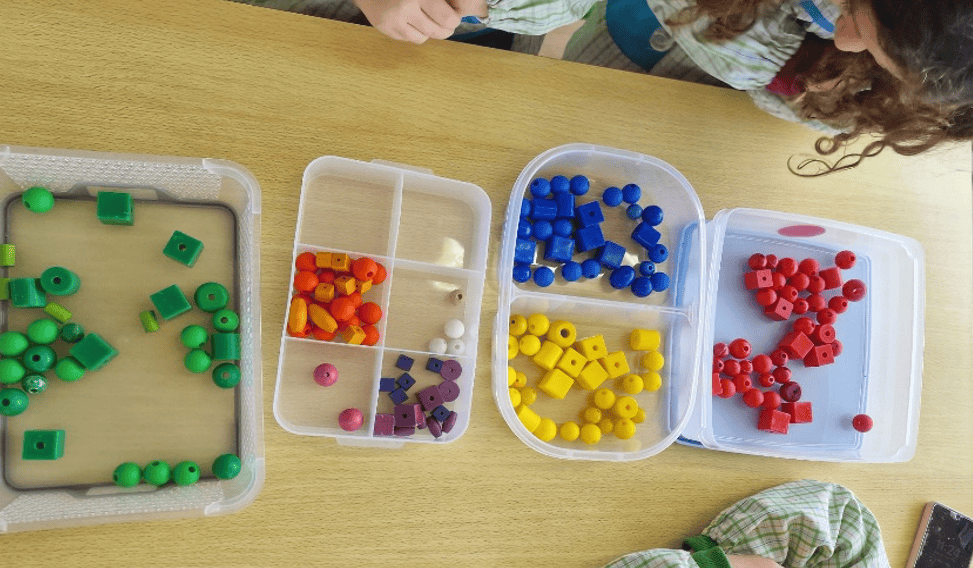
This study investigates how kindergarten children develop reasoning involving the classification process within exploratory learning tasks. Using a qualitative case-study, the research followed an experienced kindergarten teacher and eight children aged five during a teaching investigation conducted in a Portuguese kindergarten. Data was collected through video-recorded observations and analysed using content analysis focused on classification as a process of mathematical reasoning. The findings indicate that children can identify attributes, proposing and revising classification criteria, when engaged in inquiry-based tasks. Pedagogical questioning emerged as a key mediating factor in sustaining engagement and deepening children’s reasoning. The study highlights the importance of integrating exploratory mathematical tasks into early childhood education to support the development of reasoning from an early age.
Key words: Mathematics, reasoning, questioning, classifying, colour, size, shape, inquiry-based, learning engagement, thinking.
Full reference: Duarte, N.G., da Ponte, J.P.M, and Pinto, H.G. (2026). Classifying in Early Childhood Education. NZ-International Research in Early Childhood Education Journal, 28(1), 53-68.
Mathematical Skills Instruction in 5-year-old Children
Agustina Méndez-Jurado and Rufina Pearson
Early mathematical skills are initially influenced by children´s home environment and later by formal instruction. This study analyses the relationship between teachers’ strategies and mathematical performance of five-year-old children attending kindergarten private schools across different socioeconomic contexts in Buenos Aires. Using a mixed-methods approach, this research integrates classroom observations and teachers’ interviews (n = 7) with the assessment of 132 children using a digital mathematical skills test. Results show that explicit instruction is linked to higher performance in basic numerical skills, such as counting and number recognition, while verbal calculation and problem-solving showed lower performance than expected. Non-symbolic numerical skills remain within the expected range despite the absence of formal instruction, suggesting that informal learning experiences at home play a significant role. Although children may acquire certain mathematical concepts implicitly, the findings suggest that more complex symbolic skills may benefit from systematic and explicit instructional opportunities.
Key words: Mathematics, instruction, kindergarten, mathematical concepts, numerical skills, counting, number recognition, teacher strategies, teaching practices, mixed methods.
Full reference: Méndez-Jurado, A. and Pearson, R. (2026). Mathematical skills instruction in 5-year-old children. NZ International Research in Early Childhood Education Journal, 28(1), 69-86.
He Aka Matua: Navigating the Shifting Tides of Associate Teacher Mentoring and Leadership in Early Childhood Practicum
Chrissie Keepa and Catherine Vaughan
This paper examines the critical yet under-researched role of Associate Teachers (ATs) as mentors and leaders in early childhood practicum. It explores how ATs conceptualise their professional identities, particularly through a Kaupapa Māori lens. Reflecting on how anecdotal differences in student experiences prompted the development of the “He Aka Matua” project at Toi Ohomai Institute of Technology, the authors detail a mixed-methods study grounded in relationality and reciprocity. The article argues for recognising ATs as leaders of learning, seeking to strengthen ITE partnerships and support culturally responsive mentoring for emerging teachers.
Key words: Associate teacher, mentoring, professionalism, student teacher, initial teacher education, leadership, Kaupapa Māori lens.
Full reference: Keepa C., and Vaughan, C. (2026). He Aka Matua: Navigating the Shifting Tides of Associate Teacher Mentoring and Leadership in Early Childhood Practicum. NZ-International Research in Early Childhood Education Journal, 28(1), 87-93.
Can Risky Play Be Safe? Educator Perspectives on Supporting Outdoor Risky Play in Early Childhood Education
Nilufar Jahan and Mahmuda Shaila Banu
Outdoor risky play (ORP) provides important opportunities for young children to test their limits and support physical, cognitive and socio-emotional development. Despite these benefits, heightened safety concerns and risk-management practices among parents and institutions often restrict children’s opportunities for challenging outdoor play in early childhood settings. This systematic review examines educators’ perceptions and strategies for supporting ORP in Australia. Drawing on 11 peer-reviewed studies published over the past decade, the review employed reflexive thematic analysis informed by Sandseter’s risky play framework. The findings indicate that educators conceptualise ORP as a form of holistic learning and emphasise the intentional design of outdoor environments to facilitate children’s engagement with challenges, uncertainty and risks. At the same time, educators are required to mediate children’s autonomy alongside safety responsibilities, often within the constraints of regulatory expectations and parental safety concerns. The review indicates that intentional design of the outdoor environment, educator professional development and parent engagement can support ORP. Supervision and risk–benefit assessment can further manage harmful risk while preserving appropriate risk-taking. Finally, this study proposes a practice framework facilitating ORP in early childhood education, shifting from a protection-oriented perspective toward a model of balanced risk.
Key words: Risky play; safety; outdoor play; outdoor environment; risk-taking.
Full Reference: Jahan, N. & Banu, M.S. (2026). Can risky play be safe? Educator perspectives on supporting outdoor risky play in early childhood education. NZ International Research in Early Childhood Education Journal, 28(1), 94 -108