Election 2026: A Guide to Political Party Promises for Early Childhood Education
Election 2026 is fast approaching. Political parties are starting to release their early childhood education policies and campaign commitments. Many voters will cast their ballots well before election day, so having clear, up‑to‑date information matters.
OECE will track each party’s announcements as they are released.
This page will be updated regularly as new policies and promises roll out, allowing you to compare positions at a glance and see what each party says it will do for early childhood education. Our aim in providing this guide for Election 2026 is to support you to assess whether proposed policies are moving in the right direction, missing what really matters, behind the times, or potentially harmful for children, teachers, or services.
We’ve been reporting on election promises every three years, beginning with the 2005 General Election. Looking back across those campaigns, one pattern is unmistakable: many promises simply aren’t delivered.
Why is this? Good policies are often set aside in the interests of political expediency. In coalition governments especially, a party may drop or dilute a policy to maintain cohesion or satisfy its partners. Recent experience with the National–ACT–NZ First Coalition Government has also shown that voters who support one party’s early childhood education policies (National or NZ First) may find that, once in government, coalition dynamics can completely shift which party’s values and priorities (ACT’s) shape the agenda.
National party
National’s specific ECE commitments for election 2026 are:
- Stop all screen and individual-device use in ECE
- Introduce a School Start Check at ECE before children transition to primary school
- Introduce developmental milestones throughout ECE and have services report children’s progress to parents along with identifing areas where children may need additional support and address that through the Early Intervention Service
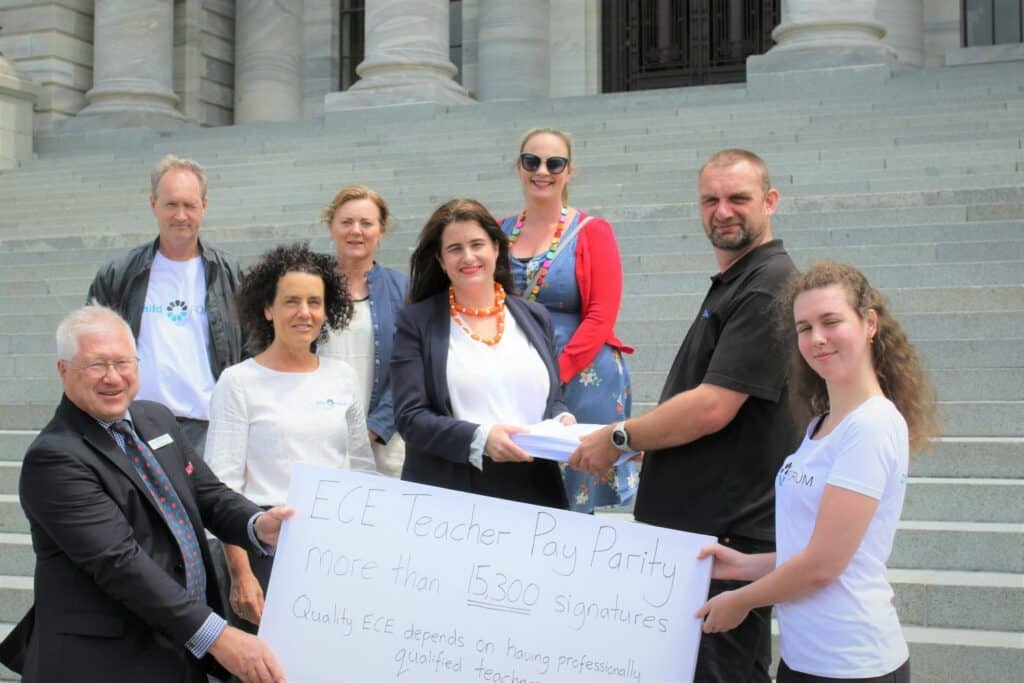
The last substantial ECE policy National released was in 2020, when Nicola Willis was the party’s spokesperson for ECE. At that time, National proposed a wide range of changes across ECE provision, operations, and funding. Key elements included tightening monitoring and enforcement of regulated standards and continuing to lift pay requirements for ECE teachers.
Some of the ideas National promoted in 2020 have since been implemented during its time in government, for example, reducing regulatory red tape (an area where it aligned closely with ACT) and making teacher registration free for ECE teachers.
However, most of its other proposals including stronger enforcement of standards and further progress on teacher pay have not been advanced under the coalition arrangements of the past three years, and in several of these areas policy has, in practice, moved in the opposite direction to what it
Opportunity party
The Opportunity Party is not currently represented in the New Zealand Parliament, but recent polling shows a steady upward trend for the party as the November 2026 election approaches.
Opportunity refers to early childhood education as “early learning”, uses the term ECCE for the ECE system, and describes home‑based ECE as home‑based care.
Key Policy Commitments
- Replace the current licensing approval model to quality-based contracting (based on government objectives of the day)
- Prioritise flexibility for ECCE centres to co-locate with retirement villages
- In homebased care, move away from 1 educator to up to 4 children per home setting to 2 educators and up to 8 children per home
- Increase core funding for Playcentre, Kōhanga Reo, Kindergartens, Pacific language nests, Playgroups
and Nature Based Services. - Require minimum ratios of 1:3 for under-twos, 1:5 for 24-36 months and 1:8 for children aged three and over.
- Match Australian standards for the amount of space per child indoors and outdoors (not specified whether this applies to both home‑based and centre‑based settings).
- Set maximum indoor group sizes
- Requiring 80% minimum qualifications for teacher-led services (qualification level or which qualifications are not specified).
- Expand the NZCER Wellbeing@School survey to ECCE teachers.
Read more: Opportunity Party – Future Fit Education Policy
It’s policy direction now differs quite a bit from its 2023 election commitments, which focused on:
- Pay parity for ECE teachers with primary and secondary teachers.
- Integrating early childhood education with the early years of primary school, aiming for a more coherent and continuous learning pathway for children.
- Levelling the playing field between community‑run and corporate ECE centres, recognising the educational value of community settings and the benefits of involving parents in teaching and learning.
- Limiting the size of ECE centres and introducing more stringent requirements for physical space and educator‑to‑child ratios.
- Increasing support for parent‑led and community‑owned ECE services.
NZ First party
One of the party’s founding principles is that “money spent on education will be treated as an investment, not as expenditure.” Past statements have acknowledged that ECE is not simply childcare or babysitting, but must be high‑quality and educational for the hours children attend. However, in recent times NZ First has shown limited engagement with the sector’s current conditions, needs, and challenges. At this stage, the extent of NZ First’s commitment to ECE for the 2026 election is unclear.
NZ First’s policy announcements made so far:
- Kiwi Kids Grant. In practice, it would give lower‑income families and households reliant on two incomes an improved financial choice for one parent to stay at home during the early years if they choose, and to use low‑ or no‑cost ECE options such as kindergarten or Playcentre. For some parents the extra $5,000 per year could make the difference between needing to work to live or staying at home with their child/ren.
- A universal, non‑means‑tested, tax‑free grant of $5,000 per year for the first three years of each of the first, second, and third child = total $15,00 per child or $45,000 for 3 children.
- The policy is framed as an incentive to increase the birth rate among New Zealand citizens – noting factors such as career prioritisation, preference for a child‑free adulthood, rising costs, and the sacrifices associated with raising children
Labour party
On the campaign trail, Labour has talked about its ECE policy commitments. Until these are published as part of Labour’s election manifesto, these are not set in concrete and may be tweaked, added to, or changed. We will update this section to include what Labour has promised when the party’s ECE policy commitments are confirmed.
Historically, Labour’s core commitments in ECE have centred on building a well‑qualified, well‑paid workforce including goals to increase the proportion of qualified teachers in ratios, deliver pay parity for ECE teachers with school teachers (or kindergarten teachers who are ECE teachers? this has not been clear), and ensure services are well resourced to provide a strong curriculum. A difficulty that Labour has had is that it tends to look at 10 year cycles and set-up working groups, which delays or means commitments such as for increasing the proportion of ECE-qualified teachers may not be implemented in its term in government.
Looking ahead to the 2026 election, several broader system‑level questions remain open. These are areas to watch not only for Labour, but for all parties as they develop their ECE platforms:
- Whether it will initiate a review of regulations through a child‑rights and evidence‑based lens and ensure rules are regularly updated in response to learnings from serious incidents and emerging evidence.
- Whether it will address concerns about the quality and orientation of policy advice, including criticism that membership of the Ministry of Education’s Early Childhood Advisory Committee is unbalanced, and that advice from the Ministry and ERO to Ministers can prioritise service‑provider interests over those of children, families, and taxpayers.
- Whether it will restore ECE regulatory functions to the Ministry of Education, reversing the current government’s changes and aiming to integrate ECE more fully into the wider education system
- Whether it will strengthen support for parents’ active involvement in their child’s early education
- Whether it will introduce regular spot‑checks of services to give families greater assurance of safety and quality
- Whether Labour will restore network management (a policy it introduced when it was last in government) so new services must demonstrate community need before opening
- Whether it will address issues with current regulations regarding ratios, group size, and ensuring children have ECE-qualified teachers in teacher-led centres.
These questions and Labour’s overall direction for ECE will become clearer once the party releases its 2026 policy.
Green party
The Green Party has been the first to release its early childhood education policy for the 2026 election, providing a full set of commitments and a clear outline of its priorities.
Key Policy Commitments
- End public funding for private, for‑profit ECE centres by 2028. Centres could continue to operate and be licensed, but would need to transition to non‑profit status to receive public funding
- Expand community and not‑for‑profit ECE provision to strengthen and grow publicly‑focused, community‑based services
- Cap parent fees at $10 per day per child above the 20‑hour free entitlement, reducing this to zero cost for up to 35 hours from 2029
- Introduce free early childhood education from 2029, with a network of community ECE centres funded to provide 35 hours a week from 6 months to school age.
- Directly fund ECE teachers to ensure fair wages and access to training and professional support
- Pay parity for kaiako (Note that there is little detail on this and whether it would include all ECE qualified teachers from across different service types).
- Secure long‑term funding for kaupapa Māori providers to strengthen Māori‑led early childhood education
- Restore the network management function so the Ministry of Education plans ECE provision in the same way school provision is planned, ensuring services are located where communities need them.
Read more: Green Budget: Early Childhood Education for Everyone
Te Pāti Māori
Te Pāti Māori policies are framed around identity and stating that education should strengthen tamariki, grow confidence, open pathways, and prepare Māori to lead in the world as Māori.
Key Policy Commitments
- Establish a Te Kōhanga Reo Act and lock in secure annual baseline funding for kōhanga reo
- Invest $20 million a year in a dedicated capital fund, alongside a $50 million investment to address the backlog of around 80 kōhanga reo needing new builds or refurbishment.
- Build Māori-led education authority and solutions.
- Embed mātauranga Māori properly across learning.
- Remove barriers that block whānau from education and training.
- Support Māori governance and decision-making in education.
The ACT party
ACT has not yet indicated its early childhood education policy for the 2026 election. However, many voters will be familiar with ACT’s general positions, given that party leader David Seymour has served as Associate Minister of Education with responsibility for ECE over the past three years.
During this term, ACT’s approach has emphasised reducing regulatory requirements, cutting compliance costs, and making it easier for ECE services to operate. The party has not supported ECE teacher pay parity with school‑based colleagues. There has also been a focus on shifting ECE further from the schooling system, including transferring ECE regulatory functions from the Ministry of Education to ERO, and framing ECE regulation and funding primarily around supporting parents’ participation in the workforce. Taken further, this direction may de‑prioritise part‑day and community‑based services such as Playcentre, free kindergartens, and similar models.
Election 2026 – Your Voice
Got insights, corrections, or ideas about what parties should be offering? Add your comment below.
Your feedback helps keep this Election 2026 guide relevant and grounded in what matters for children and our sector.