Phoenix Preschool Ashburton Wins Award

Search Newsroom Posts
teddy teddies care love

Phoenix Preschool.
July 31, 2019.
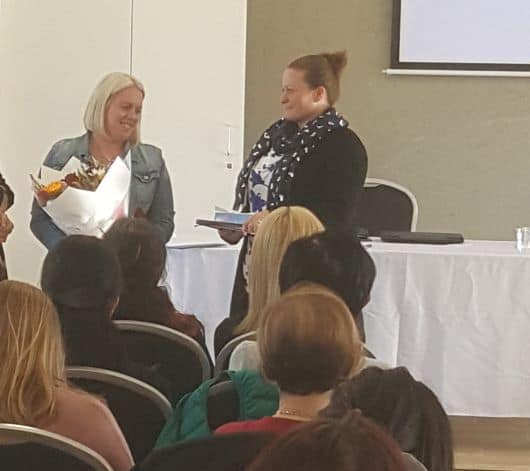
Phoenix Preschool: Ange Ross and Hayley Gallagher

It is common for community-based centres to struggle due to resource issues but Phoenix Preschool in Ashburton has found a way through and sees only a positive future ahead.

Being presented with the My ECE Award for Excellence in front of early childhood services from across the country at the 2019 ChildForum national management summit in Auckland was not only a great honour according to Preschool manager Ange Ross, it was recognition of the personal investment everyone in the Phoenix whanau had in the preschool.

Phoenix originally started as a creche for the children of staff at Ashburton College. It has evolved over time to be a full-time service for 45 children of which up to 13 are under-twos. 

It is governed by a Board of parent volunteers who are passionate about the preschool, support the team, and see the preschool as a valuable part of their community to maintain.

Critical to the preschool’s success today was the decision to employ an office manager, Hayley Gallagher, 5 days a week to ensure smooth running and splitting the manager’s role to allow Mrs Ross to be a team leader in the mornings in the over-twos room. 

This has proven to be a successful model of management as Mrs Ross has time to build partnerships with families, children and staff and ensure a supportive and cohesive centre community.

Mrs Ross said: “The split of my role ensures I can still be with the children, supporting my team, and being very approachable to families, while also holding the management role.”

The centre’s philosophy emphasises relationships.

“We want everyone to feel like they are coming home when they come in the door.  Our passionate and dedicated team of Kaiako work really hard every day to ensure each child and their family is made to feel that they belong. And, we are strong advocates for maintaining the sense of community and family that makes Phoenix what it is.”

Parents agree with Mrs Ross. The preschool has achieved 5 stars on Parent Reviews on My ECE (www.myece.org.nz). Comments posted by parents include: 

  • Phoenix isn’t just a place to drop your child off so you can go to work, it is another family. The staff are so supportive to the child and to the parents. They listen if you have had a rough night with your child. The staff truly do care.
  • The centre is governed by volunteer parents who all want the absolute best for the centre.
  • We started at Phoenix Preschool after leaving another preschool in the area that was not a great fit for my son. I have been totally blown away by the staff and how much he has learnt by going to Phoenix.
  • One of the things that makes Phoenix special is their community, with great activities through the year enabling us to meet families that we may have missed if our kids attend different days.

“I am so proud for our centre and I truly love my job.

“It is a most wonderful centre and I don’t see myself doing any other job,” Mrs Ross said with a sparkle in her eye as she collected the My ECE Award with Mrs Gallagher on behalf of Phoneix. 

* The Award included a framed certificate for display, $300 for the preschool, a voucher for free staff training on injury prevention, a beautiful bouquet of flowers and box of chocolates.

Already subscribed?
ECE Newsroom

NZ’s own specialist ECE newsroom. 
Access national and local stories, in-depth analysis, & original commentaries.  

Membership Support for Teachers & Educators

(Comes with free Newsroom and Research access)

Membership Support for ECE Service Owners, Managers, & Community Organisations

(Comes with free Newsroom and Research access)

Researchers & Tertiary Education Libraries

Full access to over 25 years of ECE academic research articles – NZIRECE Journal.
Plus, guidance and resources on doing and publishing research

Has this been useful?  Give us your feedback.

You are welcome to add a link to this page on your website. Copyright belongs to the OECE so please do not copy any content without our written permission.

Information provided is of a general nature. It is provided ‘as is’, and we accept no liability for its accuracy or completeness. See our Terms and Conditions.

Related Posts

teacher wages, pay scales, in childcare and early childhood education

What ECE Teachers and Workers Earn: Pay, Benefits and Conditions

Anyone thinking about getting a job in ECE working in ECE or thinking about moving to a different service will find clear, practical information in this article about pay rates, employment conditions, and what to expect in different roles. It explains everything from starting salaries and pay‑step calculations to workplace rights, benefits, and how to recognise a supportive, professional environment.

Read More »
teddy teddies care love

Grief and Preparing a Child For Loss

Supporting a grieving child can be distressing for a teacher. However it is important that teachers do not try to avoid dealing with a child’s grief, or with their own grief. Teachers can support children’s grief in a sensitive and caring manner.

This article covers:

1.  Preparing for grief and loss2.  What does grief look

This is a member/subscriber only post. To access it, please see the message below for details on access and joining.

Read More »
Child playing with toy dinosaurs while a girl looks on the shelves for more toy animals at their early childhood centre.

Progressing Play

How to teach and not what to teach is the focus of ‘Progressing Play’. 

The authors detail, discuss and throughout the book provide real-examples of children’s play and teacher action and responses – to support and inspire the reader to think about and extend the quality of her or his teaching in many different areas

Read More »

Classifying in Early Childhood Education

FULL REFERENCE: Duarte, N.G., da Ponte, J.P.M, and Pinto, H.G. (2026). Classifying in Early Childhood Education.  NZ-International Research in Early Childhood Education Journal, 28(1), 53-68.

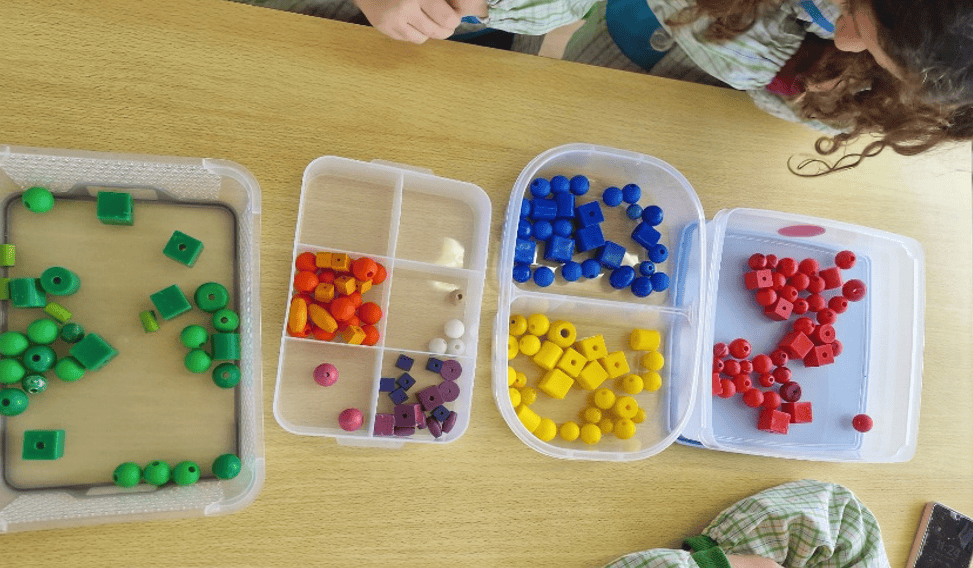
ABSTRACT: This study investigates how kindergarten children develop reasoning involving the classification process within exploratory learning tasks. Using a qualitative case-study, the research followed an experienced kindergarten teacher and eight children aged five during a teaching investigation conducted in a Portuguese kindergarten. Data was collected through video-recorded observations and analysed using content analysis focused on classification as a process of mathematical reasoning. The findings indicate that children can identify attributes, proposing and revising classification criteria, when engaged in inquiry-based tasks. Pedagogical questioning emerged as a key mediating factor in sustaining engagement and deepening children’s reasoning. The study highlights the importance of integrating exploratory mathematical tasks into early childhood education to support the development of reasoning from an early age.

Log-in to read the full research paper below. Or order a pdf copy of the article from the main NZIRECE Journal page.

KEY WORDS: Mathematics, reasoning, questioning, classifying, colour, size, shape, inquiry-based, learning engagement, thinking.

INTRODUCTION

Early childhood is an important period for the development of mathematical reasoning. Between the ages of three and six, children naturally explore patterns, relationships, and structures in their environment, forming the basis for later mathematical learning. Research emphasises that reasoning processes such as classifying, generalising, and justifying are as important as the acquisition of specific mathematical concepts (Butera et al., 2014; National Council of Teachers of Mathematics [NCTM], 2000). In kindergarten education, mathematics learning occurs primarily through concrete, playful, and socially mediated experiences. Engagement in exploratory tasks supports not only cognitive development but also communication, creativity, and positive dispositions toward mathematics (Baroody, 2017; Sarama & Clements, 2009). In this context, classification is a foundational process through which children organise objects and ideas based on shared attributes, progressively coordinating multiple criteria.

While seminal theoretical perspectives, such as those of Piaget and Vygotsky, continue to provide important foundations for understanding children’s cognitive development, recent research has emphasised the need to revisit these perspectives in light of contemporary views on early mathematical learning. Current studies highlight that young children are capable of engaging in complex forms of reasoning when supported by rich, inquiry-based environments that promote exploration, discussion, and reflection (Alsina, 2014; Baroody, 2017; Clements & Sarama, 2008). In particular, there is increasing recognition that mathematical reasoning in early childhood should be understood as a socially mediated and context-dependent process, emerging through interaction with tasks, peers, and teachers (Brodie, 2010; Jeannotte & Kieran, 2017).

This study aims to investigate how kindergarten children express and develop mathematical reasoning involving classification, when engaged in exploratory tasks. The research addresses the following question: How is the classification process characterised in children’s task-solving?

Read More »
The Office of ECE

Share This Information

Table of Contents

Table of Contents

The Office of ECE Login

Take Action!

Help spread this vital ECE information, join our free social and email groups and become a member of OECE.

pay parity funding policy

1. Share This Information

2. Follow Our Social Pages

3. Get Regular Updates

Sign up to our free newsletters.

4. Become a Member