Lobbying in ECE – Who has the Minister’s, and the Ministry of Education’s ear?
SARAH’S VIEW – OPINION COLUMN
Monday 1 December 2025
Since becoming associate education minister and taking over the ECE portfolio after the 2023 general election, David Seymour has met with ECE sector groups and representatives about 30 times (that equates to more than once a month, on average).
While on the surface that figure might make it seem like he’s engaging with the key stakeholders of the sector regularly, when you comb through his ministerial diaries more thoroughly, you’ll see the same names pop up again and again.
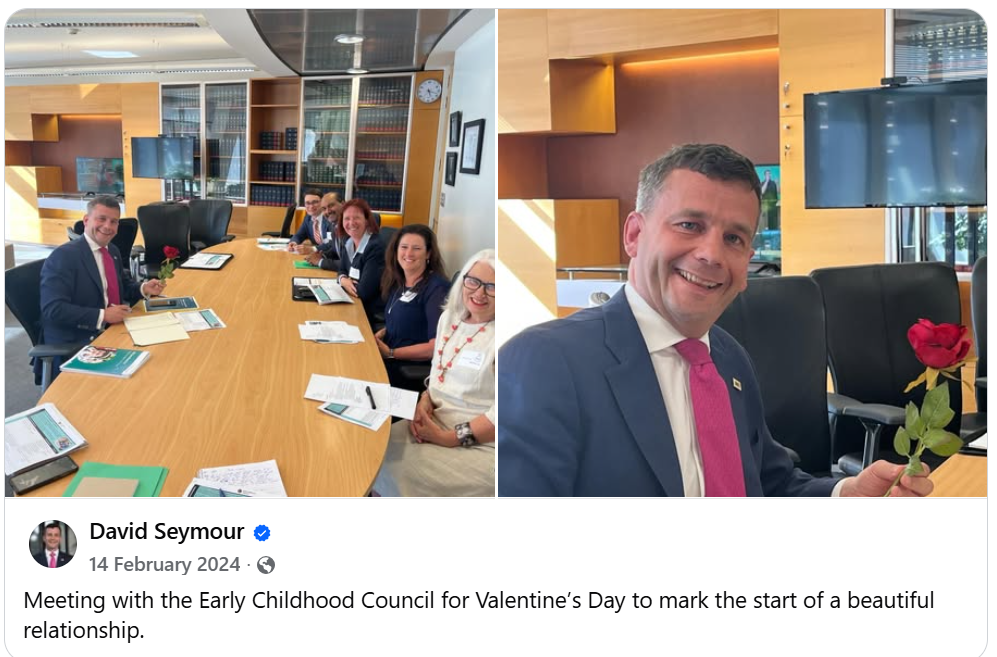
At many of the ECE-related meetings, visits and events he’s attended in the last two years the Early Childhood Council and/or its chief executive Simon Laube, has also been there.
He’s also met with Kelly Seaburg, a spokesperson for another group for private service providers called Advocates for Early Learning on several occasions, as part of a larger grouping of provider representatives.
However, other major players in the sector, such as the teachers’ union NZEI to discuss ECE specifically, have barely got a look in.
The minister has visited private, for-profit centres numerous times to meet-and-greet owners, hold media stand ups or pose for photos reading to children, but not once has he done the same at a free kindergarten, kōhanga reo or Playcentre.
One major group (arguably the largest and most important) of ECE stakeholders that Seymour has failed to engage with at all is parents. It’s come as no surprise to me that the ECE Parents’ Council started a petition calling for ECE reforms to be paused until their impact on children has been thoroughly assessed.
The Ministry of Education has taken a similar stance, excluding parents from its Early Childhood Advisory Committee (ECAC) on the grounds that it is “for service providers only.” It’s worth noting that Laube and Seaburg are members of the Ministry of Education’s early childhood advisory committee.
Likewise, despite terms of reference recommending parent representation on the ECE funding review, Seymour appointed Laube and Seaburg and Linda Meade (also a private childcare centre provider) but no parent advocates.
Other decisions raise further alarm. Seymour has frozen the pay parity scheme designed to bring ECE teacher salaries closer to those of their school-sector colleagues – a scheme critical for retaining qualified teachers. It may soon be scrapped altogether. At the same time, Seymour has directed the Ministry of Education to develop policy that makes teaching qualifications in ECE more “flexible” than they already are (in practice, reducing qualification requirements).
He has also overseen legislation that lowers penalties for poorly performing ECE services and shifts responsibility for licensing and monitoring away from the Ministry of Education to a newly created role: the Director of Regulation.
Taken together, these facts and moves make it clear whose voices are listened to.
Even more troubling is the proposed redefinition of ECE’s purpose: shifting focus away from children’s safety, education, and wellbeing toward operating to support parental workforce participation.
So concerned is the Children’s Commissioner about the potential harm to children, that speaking to Parliament’s Education and Workforce Committee, she has called for the proposed changes to be immediately paused and for a child impact assessment to be undertaken.
In Australia, it’s openly spoken about that privatisation and profit-driven ECE has not been in the best interests of children. Yet in NZ, we are pressing ahead with reforms that reduce transparency for businesses entrusted with public money to care for our youngest and most vulnerable children.
In my view, if these changes backfire then the Government will have responsiblity for any harm caused. The report into Abuse in Care makes this abundantly clear.
As someone with more than 40 years of experience in the early childhood sector, as a teacher, academic and adviser, I urge anyone who values children and wants to protect their rights to safe high-quality care and education to sign the ECE Parents’ Council’s petition.
I want to see Seymour and the Ministry engage with a wider range of stakeholders, which would lead to better decision‑making.
I also call on the National Party to clarify its position. These reforms represent a significant departure from the perspectives of previous National ministers I’ve talked with over several decades such as Bill English, John Luxton, and Lockwood Smith, who viewed ECE principally as being for children and families – and not about serving the financial interests of childcare operators.
My plea to members who are concerned about the direction in which the Government is taking ECE (which the OECE’s latest survey indicated was the majority) is to have the courage to speak up, even when facing personal attacks or political pressure to stay silent.
We cannot sit back and allow the ECE sector to become an oligarchy. There’s too much at stake.
– end –
Update: A related op‑ed by Dr Sarah Alexander was published in The Post on 25 November, and here’s a link to David Seymour’s reply.
Mr Seymour’s response warrants further scrutiny. Read more
We’d love to know your thoughts – add your comments below.