Funding Review: What it Wants to Axe, Where the Money Will Go, and Who Is Making the Decisions
ECE NOTICE/OPINION – Updated on 27 July 2026
The ECE funding review proposals shift money toward large commercial daycare, cuts pay parity, reshapes equity funding, and overlooks quality, affordability, and small‑service sustainability.
In June 2025, Associate Education Minister David Seymour set up a Ministerial Advisory Group (MAG) to redesign the ECE funding system.
The funding review has been allocated $3.856 million in taxpayer funding to cover member fees, expenses, and administrative support (see below for the list of members). This is a significant amount of money to be given for a single policy review, raising fair questions about whether the spending is proportionate to the task and whether the MAG is delivering value for money.
Kōhanga Reo and Playcentre funding are outside the review’s scope, despite both being nationally important ECE services. Their separation out from the sector raises a possibility that these services may later be shifted to another government agency, such as the Ministry of Social Development.
What the Terms of Reference Require
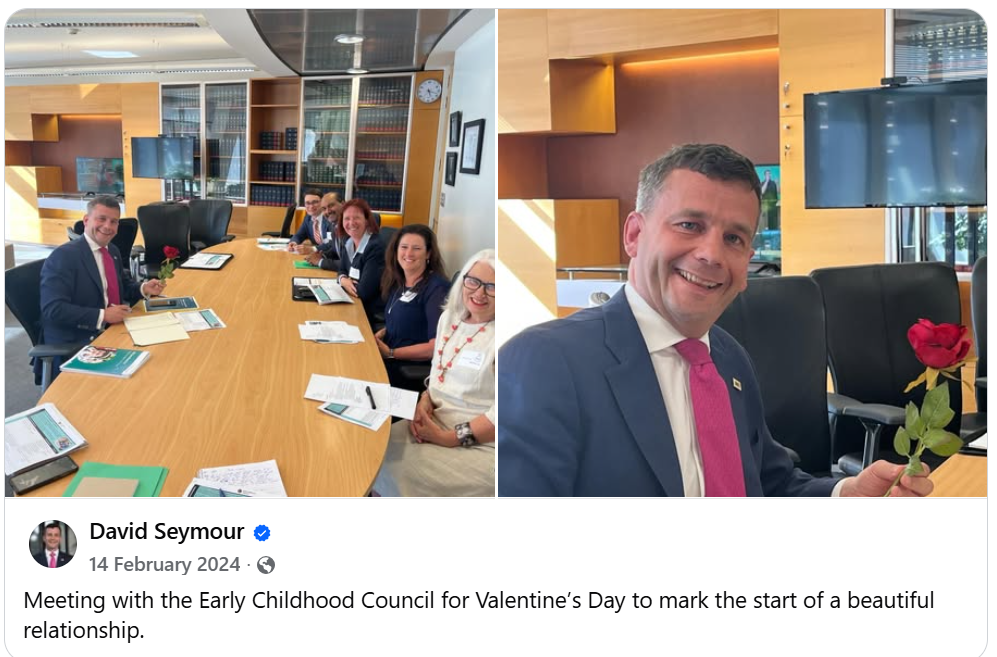
The Ministerial Advisory Group (MAG) is described as an independent body, but all members were appointed by Minister Seymour and supported the Minister’s Terms of Reference for the review.
The MAG has been asked to recommend how the ECE funding system could be redesigned with a strong focus on supporting parent labour‑market participation. This includes:
- Prioritising services that support parents in paid work
- Increasing child participation – essentially increasing sector capacity and prioritising funding for longer hours for children
- Balancing quality with affordability within existing funding levels – a diplomatic way of saying funding decisions may require trade‑offs between quality and cost for the government.
Who are the MAG Members and their Renumeration
MAG members are appointed for a period of 12 months (link to Cabinet report on member appointment)
- Each member receives $616.00 per day, plus all expenses
- The Chair receives $974.00 per day, plus all expenses
Linda Meade – Chair
Chair of the Ministerial Advisory Group and member of the Early Childhood Council. Owns two long‑day centres (both Equity Index >5).
Managing Director of Kalimena Advisory, specialising in financial optimisation.
Kelly Seaburg
Licensee of two large long‑day centres under the New Shoots brand (a long‑standing Early Childhood Council member). Both centres have an Equity Index >5. A third commercial long‑day centre is scheduled to open in September 2026.
Spokesperson for Advocates for Early Learning Excellence, a coalition of commercial ECE operators (New Shoots, Educare, Kindercare, Busy Bees, Evolve Education) formed to get an additional and more influential voice on Ministry advisory groups, share information and support each other in the ECE market.
Simon Laube
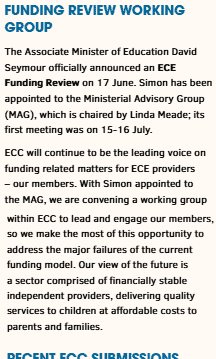
CEO of the Early Childhood Council. Former Ministry of Education bureaucrat who, in 2011, recommended discontinuing wage‑related funding adjustments for education and care centres to save $20 million annually and place greater onus on providers to reduce staffing costs.
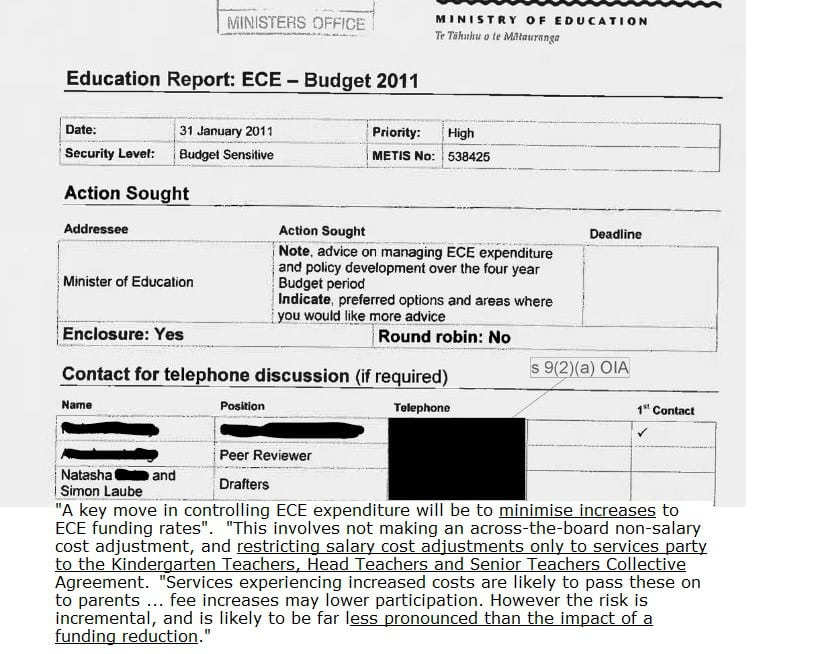
In March 2023, Laube initiated ECC member funded legal action against the government to challenge the provision of ECE teacher pay-parity.
In August 2024, the ECC submitted to the Ministry for Regulation’s ECE review that “pay parity policy is an unjustified intervention in the early childhood workforce.”
Melissa Glew
Former Financial Officer at the Auckland Kindergarten Association. Left the AKA after appointment to the MAG.
Sarah Hogan
Economist at the New Zealand Institute of Economic Research (NZIER). Appointed by Minister Seymour to the MAG after Michael Fletcher resigned early in the process.
Kylie Eagle
Chief People Officer at Fletcher Building.
Dr Kane Meissel
Associate Professor of Educational Psychology at the University of Auckland.
Left the MAG on 31 May 2026.
Additional Context
- No MAG member holds early childhood teaching qualifications or has an established record as an ECE teacher educator or ECE researcher.
- No MAG members are experts in ECE quality.
- Three members either operate or represent commercial childcare centre providers.
- There are no members with experience in community‑based not‑for‑profit ECE, home‑based ECE, or representation from the ECE Parents’ Council or children’s rights organisations.
- Minister Seymour described Kelly Seaburg as having a “strong understanding of ECE and literacy,” but there is no evidence of peer‑reviewed research or established recognition in the national or international ECE field of early childhood literacy (Cabinet paper, 3 June 2025).
MAG members may advance recommendations that benefit their own organisations or commercial interests.
MAG Proposals Open for Consultation
The Ministerial Advisory Group (MAG) has released its proposals for public consultation. Overall, the package strongly favours large, long‑daycare, commercially operated services, prioritising market efficiency over educational quality.
There is no evidence in the proposals of any plan to improve the quality or safety of early childhood education, nor any assurance that changes to the funding system will support a diverse ECE sector, expand parent choice, or improve affordability.
1. Restructure Equity and Targeted Funding
Current targeted funding streams include:
- Targeted Funding for Disadvantage (TFFD): For children experiencing significant disadvantage, allocated using MSD benefit data.
- Equity Funding Component A: For services in low‑socioeconomic communities (based on the Equity Index).
- Equity Funding Component B: For children with special needs and those from non‑English‑speaking backgrounds.
- Equity Funding Component C: For services delivering curriculum in a language or culture other than English.
- Equity Funding Component D: For all geographically isolated services – funding is not based on the size of a service, nor on income (the number of funded child hours claimed).
- Annual top-up for Isolated Services (ATIS): ATIS is based on a service’s income – it is an income top-up for ECE services in isolated areas that are very small – they receive less than $20,000 excl GST per annum in ECE Funding Subsidy, 20 Hours ECE and Equity Funding
The MAG proposes merging: equity funding A, B, and TFFD into a single equity funding stream, and combining Equity D and ATIS into one funding stream for isolation.
Such a change would make services eligible for equity / targeted funding even if only meeting one A or B component or TFFD. And, combining Equity D and ATIS into one funding stream for isolation would open ATIS funding to services previously not eligible due to their size/income. To pay for this, the MAG propose reducing universal funding.
Services currently eligible for A, B, and TFFD may be disadvantaged by merging these streams into a new single equity component. It has not been proposed to be allocated on a sliding scale – yet the funding could be critical for services that are currently eligible for both equity funding and TFFD.
Under this proposal funding currently directed for a specific purpose or group of children – for example, children with special needs – could be redirected by services into other areas once merged into a general equity pool. This risks weakening targeted support for the children who need it most.
The small services that currently get ATIS and Equity D funding could be disadvantaged from the merger of these two funding streams because ATIS funding would be pooled with Equity D funding that is available for all geographically isolated services regardless of size.
2. Change Childcare Subsidy Settings and Align with FamilyBoost
The MAG proposes to:
- Reduce income‑assessment frequency from weekly to monthly or quarterly.
- Increase subsidised hours for parents not in paid work or study from 9 hours to 20–30 hours per week.
- Align income thresholds for the Childcare Subsidy and FamilyBoost, or merging the two schemes (MSD and IRD).
These changes would shift subsidies toward long‑daycare models and increase public spending on childcare support.
3. Increase Funded Hours to Promote Longer Hours of Child Attendance and Change Home‑Based Funding
The MAG proposes to:
- Increase maximum funded daily hours for 20 Hours ECE from 6 to 8 hours per day.
- Increase funded daily hours for all ECE from 6 to 8 hours per day.
- Fund based on children, not “child places.”
- Change home‑based ECE funding so it is funded differently from centres, potentially reducing home-based current funding levels.
4. Reduce Qualified & Certificated Teacher Numbers & Have Funding Applied to Teacher Hours When Not With Children
The MAG proposes significant changes to the certificated teacher funding system:
- Remove the 100% certificated teacher funding band.
- Change the top funding bands from 80–99% and 100% to 80–95% and 96%+.
- Alternatively, reduce the system to two bands: under 80% certificated teachers, and 80%+.
- Allow services to have teachers in non‑contact time (including cleaning, admin, other tasks) counted toward the 80% threshold.
Such changes would reduce incentives for services to employ fully qualified teachers with a practising certificate and further incentivise services toward operating on a skeletal staffing basis. Centres are already encouraged to operate on a skeletal staffing basis because for up to 80 hours per 4-monthly funding period a non-certificated teacher can be in the position of a certificated teacher for funding purposes.
Removal of the 100% certificated teaching band would cut funding for about 78% of kindergartens and one third of education and care centres according to the MAG. It wants services currently on 100% funding to change the way they operate (i.e. decrease employment of certificated teachers) or increase fee charges to families.
Allowing teacher time counted in the funding bands to be used more flexibility would reduce the number of certificated teachers that are in ratio with children to interact, nurture, and teach. Across teacher-led early childhood services ratios with children is already a huge concern for children’s safety and quality of education, and the MAG’s proposal would heighten risks.
5. Make Savings by Axing Pay Parity
The MAG proposes removing all progress made on pay parity since 1 January 2022. This mirrors the Early Childhood Council’s submission to the regulatory review, which argued that pay parity “unreasonably regulates employment conditions and increases costs for providers.”
The MAG’s proposals include:
- Return teacher‑pay funding to pre‑2022 settings, eliminating the pay‑parity steps introduced for education and care teachers.
- Create a single pay‑progression system across all service types, including kindergartens-effectively removing kindergarten teachers’ long‑standing pay parity with primary school teachers, first achieved in 2002.
These changes would significantly reduce government investment in an ECE teacher qualified workforce, undermine teacher retention, and risk returning many qualified, experienced teachers to pay levels close to the NZ minimum adult wage – as situation common in the sector before 2022.
6. Collect Information on Ratios and Pay; Require Services to Publish Fees
The MAG proposes collecting more data on adult‑child ratios and workforce pay, and requiring all services to publish their fee schedules online.
7. Simplify Reporting and Funding Processes
The MAG proposes to:
- Streamline reporting on targeted funding.
- Move to monthly funding payments instead of three times per year.
- Reduce attendance and absence verification requirements.
- Reduce annual financial reporting requirements for providers.
- Investigate challenges faced by hospital‑based services.
What the MAG Has Not Addressed
The MAG’s recommendations do not address how funding could be used to improve quality or ensure fairness across different types of ECE services. This gap reflects the Funding Review Terms of Reference, which did not require the MAG to consider quality or equity.
Key issues missing from the proposals include:
1. Funding for Small Services
Small, single‑site services do not have the economies of scale that large, multi‑site operators have. Their per‑child costs are higher, and they need funding that reflects this reality to remain sustainable and competitive.
The MAG has not considered rebalancing funding to support small services. As a result, the funding system will continue to favour large providers, further disadvantaging small community‑based, not‑for‑profit, and independent owner-operated services.
2. Quality‑Focused Funding Incentives
The MAG does not propose funding mechanisms that support:
- Small group size.
- Adult‑child ratios better than minimum legal requirements.
- A qualified, certificated ECE teaching workforce.
3. Equitable Funding Design
The MAG does not address inequities between service types. Current funding rates for Playcentre, Kōhanga Reo, and home‑based ECE are significantly lower than for education and care centres.
Missing proposals include:
- Funding based on ECE provision, not service type or philosophy.
- Aligning part‑day sessional service funding rates with full‑day rates.
4. 20-Hours ECE Integrity
The MAG does not propose restoring 20 Hours ECE to its original intent of being free for families, with clear rules on transparency and charging.
5. Financial Transparency and Public Accountability
The MAG does not propose requiring service providers to publish individual financial accounts for each licensed service. Doing so would prevent aggregated multi‑centre reporting and allow parents, communities, and taxpayers to see how public funding is used – and how much is retained as profit -by providers.
The Timeline Keeps Shifting
The consultation phase was originally scheduled to run from April to July 2026. In practice, consultation did not begin until 30 June 2026 and is now set to close on 6 August 2026.
The final report was initially expected in September 2026, but it is now stated that the report will not be completed until late 2026.
Implementation of any recommendations will depend on what parties are in Government after the election on 7 November 2026, and subsequent Cabinet decisions.