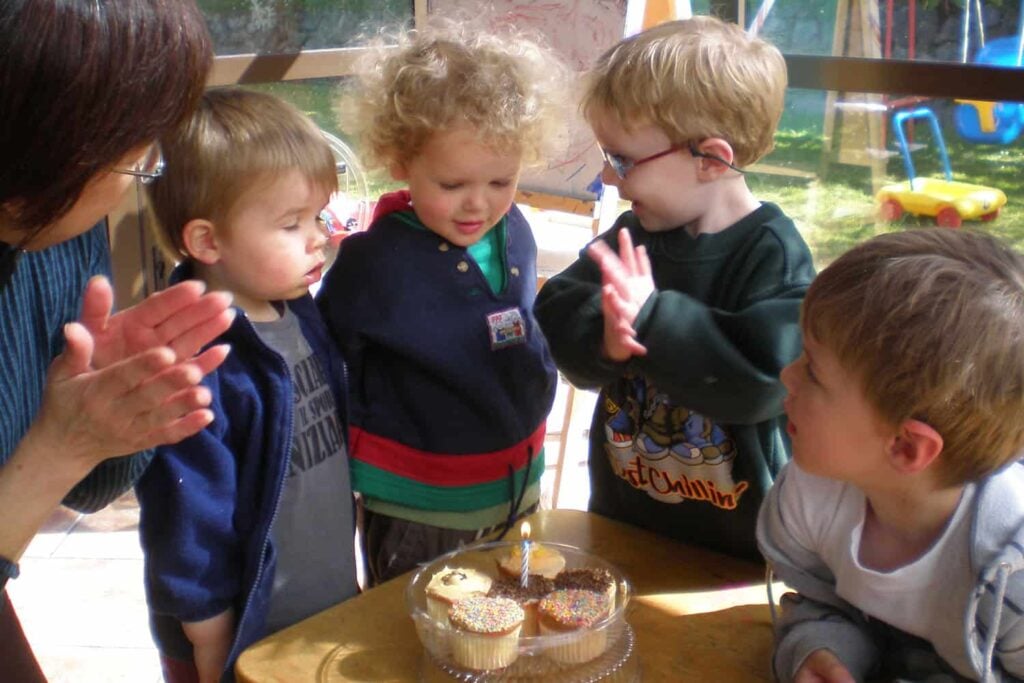
Teacher-Child Verbal Interaction in Kindergarten Picture Book Teaching Activities

Search in Research
school bags

FULL REFERENCE: Song, J., Li, W. & He, X. (2026).  Teacher-child verbal interaction in kindergarten picture book teaching activities.  NZ International Research in Early Childhood Education Journal, 28(1), 39-52.  

ABSTRACT: Teacher-child verbal interaction is fundamental to children’s language development and cognitive growth. This mixed-methods study examines the patterns and quality of such interaction during picture book teaching activities in a Chinese kindergarten. Using improved Flanders Interaction Analysis System (iFLAS) and Teacher Scheme for Educational Dialogue Analysis (T-SEDA), 16 picture book sessions involving four teachers (two novices, two experienced) were analysed across six dimensions. Four key findings emerged. First, interaction remains teacher-dominated: teacher talk accounts for 64.45% of verbal exchanges, and the Initiation-Response-Feedback (IRF) pattern prevails. Second, teachers show positive emotional support and prefer open-ended questioning, yet higher-order dialogue is limited. Third, pedagogical silence is minimal (0.97%) and child-initiated turns are rare (11.09%). Fourth, four distinct teacher profiles emerged – from “open-exploratory” to “generative-responsive”- revealing significant individual variability in scaffolding practices. These findings suggest that picture book reading can foster children’s agency and cognitive engagement, but this potential is constrained by teacher-directed routines. The study offers recommendations for professional development, emphasising teachers’ role as dialogue facilitators and the need for conditions that support children’s active participation in co-constructing knowledge.

Log-in to read the full research paper below. Or order a pdf copy of the article from the main NZIRECE Journal page.

KEY WORDS: Teacher-child interaction, picture books, teacher talk, oral language, language development, cognitive growth, educational dialogue, iFLAS, T-SEDA.

INTRODUCTION

Language is not merely a tool for cognitive construction but serves as the core medium for children’s social interaction. The World Bank (2021) emphasises that language is vital for children’s subsequent learning, development, and human capital accumulation. This macro-consensus is reflected in global early childhood curriculum frameworks. For instance, New Zealand’s Te Whāriki identifies “Communication” (Mana Reo) as a key pillar, emphasising children’s meaning-making through rich symbolic environments (New Zealand Ministry of Education, 2017). Against this backdrop, the picture book with its unique literary genre combining text and imagery provides an ideal vehicle for children to understand the world and experience aesthetic value. Building upon this, picture book reading and discussion activities are validated as a critical pedagogical approach for fostering children’s linguistic competencies in early childhood settings (Noble et al., 2019).

However, the educational value of picture book teaching is highly dependent on the quality of teacher-child verbal interaction. Recent empirical evidence underscores that the strategic use of storybooks as scaffolding tools can significantly enhance the depth of teacher-child dialogue and children’s cognitive engagement (Aktulun et al., 2024). Nevertheless, a persistent gap remains between these pedagogical ideals and actual classroom practice. The prevalent Initiation-Response-Feedback (IRF) pattern inherently reinforces teacher control by dominating conversational turns and evaluating responses, thereby restricting children’s opportunities for sustained dialogue (Houen et al., 2026). To address these challenges, it is essential to move beyond theoretical advocacy and scrutinise the specificity of classroom practice.

This is a member/subscriber only post. To access it, please see the message below for details on access and joining.
Already a Research Subscriber?
Reasons to Subscribe
Tertiary education libraries and individuals.

Enjoy online access to full copies of the latest issues of the NZ-International Research in ECE journal and more than 25 years of past issues of peer-reviewed published articles.

You will also have access to the NZ Doctoral thesis (Ph.D, and Ed.D) and the NZ Master’s thesis directory of theses relevant to early childhood education and care.

For those who are new to doing research, thesis supervisors, and conference paper selectors, we have a range of articles to inform and support you.  These include a guide to ethics when doing, writing, and disseminating research; reviewing abstracts and conference submissions, and more.

Sign-up now

Are you a teacher educator or academic, a practitioner, or a policy advisor, who is keen to keep up with ECE research?

Maybe you are planning to do some research yourself? Or maybe you are advising and supervising students who are undertaking projects?

Enjoy unrestricted access to the hundreds of articles in the Research Area of our OECE website.

Choose your own username and password when you subscribe online. This will be your login for access.

Libraries can request IP address access for staff and students on the library site, instead of password access.  Please note that this is dependent on whether system settings at your end can support this.

Your investment

Personal research user membership – $79.00 for 12-months

Libraries and tertiary education institutions – $250.00 for 12-months

Please see and abide by the Terms & Conditions of membership.

Article copyright belongs to the OECE / ChildForum. You are welcome to add a link to this research article on your website.

Related Posts

teacher wages, pay scales, in childcare and early childhood education

What ECE Teachers and Workers Earn: Pay, Benefits and Conditions

Anyone thinking about getting a job in ECE working in ECE or thinking about moving to a different service will find clear, practical information in this article about pay rates, employment conditions, and what to expect in different roles. It explains everything from starting salaries and pay‑step calculations to workplace rights, benefits, and how to recognise a supportive, professional environment.

Read More »
suitcases travel leaving arriving

The Place of Travel in Teachers’ Professional Development

Travel in Teachers’ Professional Development. By Kathy Goouch and Hazel Bryan.

There has been increasing interest shown by those concerned with young children’s learning in international policy and practice. By travelling ourselves, we sought to understand the imperative for practitioners to look beyond their own geographical and cultural

This is a member/subscriber only post. To access it, please see the message below for details on access and joining.

Read More »
child holding adult's hand

HIV and AIDS Childcare and Confidentiality Guidelines

HIV / AIDS Children and Adults At Early Childhood Services.

In May 2012 a Northland Childcare Centre was publicly slammed when it decided to send home an HIV-positive child. The centre was criticised by the AIDS Foundation and the story made the national news over several days. The centre claimed its exclusion of the child was temporary only w

This is a member/subscriber only post. To access it, please see the message below for details on access and joining.

Read More »

Are you teaching and caring for children or studying for an ECE qualification?

If you are, that’s great!   Join us now, and become a teacher member.

The Office of ECE

Share This Information

Notice for Students and Library Users
You are able to access all Journal Research articles under the library's subscription. But unless you hold a personal membership you are missing out on a whole lot of valuable teaching and policy articles and other important information. At home, or on your mobile device that is not linked to your institution or library's internet or subscription - click on the JOIN button below.

Table of Contents

Table of Contents

The Office of ECE Login

Take Action!

Help spread this vital ECE information, join our free social and email groups and become a member of OECE.

pay parity funding policy

1. Share This Information

2. Follow Our Social Pages

3. Get Regular Updates

Sign up to our free newsletters.

4. Become a Member