Creating Edible Gardens with Children

Search in Teacher
Edible_gardens_2

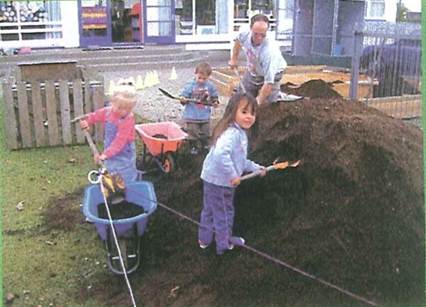
Edible gardens in early childhood centres and homes provide a valuable resource for teaching many aspects of the early childhood curriculum while also creating and sustaining a regular growth and supply of fruits and vegetables.

One of the joys of encouraging children into gardening is the pleasure of seeing, tasting and sharing the results of the effort.  Dispositions such as perseverance and curiosity are nurtured through the experience of growing and tending to plants.

Gardening provides a real, as opposed to an artificial, context for the learning of natural science, maths, and language. 

On this page we present information and guidance on: purposes of an edible garden, what size and structure works well, produce use, and which plants are most suitable to grown in ECE for speed, fun, and for children to eat.

Motivations and reasons for an edible garden include

This is a member/subscriber only post. To access it, please see the message below for details on access and joining.
Already a Teacher Member?

Are you teaching and caring for children or studying for an ECE qualification?

If you are, that’s great!   Join us now, and become a teacher member.

Five Reasons to Join Us
1. Professional recognition

It is prestigious to belong to the OECE – you can skite about it! 

Ask us for an OECE Member Certificate, to include in your professional portfolio as proof you are engaged in reading and professional learning that advances your understanding of the relationship between practice and outcomes for children.

2. Extra benefits

No need to pay a subscription fee for access to NZ’s specialist ECE Newsroom – your member login will let you view everything in the ECE Newsroom. 

No need to pay to access the best NZ and international research – your member login gives you free access to the Research Library and support. 

3. Professional growth and no-judgement help

Teaching resources and advice on probably everything you can think of, including what to wear as a teacher, how to ask for a pay raise, identifying child behaviour causes and responding to needs, new play activity ideas, etc., etc.  all of this is at your finger-tips 24/7 whenever you need help or advice – login to view. 

4. Representation

Did you know that the OECE meets personally and regularly with the Ministry of Education national team, and the regulations committee and other forums? 

Political leaders and journalists are able to use the OECE to gain deeper knowledge on a topic or issue, and we provide a sounding board for ideas and feedback.

The OECE promotes safe working environments for teachers.  We also promote the absolute need for full pay parity with school teachers for all certificated teaching staff working in teacher-led centres and in home-based, and whether permanently or casually employed. 

5. Value for Money

We are committed to keeping membership prices affordable and providing value for money. 

Teacher membership is just $89 for a full year, or save by joining for 2 years.

Has this been useful?  Give us your feedback.

You are welcome to add a link to this page on your website. Copyright belongs to the OECE so please do not copy any content without our written permission.

Information provided is of a general nature. It is provided ‘as is’, and we accept no liability for its accuracy or completeness. See our Terms and Conditions.

Related Posts

Wages exploitation and bullying of early childhood teaching staff

Working More Hours than You are Being Paid

Not Being Paid for Hours Worked.

A teacher’s work is never done. This is a phrase that are heard all too often in early childhood education when referring to unpaid work that is done by teachers. It is almost an expectation in some services that teachers spend hours of their own time setting up, cleaning, attending staff meetings, attending w

This is a member/subscriber only post. To access it, please see the message below for details on access and joining.

Read More »
teacher exploitation stress sad bullied work related injuries

Sick Leave Entitlement and Staff Faking Sickness or Taking Unscheduled Time Off

A minimum of 10 days per year for employers with an employer for 6 months or more is claimable. Employers may offer more than 10 days and many in the early childhood sector do. Employees can carry over 10 days of unused sick leave into the new year, and employers can choose to let employees carry over more.

But, how should you respond and wha

This is a member/subscriber only post. To access it, please see the message below for details on access and joining.

Read More »

Share This Information

Table of Contents

Table of Contents

The Office of ECE Login

Take Action!

Help spread this vital ECE information, join our free social and email groups and become a member of OECE.

pay parity funding policy

1. Share This Information

2. Follow Our Social Pages

3. Get Regular Updates

Sign up to our free newsletters.

4. Become a Member