ECE Pay Parity: A Quick History
Office of Early Childhood Education
11 November, 2026
Pay parity is the idea that teachers who work in the early childhood education sector should be paid the same as primary and secondary teachers with equivalent qualifications, experience, and responsibilities.
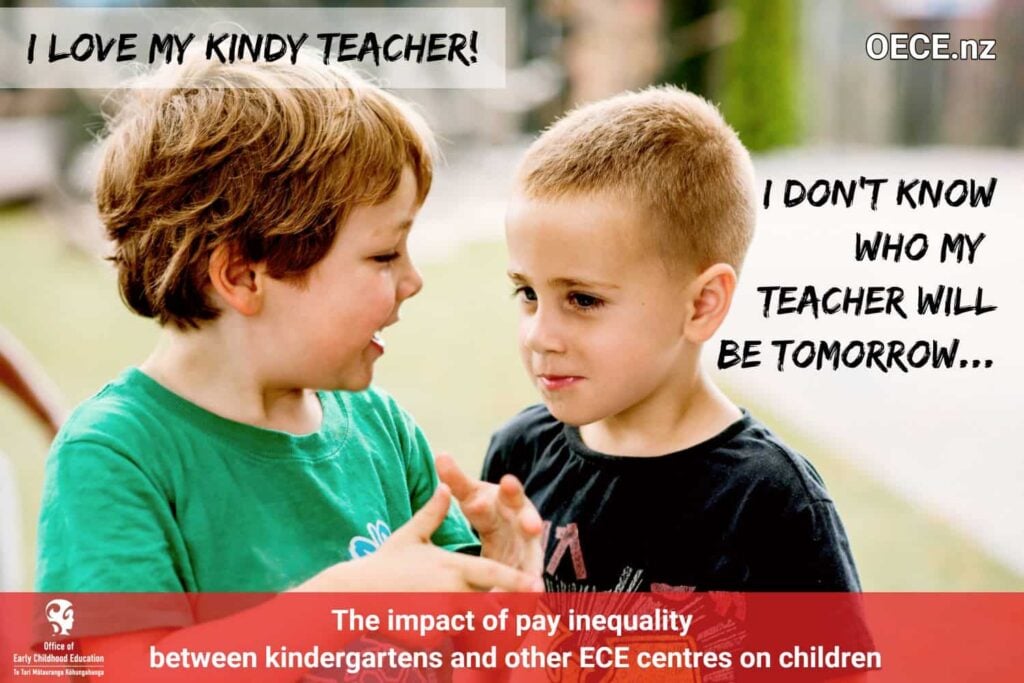
It’s about recognising that the early years of education are as important as the school years, and that high‑quality ECE for children depends on attracting and retaining great teachers who are appropriately qualified in ECE, well‑supported, and well‑paid.
Here’s how we got to where we are today:
The Long Road to Recognition (1980s-2001)
Government reports in the 1980s acknowledged disparities between free kindergartens and childcare centres in access to teacher training, salaries, and professional employment conditions.
In 1985 a joint Departments of Education and Social Welfare paper on the transition of childcare to the education sector noted that to achieve quality childcare adequate working and employment conditions for staff had to be considered. This required “the development of a basic salary scale” for all staff and support for “negotiable conditions of employment”.
A 1987 survey of Christchurch teachers’ wages showed that early childhood teachers were the lowest paid (Department of Labour Statistics Division report). The average ordinary weekly wage per full-time early childhood teacher (including kindergarten, childcare and playcentre) was $261.21 as compared with $445.46 in the primary school system and $464.09 in the secondary school system.
In 1987, the Government opened kindergarten teacher training courses in Colleges of Education to childcare workers, integrating kindergarten and childcare teacher education and helping establish a unified ECE teaching profession. As a result, childcare students were also able to study alongside primary education students in general electives like human development and te reo Māori, and had the opportunity to complete a teaching placement at a primary school.
A less well-known but significant change occurred in 1990 when the Government amended the Free Kindergarten Regulations 1959. The amendment removed the requirement that children attend kindergartens free of charge and allowed free kindergartens to charge fees if associations chose to do so. Along with the alignment in staff training, the removal of the requirement to be fees-free marked the beginning of a gradual shift away from some of the traditional characteristics that had historically distinguished free kindergartens from other early childhood centres.
First Success: Pay Parity for Kindergarten with School Teachers (2001-2002)
In 2001, a major breakthrough came under the Labour Government. Education Minister Trevor Mallard established a Kindergarten Teachers’ Pay Parity Working Group and committed to achieving pay parity for kindergarten teachers.
On 1 July 2002, teachers employed in free kindergartens were granted pay parity with primary school teachers through their Kindergarten Teachers, Head Teachers and Senior Teachers’ Collective Agreement (KTCA), to which the New Zealand Government represented by the Secretary for Education (on behalf of the Ministry of Education) is a party and signatory to.
A More Equal Funding System and Free Kindergartens Adapt (2005-2010)
In 2005, a new ECE funding system placed free kindergartens and other teacher-led services on a more equal footing. Funding incentives were linked to employing qualified and registered teachers rather than the type of service.
This created a period in which many education and care centres could offer more competitive salaries, and ECE-qualified teachers were in very high demand.
A further shift occurred following the introduction of 20 Hours ECE funding in 2007. Many Free Kindergarten Associations moved away from the kindergarten sessional hours model and relicensed centres as all-day centres. Some expanded their enrolment ages to younger children also.
These changes reduced many of the practical differences that had historically existed between free kindergartens and education and care centres. By the end of the decade, teachers across the two parts of the sector generally held the same qualifications, worked under the same regulatory framework, and delivered the same early childhood curriculum.
This raised a policy question that remains relevant today: if teacher-led ECE services were becoming more alike, why should pay parity apply only to teachers employed in free kindergartens and not to all qualified and certificated ECE teachers?
A Turning Point: Funding Diverges (2011)
A 2011 policy decision reduced funding for non-kindergarten services, severely limiting their ability to match the competitive wages offered by free kindergartens.
Following advice from the Ministry of Education, the Government introduced separate funding rate tables for free kindergartens and for other teacher-led ECE services. While free kindergartens continued to receive funding adjustments to reflect increases in teacher salary costs, equivalent salary cost adjustments were no longer automatically provided to education and care centres.
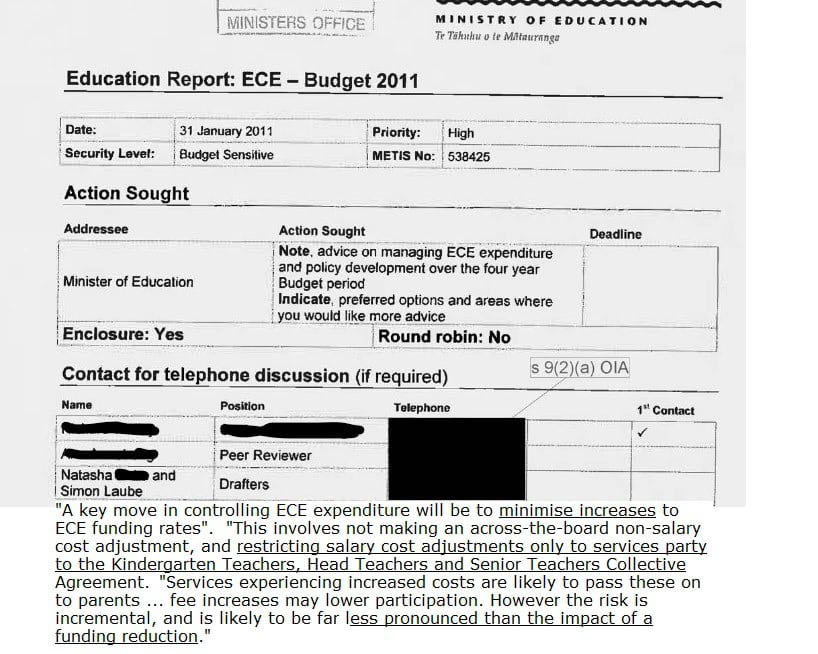
The Minister was advised that: “Providing a salary increase only to those services bound by the KTCA provides those services with higher funding rates, and could be seen as an untargeted and unfair price advantage. We would not recommend this as a long-term strategy.”[1]
Nevertheless, in 2011 Cabinet approved separate funding rates for kindergartens and for other identically regulated ECE services and this “unfair” situation persists today.
The change placed financial pressure on education and care centres that had been paying salaries comparable to, or higher than, those offered by kindergarten associations in order to attract and retain qualified teachers. Some centres reduced staffing costs, while others faced difficult financial decisions as the gap in funding widened.
This policy decision became a major catalyst for the later pay parity campaign.
Education and care centres could access funding for the proportion of qualified teachers they employed if they attested to paying their teachers at one of three pay rates depending on the level of the teacher’s qualifications and these rates were based on an NZEI Early Childhood Workers’ Collective Agreement with a small number of education and care centres.
| Qualification levels | 2015 | 2017 |
| Q1 & Q2 rates (holds a Diploma of Teaching or equivalent) | $40,458 | $41,067 or $19.74 hour |
| Q3 rate (holds a recognised 3yr teaching degree, an advance diploma or has upgraded their teaching diploma to a degree) | $44,373 | $45,041 or $21.65 hour |
| Q3+ rate (examples of quals at this level: a 4-yr Bachelor of Teaching degree, or a Bachelor degree with a recognised ECE qualification) | $45,680 | $46,368 or $22.29 hour |
The Modern Pay Parity Campaign (2019-2020)
By 2019, concern about low teacher pay outside the free kindergarten sector had reached a tipping point.
A sector survey published in June 2019, Should Salary Attestation Rates Be Increased?, found overwhelming support for pay parity with primary and kindergarten teachers. Respondents also strongly supported linking salary attestation rates to the same pay scales as free kindergarten teachers and increasing funding accordingly.
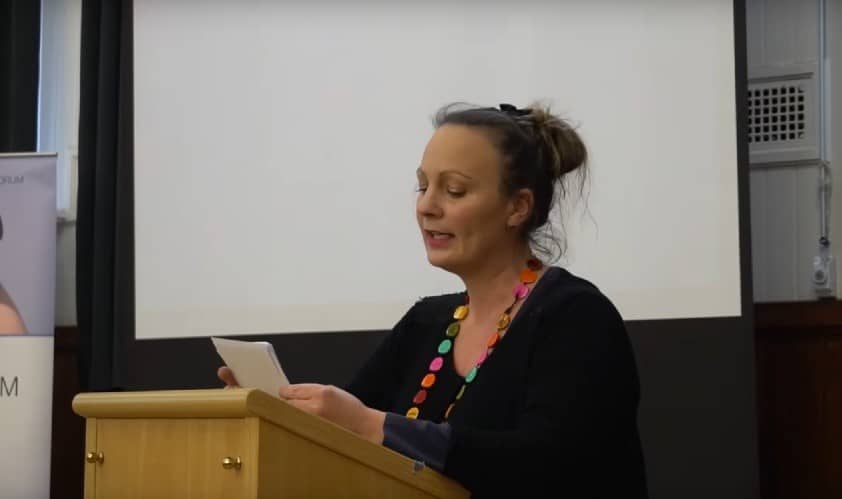
In July 2019, Dr Sarah Alexander convened a national meeting in Wellington to discuss teacher pay and workforce issues. Teachers shared their experiences of low pay, staff shortages, and centre difficulties in retaining qualified teachers. National Party education spokesperson Nicola Willis attended and spoke about the importance of early childhood teachers and the need for their work to be properly recognised and valued.
At the meeting, ECE policy analyst David Haynes outlined the distinction between pay parity and pay equity. Group discussion focused on the best pathway for improving teacher pay. NZEI representatives argued that the sector should focus on achieving pay equity through comparisons with traditionally male-dominated occupations. Others argued that pay parity with school teachers was both achievable and an important issue of professional recognition in its own right.
With no clear timeframe for a pay equity settlement, and strong support emerging for parity with school teachers, Dr Sarah Alexander established a Pay Parity Steering Group and launched a national campaign for pay parity in ECE (Read more).
On 1 October 2019, the Early Childhood Pay Parity Campaign book was published setting out the case for pay parity and funding reform.
Around the same time,NZEI launched its own sector-wide campaign seeking an 11% pay increase through the Early Childhood Education Collective Agreement (ECECA). However, the ECECA covered only a small number of employers and the Government was not a party to the agreement, limiting its ability to lift pay across the wider ECE sector.
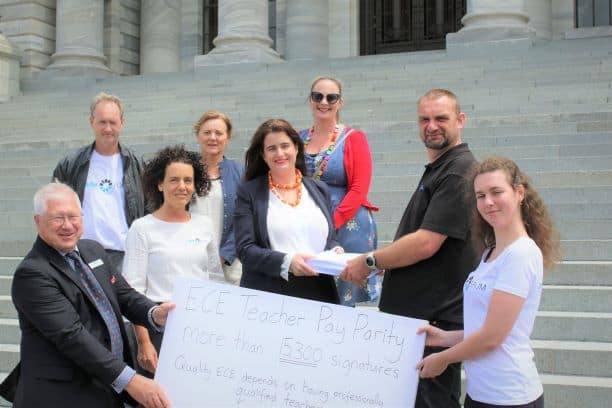
In December 2019, a petition signed by more than 15,000 people was presented to Parliament and received by National Party ECE spokesperson Nicola Willis on behalf of the House of Representatives. Presenting the petition to Parliament ensured it would be considered by the Education and Workforce Committee, rather than remaining solely with the Minister of Education. This elevated pay parity from a ministerial issue to one considered more broadly by Parliament.
The campaign helped shift public and political debate from whether a pay gap mattered to how it could be addressed. For example, read Pay Equity and What’s Happening in 2021 by David Haynes
Progress Under Labour (2020-2023)
The Labour Government made the first significant move toward extending pay parity beyond free kindergartens.
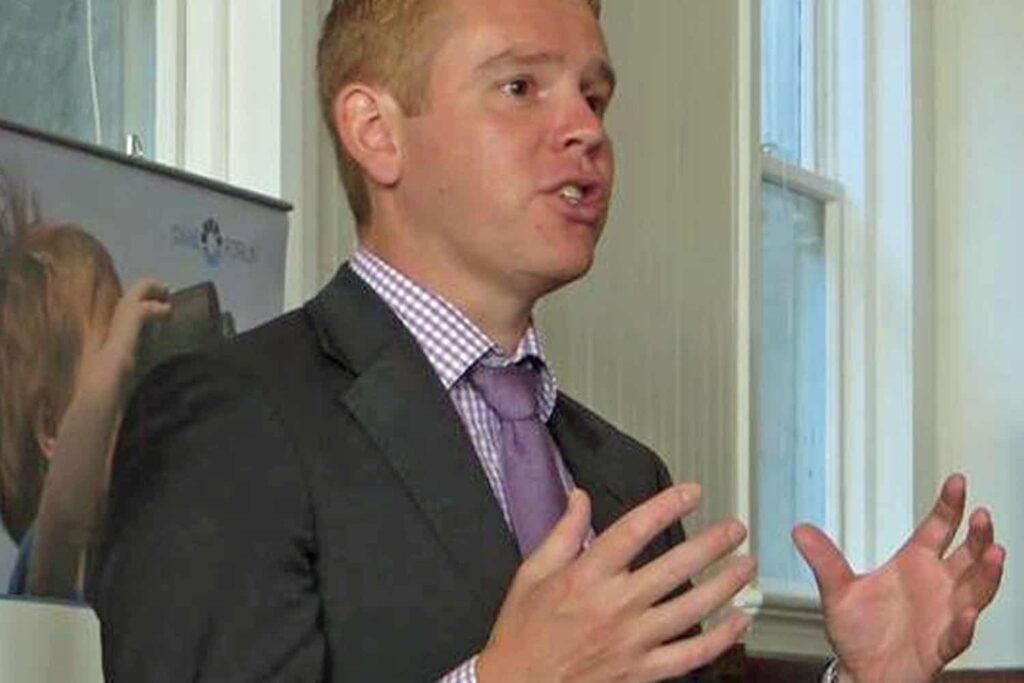
The Pay Parity Steering Group noted a significant shift in the Government’s position during 2020. Education Minister Chris Hipkins publicly acknowledged that all qualified ECE teachers should ultimately receive pay parity with school teachers, describing the existing pay gap as “unacceptable” and “unsustainable”.
On 26 May 2020, Dr Sarah Alexander and members of the Pay Parity Steering Group met with Ministry of Education officials and presented forms signed by more than 500 teacher-led services indicating they would provide full pay parity if funding was restored to the same level as free kindergartens.
From 1 July 2020, the minimum salary attestation rate was linked to Step 1 of the Kindergarten Teachers’ Collective Agreement (KTCA) salary scale. This replaced the previous link to the Early Childhood Education Collective Agreement (ECECA), which had expired in 2019 and had not yet been replaced. The change followed increasing pressure on the Government to address growing pay gaps after substantial pay increases had already been awarded to school and kindergarten teachers.

On 12 May 2021, the Government announced that the salary attestation scheme would be expanded to cover the first six steps of the KTCA salary scale from 1 January 2022.
However, resistance from some provider groups soon emerged. Following lobbying from the Early Childhood Council the Government subsequently deferred implementation of the sixth step until 1 January 2023.
In 2022, the Government introduced an Extended Pay Parity funding option, providing access to additional salary steps and management positions. For the first time, experienced teachers and centre leaders outside the kindergarten sector had a pathway to salaries closer to those available in free kindergarten.
On 1 November 2023, Full Pay Parity funding was introduced. Participating services could access funding linked to the full teacher salary scale and management positions. This represented the most significant advance towards sector-wide pay parity since kindergarten teachers achieved parity with primary school teachers in 2002.
However, full pay parity proved short-lived. Funding was not subsequently adjusted to reflect later increases in school and kindergarten teacher salaries, meaning the gap began widening again almost immediately.
Resistance
Not everyone supported the extension of pay parity beyond free kindergartens or the requirement for employers to pass on funding intended for teacher pay, to teachers.
In 2021, responses to Official Information Act requests revealed that the Ministry of Education had not advised the Minister about the more than 500 teacher-led services that had indicated they would provide full pay parity if equivalent funding was made available.
The Ministry also confirmed it had undertaken no costing work on reversing the 2011 funding decision that restricted salary-cost adjustments to kindergarten associations.
When asked for:
- costings on extending kindergarten funding rates to education and care services providing full pay parity; and
- risk analysis of limiting pay parity to only the first five or six salary steps,
the Ministry’s response was simply: “The requested information does not exist.”
In early 2022, the Ministry established a Pay Parity Expert Advisory Group to advise on future funding arrangements. However, the Ministry handpicked who it wanted on its group and made no public call for nominations. Several members were aligned with the Early Childhood Council, including Kelly Seaburg of New Shoots Children’s Centres and ECC Treasurer Lonnie Parker. No representatives from the free kindergarten sector were appointed despite its long-standing experience of operating a pay parity system.
Opposition became more public in 2023.
On 19 March 2023, the Early Childhood Council (ECC) announced its intention to challenge the Government’s pay parity policy through legal action. Former Ministry of Education employee and now ECC Chief Executive Simon Laube argued that the policy restricted employer flexibility and discriminated against experienced teachers. The Ministry did not review membership of its Pay Parity Expert Advisory Group even though there was potential conflict of interest.
The legal action was later withdrawn. However, criticisms of pay parity salary steps and requirements continued to feature in ECC advocacy.
A Change in Direction (2024-2026)
Following the 2023 election, the National-Act-New Zealand First Government took a different approach to pay parity.
Although existing pay parity funding settings remained in place, funding rates were not increased to keep pace with later school and free kindergarten teacher salary settlements. As a result, progress towards full pay parity effectively stalled.
David Seymour became Associate Minister of Education with responsibility for ECE.
During 2024, employer representatives including Kelly Seaburg of New Shoots Children’s Centres and Simon Laube of the ECC advocated for changes to salary attestation requirements.
Following advice from the Ministry of Education on what employer representatives wanted, on 4 September 2024, Minister Seymour announced changes intended to provide greater flexibility for employers and reduce the number of teachers covered by pay parity requirements.
From October 2024:
- services could count unqualified staff for up to 80 hours per funding period without first demonstrating they had attempted to recruit a qualified and certificated teacher; and
- salary attestation requirements would apply only to permanent certificated teachers, excluding relief teachers, casual employees, and other teachers on non-permanent contracts.
At the same time, the Ministry for Regulation undertook a review of ECE regulations. In its submission, the Early Childhood Council described pay parity as “an unjustified intervention in the early childhood workforce”.
In April 2025, Ministry advice to Minister Seymour referred to claims from sector representatives that pay parity was creating financial pressure and contributing to service closures. However, Office of Early Childhood Education (OECE) analysis of service openings and closures between 2022 and 2024 found no evidence that services receiving pay parity funding were more likely to close than other services.
In 2025, Minister Seymour established the ECE Funding Review Ministerial Advisory Group (MAG). The only ECE sector representatives appointed were Kelly Seaburg, Simon Laube and Linda Meade, all of whom were either private providers or representatives of private providers.
Further changes followed from July 2025:
- newly certificated teachers and teachers entering the New Zealand ECE sector could be placed on Step 1 regardless of previous experience or higher qualifications; and
- services could move to lower pay parity funding bands, but not higher ones.
In June 2026, the MAG consulted on proposals to reconsider how Government supports ECE teacher pay. The options presented all involved reducing or restructuring existing pay parity arrangements. Maintaining the existing system was not offered as a standalone option and pay parity for all ECE teachers was not proposed.
- Returning to the pre 2022 settings, i.e. removing all pay parity for non-kindergarten teachers.
- Simplifying the current system, providing more ‘flexibility’ for employers (and without additional funding this inevitably means a degradation to pay parity).
- Replacing the current system with a “system-wide framework” including for kindergartens which would result in everyone losing pay parity with their school teacher peers, since the Minister had said there would not be additional funding.
Maintaining the existing system was not offered as a standalone option and pay parity for all ECE teachers was not proposed.
Where the Campaign Stands Today
Over the past quarter of a century the sector has achieved important gains:
- Free kindergarten teachers achieved pay parity with school teachers in 2002.
- OECE and the Pay Parity Steering Group helped place pay parity firmly on the national policy agenda from 2019 onward.
- Teachers in non-kindergarten services gained access to staged pay parity funding between 2020 and 2023.
- Pay parity became an accepted policy objective across much of the sector.
At the same time, substantial differences remain between the salaries of teachers working in different parts of ECE, and there continues to be opposition from some employers and their representatives about the extent to which government funding should be tied to teacher pay.
The central goal remains unfinished: ensuring that all qualified and certificated ECE teachers, regardless of the type of service in which they work, receive the same pay as school teachers with equivalent qualifications, experience and responsibilities.
Related Information and Resources
Teacher Salaries, Pay Scales, & Conditions of Work
Pay Parity Calculator and Ministry of Education Guidance on Setting Your Initial Pay Step
Correcting the Record on Pay Parity with the Minister and Ministry
Free Kindergarten Teachers Mark Quarter of a Century of Pay Parity with School Teachers
[1] Education Report: ECE – Budget 2011 METIS No: 538425 dated 31 January 2011