The Early Childhood Council is suing the government to increase subsidies to pay teacher wages and salaries so centres won’t close, increase their fees, or churn through teaching staff to keep their (female) workforce young. But this is not what it seems.
In this article Dr Sarah explains what motivates the ECC and problems with its claim. It is using community-based services in its claim intended to benefit the financial position of private and corporate centres. The ECC has not agreed that its centre owners will cap parent fees in return for greater subsidy money. It also has not said that its centre owners will stop employing mostly younger women teachers on lower salary steps over more experienced teachers and male teachers should government increase subsidies.
Sarah Alexander.
March 22, 2023.
OPINION: The government is providing funding and the Ministry of Education is setting pay scales to assist ECE centre owners pay their teaching staff at least up to Step 6 of the unified base salary scale for teachers in the state sector and improve the pay of teachers above Step 6 and in management positions. Funding to help centre owners meet the costs of pay parity is and always has been on an opt-in basis and no centre has been compelled to accept.
But on 19 March, the Early Childhood Council announced that it is going to take the government to court over discrimination against older teachers and women and wants government to give it more money or top up wages. The ECC is a childcare business lobby group. It does not represent the sector and it does not represent teachers. Its claim is confused and hard to make sense of.
The Early Childhood Council says that small service providers and community-based (non-profit) centres choose to “employ mostly more experienced teachers.” In contrast its members that are larger service providers and private centres, don’t employ mostly more experienced teachers: “younger certificated teachers are always cheaper to hire to meet their teacher to child ratios, as they will be on lower salary steps”.
The ECC is accusing its own members of discrimination by choosing not to employ many older people and relying on cheaper female labour. But rather than accepting responsibility for the alleged discrimination by centre owners, the ECC is deflecting blame to the government.
Presumably at some point the focus of its human rights complaint against the government will reflect on its own centre members. And anyone who is an ECC member needs to be prepared for this.
Presumably also the President of the ECC’s executive Darius Singh and chief executive Simon Laube obtained the informed consent of every service provider to sue the government before proceeding to contract a legal team, and members were properly informed about costs and potential consequences? If not, then why not? In an interview with Kim Hill on Radio NZ, Laube confirmed that centres will be specified/named. I suggest that if your centre or centres are in the ECC and you do not want to be part of this, that you consider your options.
The Early Childhood Council is demanding more money, but it is not saying how much. It did not support the 2020 call for centres to have access to the same funding as kindergarten associations. It has not publicly discussed that in 2011 Laube recommended to Minister Tolley to restrict salary cost adjustments in funding only to Kindergarten Associations to save $20m per annum and “place greater onus on providers to manage and reduce costs”.
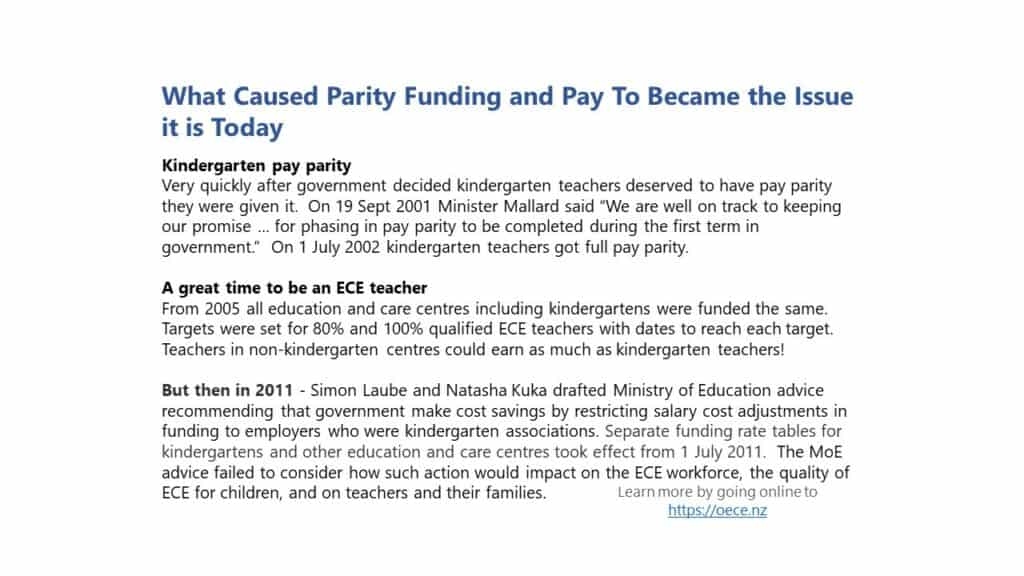
Instead of taking court action, why does the ECC not ask the Ministry of Education to change its funding rate tables so centres that are good at retaining staff will be eligible to receive a higher subsidy amount compared with those that are not good at retaining staff? Such a carrot and stick approach might also encourage centre owners to tackle issues of bullying, high workloads, and toxic work environments – which in turn would improve staff retention rates, support effective teaching, and build a more highly qualified and skilled workforce.
But that’s an idea that may not go down well with the Early Childhood Council. Laube outlined the ECC’s position to Kim Hill on Radio New Zealand. You can listen to this interview here and judge for yourself how well thought through their legal action is.
I wonder if the real intention or end game of the ECC is to force the government to scrap pay parity? Before the government introduced its pay parity policy, the ECC’s policy position was that wage negotiations should be left to employers and employees. It wanted the link between government funding subsidies and staff salaries at the level of the ECE Collective Agreement removed. The ECC has also not thought that when public money is earmarked to improve teacher pay that centre owners should be held to account to use it for the purpose intended.
Prime Minister Chris Hipkins promised in 2020 that if Labour won the election that year it would deliver pay parity to ECE teachers during its term in government.

The Early Childhood Council is putting delivery of pay parity at risk. Should the PM now decide to add ECE teacher pay parity to his list of scrapped policies because of the ECCs actions, it might be another 20 years before pay parity for non-kindergarten ECE teachers with primary school teachers gets another look at.
_________________________________________________
Footnotes
- Early in 2022 the Ministry of Education selected several of the ECC’s people for a pay parity funding review expert advisory group, giving them privileged access to confidential data, research, and analysis. Potentially this may aid the ECC’s legal team.
- The Ministry will need to consider its response and all future involvements with ECC staff and centre owners. The Ministry is expected to, and should, stand the ECC down from its ECAC and any other of its policy, regulatory, and funding groups at least for the time that legal proceedings are underway.
- The funding incentive provided to centre owners that opt-in to the higher pay scale is now very close to the subsidy rates paid to kindergarten associations. Yet, the Ministry’s current funding rules do not require centres with teachers above pay Step 6 to pay them anywhere near as much as kindergarten associations must pay their experienced teachers. Kindergarten associations employ many teaching staff at the top end of its KTCA pay scale which matches the unified base salary scale for teachers in the state sector. Kindergartens are community-based and most are small with rolls of less than 50 children.
- The ECC’s case won’t be heard in court before the government budget is released on May 18th. So it is taking a gamble that funding/ subsidy rates will not be increased as part of Budget 2023.
- The ECC may try to sue me now for my comments. But may I point out that:
- This is an OPINION piece.
- The views expressed here are my own and do not necessarily reflect the views of any other person, staff, or organisation including the Office of ECE or the Ministry of Education
- The ECC opened it up for comments and critique by announcing its action – issuing a press release, talking with the media, and so on.