Call for Papers for the NZIRECE Journal

Search in Research
names research early childhood

The NZIRECE Journal is a peer-reviewed academic journal that publishes research results, critiques, methodological papers and theoretical articles relating to children’s education, well-being and care in the early years (from birth and up to six or seven years of age).  

Research relating to teaching and learning, pedagogical approaches, inclusion, gender, language and culture, child health, child safety, regulation of services, quality of ECE, access and affordability for families, children’s rights, early education policy, funding of services, teacher education, and parent involvement are particularly welcome.

The journal was first published in 1998, when it was known as the New Zealand Research in ECE journal. The journal made history – it was the first academic journal to be published in NZ that was exclusively on early childhood education.  It paved the way for the development of an early childhood research culture. 

Today, the NZIRECE Journal is on Scopus. It is also on Informit for international access. 

The Office of Early Childhood Education (OECE) also publishes the journal on its website, providing over 25 years of published articles online.

Papers may take the following forms

1. An article reporting an original research study and findings
This is blind peer-reviewed by at least two reviewers.  (3,000-5,000 words)

2. An article providing (a) an in-depth critical review or (b) a commentary
This is blind peer-reviewed. A critical in-depth analysis of research or theory, or a commentary in which you critically examine different sides of an issue by drawing on research evidence and theory. (3,000-5,000 words)

3. Research Note
This is not a full research paper.  The purpose of the Research Note is to inform others of your work-in-progress or signal what some early findings may be.  It can take the form of a description of an original research project or of a research stage within the project, or a reflective examination of some aspect of the research experience. (2,000 words maximum).  Research notes are not subject to blind peer-review but may be edited. 

4. Other
Book reviews and other paper types such as Research Methods or Ethics papers are considered by the Editor on an individual basis. Please check and discuss the appropriateness of your paper with the Editor before submitting. 

Script Preparation

See the instructions for preparing a manuscript. Please follow the instructions closely when preparing your manuscript.

Manuscripts which exceed word limits, do not adhere to manuscript requirements, or have spelling and grammatical errors will be returned for correction prior to commencement of the review process.

Manuscripts submitted for publication elsewhere should not be submitted to the NZIRECE journal. The NZIRECE journal publishes only original work.

Submission Process

Please remove your name/s and any identifying information from your manuscript if it is being submitted for blind peer-review.

Should you be submitting a Research Note which is not blind peer-reviewed, your name and workplace affiliation should be included on the cover page.

Email your manuscript and a covering letter to NZIRECE Journal Lead Editor, Professor Wendy Boyd, Email: [email protected] 

Please note that there is no charge for manuscript publication.

Authors are provided with a personal copy of their published article as a pdf.  In submitting an article to the journal, the author(s) accepts that upon publication, copyright of the article belongs to the journal.


Already a Research Subscriber?
Reasons to Subscribe
Tertiary education libraries and individuals.

Enjoy online access to full copies of the latest issues of the NZ-International Research in ECE journal and more than 25 years of past issues of peer-reviewed published articles.

You will also have access to the NZ Doctoral thesis (Ph.D, and Ed.D) and the NZ Master’s thesis directory of theses relevant to early childhood education and care.

For those who are new to doing research, thesis supervisors, and conference paper selectors, we have a range of articles to inform and support you.  These include a guide to ethics when doing, writing, and disseminating research; reviewing abstracts and conference submissions, and more.

Sign-up now

Are you a teacher educator or academic, a practitioner, or a policy advisor, who is keen to keep up with ECE research?

Maybe you are planning to do some research yourself? Or maybe you are advising and supervising students who are undertaking projects?

Enjoy unrestricted access to the hundreds of articles in the Research Area of our OECE website.

Choose your own username and password when you subscribe online. This will be your login for access.

Libraries can request IP address access for staff and students on the library site, instead of password access.  Please note that this is dependent on whether system settings at your end can support this.

Your investment

Personal research user membership – $79.00 for 12-months

Libraries and tertiary education institutions – $250.00 for 12-months

Please see and abide by the Terms & Conditions of membership.

Article copyright belongs to the OECE / ChildForum. You are welcome to add a link to this research article on your website.

Related Posts

teacher wages, pay scales, in childcare and early childhood education

What ECE Teachers and Workers Earn: Pay, Benefits and Conditions

Anyone thinking about getting a job in ECE working in ECE or thinking about moving to a different service will find clear, practical information in this article about pay rates, employment conditions, and what to expect in different roles. It explains everything from starting salaries and pay‑step calculations to workplace rights, benefits, and how to recognise a supportive, professional environment.

Read More »
teacher support and teachers meeting

Internal Evaluation and How to Please ERO

Internal Evaluation and the Education Review Office.

Ongoing reflection and review of practice has always been a priority for ECE teachers to ensure that they are the best teachers they can be and are providing best outcomes for children.

From their initial teacher registration, teachers are taught to reflect on their  practice and this is

This is a member/subscriber only post. To access it, please see the message below for details on access and joining.

Read More »
early childhood research journal online

Shared Decision-Making as a Component of Partnership in New Zealand Early Childhood Education Centres

Research looking into the difficulty early childhood education practitioners have in establishing a genuine partnership with parents. It details tensions in shared decision-making and highlights what enables and hinders partnership in decision-making. Read the full paper below. Or to order a pdf copy of the article go to the main NZIRECE Journal page.

This is a member/subscriber only post. To access it, please see the message below for details on access and joining.

Read More »
Treasure basket

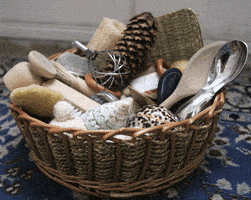
Heuristic Play and Treasure Baskets

Heuristic Play.

In the modern world where many toys are made of shiny coloured plastic and have buttons to press with flashing lights and noises, it is often easy to forget that simple things can interest and stimulate young children. 

In fact these simple things can often be better for them as they have a wider range of textures an

This is a member/subscriber only post. To access it, please see the message below for details on access and joining.

Read More »
school group mat teacher directed montessori

Learning Languages in ECE from a Young Age

Learning languages in early childhood education is important – whether it is connecting with parts of our own kiwi culture or embracing other languages.

With families coming to New Zealand from all over the world it is also important to recognise that English and/ or Māori may not be the main language/s in the home of some families.

Sig

This is a member/subscriber only post. To access it, please see the message below for details on access and joining.

Read More »

Are you teaching and caring for children or studying for an ECE qualification?

If you are, that’s great!   Join us now, and become a teacher member.

The Office of ECE

Share This Information

Notice for Students and Library Users
You are able to access all Journal Research articles under the library's subscription. But unless you hold a personal membership you are missing out on a whole lot of valuable teaching and policy articles and other important information. At home, or on your mobile device that is not linked to your institution or library's internet or subscription - click on the JOIN button below.

Table of Contents

Table of Contents

The Office of ECE Login

Take Action!

Help spread this vital ECE information, join our free social and email groups and become a member of OECE.

pay parity funding policy

1. Share This Information

2. Follow Our Social Pages

3. Get Regular Updates

Sign up to our free newsletters.

4. Become a Member