Free Kindergarten Teachers Mark 24 Years of Pay Parity
NEWS/OPINION – 1 July 2026
Today marks 24 years since free kindergarten teachers achieved pay parity with primary school teachers, a milestone that remains one of the most significant achievements in the history of early childhood education (ECE) in New Zealand.
On 1 July 2002, teachers employed by Free Kindergarten Associations gained full salary parity with primary school teachers following a commitment by the Labour Government under education minister Trevor Mallard to recognise kindergarten teaching as an equal profession within the education system.
The achievement followed decades of advocacy by free kindergarten teachers and represented the first successful pay parity settlement in the ECE sector.
However, 24 years later, the wider goal of extending pay parity to all qualified and certificated ECE teachers remains unfinished.
A Promise Made and Only Partly Delivered
When pay parity was introduced for kindergarten teachers in 2002, it was widely seen as the first step towards achieving comparable pay for all qualified ECE teachers working in publicly funded services.
At the time, Education Minister Trevor Mallard established a Free Kindergarten Teachers’ Pay Parity Working Group and stated the Government was committed to addressing disparities within the ECE sector for teachers working in all other ECE services.
While parity was successfully implemented for kindergarten teachers, it was never extended to all teacher-led ECE services.
A Decade of Relative Equality
For a period, funding settings helped reduce some of these differences.
In 2005, the Government introduced a new funding system that treated teacher-led ECE services more equally. Funding incentives were linked to employing qualified and registered teachers rather than the type of service.
This allowed many education and care centres to compete more effectively for qualified teachers. Demand for trained ECE teachers increased, salaries improved and teacher training enrolments grew.
By the late 2000s, many centres were paying salaries that were increasingly competitive with those offered by kindergarten associations.
The Impact of 20-Hours Free ECE Funding on the Free Kindergarten Model
The introduction of 20 Hours ECE funding on 1 July 2007 marked a significant turning point for the early childhood education sector.
Introduced by the Labour-led Government under Education Minister Steve Maharey, the policy provided additional funding for services offering free ECE to eligible three- and four-year-old children. Free Kindergarten Associations quickly adopted the new funding rates and, over time, all moved away from the traditional sessional kindergarten model.
To access the higher funding available through the new system, associations relicensed their free kindergartens as all-day centres. Rather than operating for around three hours per day, increasing numbers of kindergartens began offering programmes of six hours or longer.
Longer operating hours meant that kindergartens could claim funding for children attending throughout the day, reducing the number of children able to be enrolled at any one time. In many communities, the rolls at free kindergartens effectively shrank as children attended for longer periods.
At the same time, demand for additional ECE places continued to grow. Education and care centres expanded rapidly to meet this demand, contributing to substantial growth in the private ECE market and increasing pressure on government expenditure.
As ECE funding costs rose to a level that was not anticipated, the government faced growing fiscal pressures.
The 2011 Turning Point
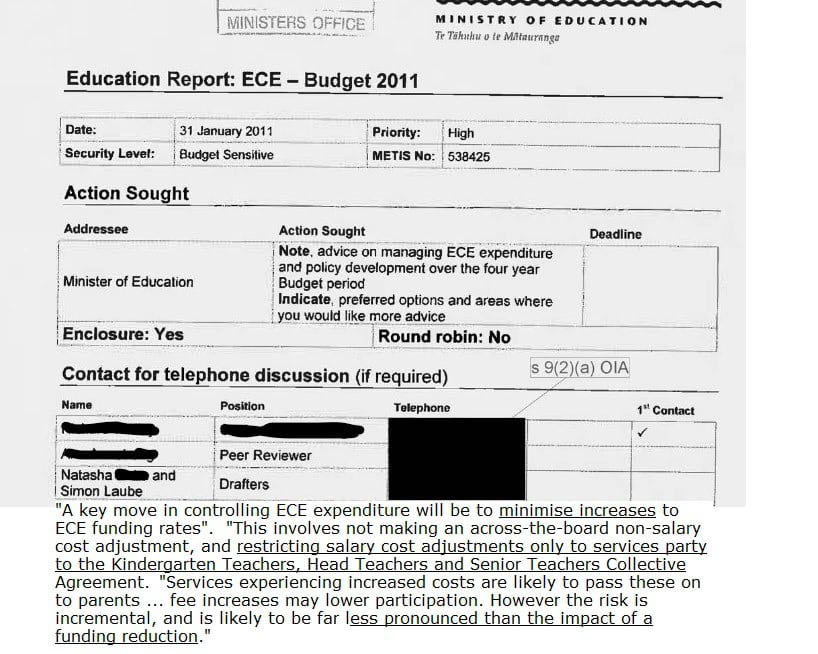
A major policy shift occurred in 2011 when the Government introduced separate funding rate tables for free kindergartens and other teacher-led ECE services.
Under the new approach, salary-related funding adjustments continued to be provided to free kindergartens to reflect increases in teacher salary costs. However, equivalent salary cost adjustments were no longer automatically extended to other teacher-led centres.
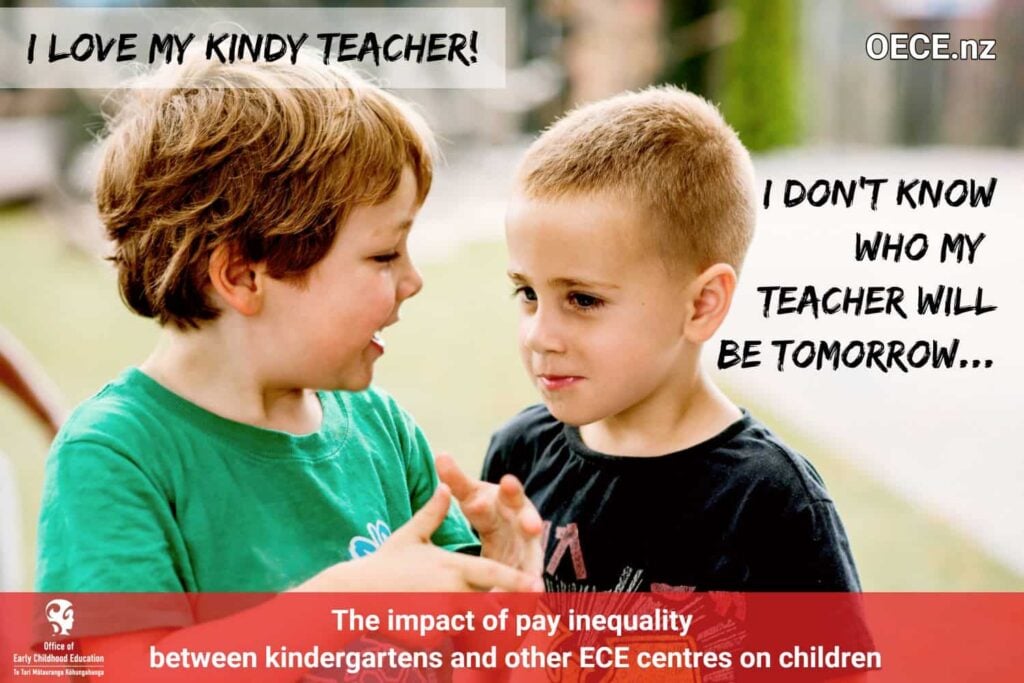
The result was a widening funding and salary gap between free kindergarten teachers and the rest of the teacher-led ECE sector. While free kindergarten teacher salaries continued to track school teacher salary settlements, teachers working in education and care centres increasingly fell behind.
The 2011 funding change was as a pivotal moment in the history of ECE pay parity, creating the divide that gave rise to the modern campaign for pay parity across the wider teacher-led sector.
The Modern Pay Parity Campaign
By 2019, concerns about teacher shortages, staff turnover and salary disparities had reignited calls for reform.
ChildForum (which later merged into the Office of Early Childhood Education OECE), led by Dr Sarah Alexander, launched a national campaign calling for pay parity for all qualified and certificated ECE teachers.

In July 2019, teachers, service leaders, political leaders, and researchers gathered in Wellington to discuss a pathway toward better pay for ECE teachers. Following this meeting a pay parity steering group was formed and a campaign booklet was produced.
Later that year, a petition signed by more than 15,000 people was presented to Parliament, helping elevate pay parity into a national political issue.
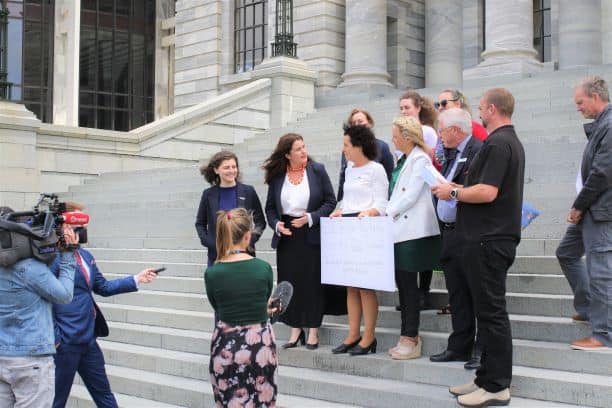
The campaign received support from teachers, parents, researchers and sector leaders, while politicians from across the political spectrum acknowledged the existence of a significant pay gap.
Progress Between 2020 and 2023
The first substantial progress toward extending pay parity beyond free kindergartens came under the Labour Government between 2020 and 2023, using a salary attestation model that allowed teacher-led centres to receive higher funding if they agreed to pay qualified teachers at specified salary levels linked to the kindergarten teacher salary scale.
For the first time since free kindergarten teachers achieved parity in 2002, many teachers outside the kindergarten sector gained access to salary scales based directly on school and kindergarten teacher rates, albeit at lower pay rate amounts.

However, the system has remained voluntary for service providers and not every teacher has benefited equally.
Twenty-Four Years On
Today, free kindergarten teachers remain the only group of ECE teachers whose salaries are fully aligned with school teacher salaries.
Their experience demonstrates that pay parity can be achieved and sustained over time when governments commit to funding it.
For many teachers, the central question remains the same as it was in 2002: if qualified teachers are delivering the same professional service within New Zealand’s education system, should their pay depend on the age of children or the type of education service in which they happen to work?