Data indicates pay parity is not causing education and care centres to close

Search Newsroom Posts
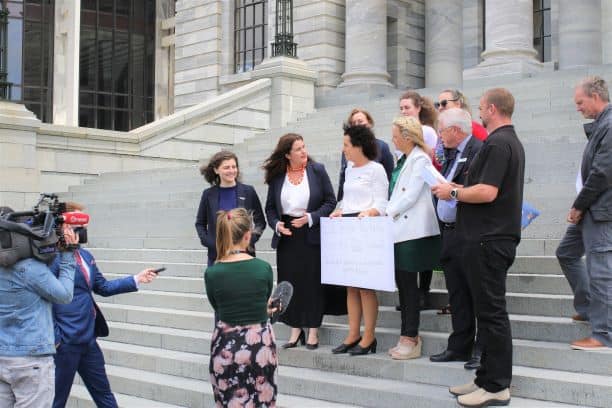
Lead advocate and advisor on why Pay Parity for all ECE teachers is vital (image: The petition presentation for the House of Representatives)

After RNZ revealed last Friday that the Government intends to axe the pay parity scheme for education and care teachers, in part to give providers “greater autonomy… to negotiate” with teachers about pay, the Office of Early Childhood Education has been fact checking claims by ECE business lobbyists that pay parity has caused more services to close.

In our view, there is no evidence of this, based on the available statistics.

In a Cabinet paper from April, which was publicly released on July 17, the Ministry of Education wrote to associate minister of education David Seymour that: “The options in this paper begin the process of proactively moving away from the opt-in pay parity system and providing greater autonomy to providers to negotiate with teachers on matters of pay. The wider funding review you are seeking Cabinet approval for provides the opportunity to complete this process”.

This is a member/subscriber only post. To access it, please see the message below for details on access and joining.
Already subscribed?
ECE Newsroom

NZ’s own specialist ECE newsroom. 
Access national and local stories, in-depth analysis, & original commentaries.  

Membership Support for Teachers & Educators

(Comes with free Newsroom and Research access)

Membership Support for ECE Service Owners, Managers, & Community Organisations

(Comes with free Newsroom and Research access)

Researchers & Tertiary Education Libraries

Full access to over 25 years of ECE academic research articles – NZIRECE Journal.
Plus, guidance and resources on doing and publishing research

Has this been useful?  Give us your feedback.

You are welcome to add a link to this page on your website. Copyright belongs to the OECE so please do not copy any content without our written permission.

Information provided is of a general nature. It is provided ‘as is’, and we accept no liability for its accuracy or completeness. See our Terms and Conditions.

Related Posts

teacher wages, pay scales, in childcare and early childhood education

What ECE Teachers and Workers Earn: Pay, Benefits and Conditions

Anyone thinking about getting a job in ECE working in ECE or thinking about moving to a different service will find clear, practical information in this article about pay rates, employment conditions, and what to expect in different roles. It explains everything from starting salaries and pay‑step calculations to workplace rights, benefits, and how to recognise a supportive, professional environment.

Read More »
Te Whāriki

Te Whāriki – NZ’s Early Childhood Curriculum

Early childhood services must follow a national curriculum called “Te Whāriki”, yet most parents and school teachers don’t know it exists. This article explains what it is, why play is part of learning, and answers the big questions people have when they first hear about it.

Read More »
Early childhood teachers meeting to discuss planning.

Focus Group Methodology

Focus Group Methodology and its Usefulness in Early Childhood Research. By Claire McLachlan. Published in NZ Research in ECE Journal, 2005, pp. 113-123.

Abstract.

Focus groups are increasingly being used by researchers as a method of qualitative data gathering in educational contexts. The history of the focus group started with the ‘foc

This is a member/subscriber only post. To access it, please see the message below for details on access and joining.

Read More »
The Office of ECE

Share This Information

Table of Contents

Table of Contents

The Office of ECE Login

Take Action!

Help spread this vital ECE information, join our free social and email groups and become a member of OECE.

pay parity funding policy

1. Share This Information

2. Follow Our Social Pages

3. Get Regular Updates

Sign up to our free newsletters.

4. Become a Member