“Quality” – What Is Quality Early Childhood Education?
By Dr Sarah Alexander
“Quality early childhood education” is often used as if there is no distinction between ECE and quality ECE – as though simply placing the word “quality” in front of the noun makes it true.
Almost every early childhood publication, Ministry of Education and Education Review Office document, and government press release uses the word quality. Scan any newspaper article and you’ll see it too: “quality early childhood education” is used as if all ECE is automatically quality.
The idea of “quality ECE” is frequently presented in policy documents as a golden bullet – a solution for everything from boosting national productivity to improving children’s later academic performance or supporting parents in the workforce. But this framing treats quality as a static attribute, not a professional practice.
“Quality ECE” is not something a service is – Quality ECE it is something a service does. Quality is enacted through standards, best practice, professional teaching, and how well an ECE service serves children and families. It is about choices that fit each child, uphold family culture and values, and meet real needs and not simply the provision of an ECE place.
At the OECE we use the term “high‑quality” because “quality” has become a catch‑all label that can describe almost any service, regardless of whether it meets key indicators of quality such as ECE‑qualified teachers, high ratios, small group sizes, stable staffing, ample physical space, and a play‑based environment in practice.
High‑quality early childhood education means:
- Meeting and exceeding standards not just complying with regulations, but consistently delivering above the minimum.
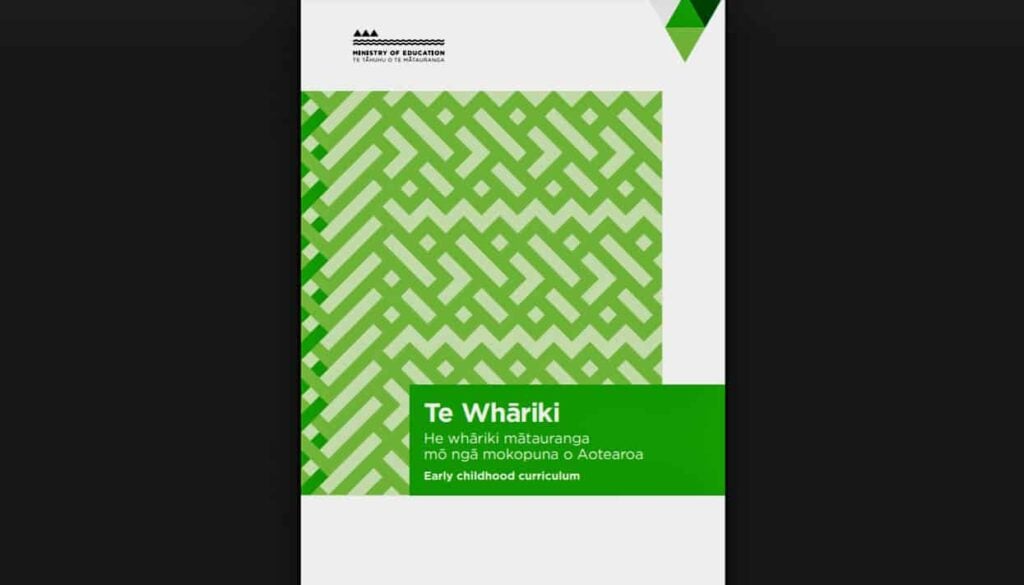
- Implementing best practice and pedagogy teaching that reflects research evidence, Te Whāriki, and professional expertise.
- Fitting programmes to the child ensuring learning adapts to each child’s development, needs, interests, culture, and identity, rather than expecting the child to fit the programme.
- Delighting and respecting families providing an ECE experience that meets and exceeds expectations, upholds family culture and values, supports parents’ wishes, involves families in planning for their child’s learning and care, and works in partnership with parents.
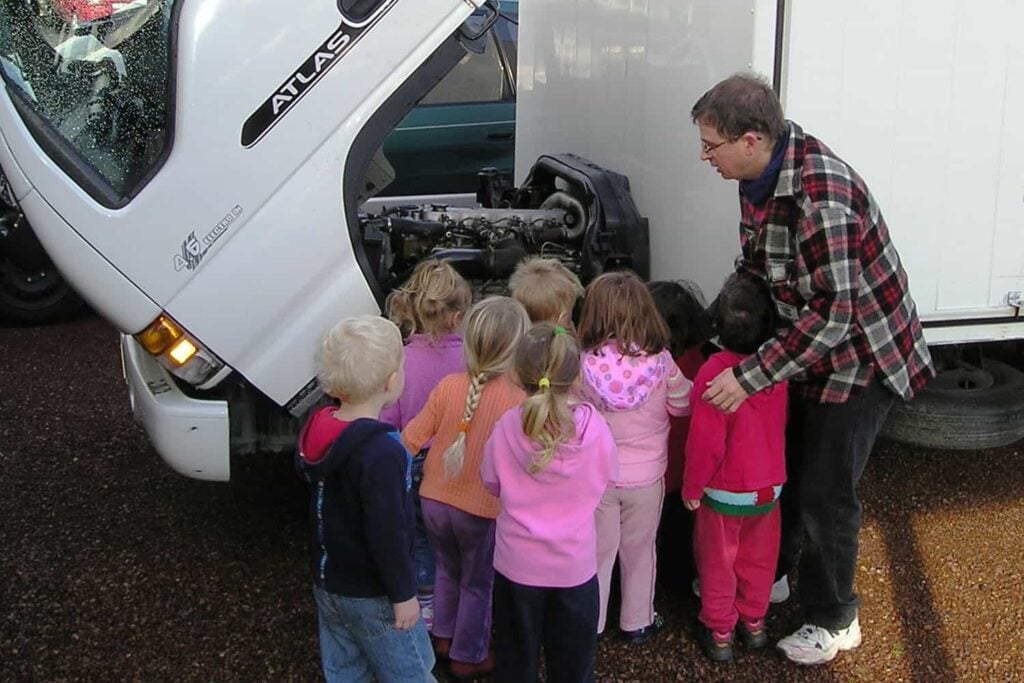
High-Quality Early Childhood Education requires as a highly skilled, play‑based, curriculum‑driven ECE-Teacher qualified profession
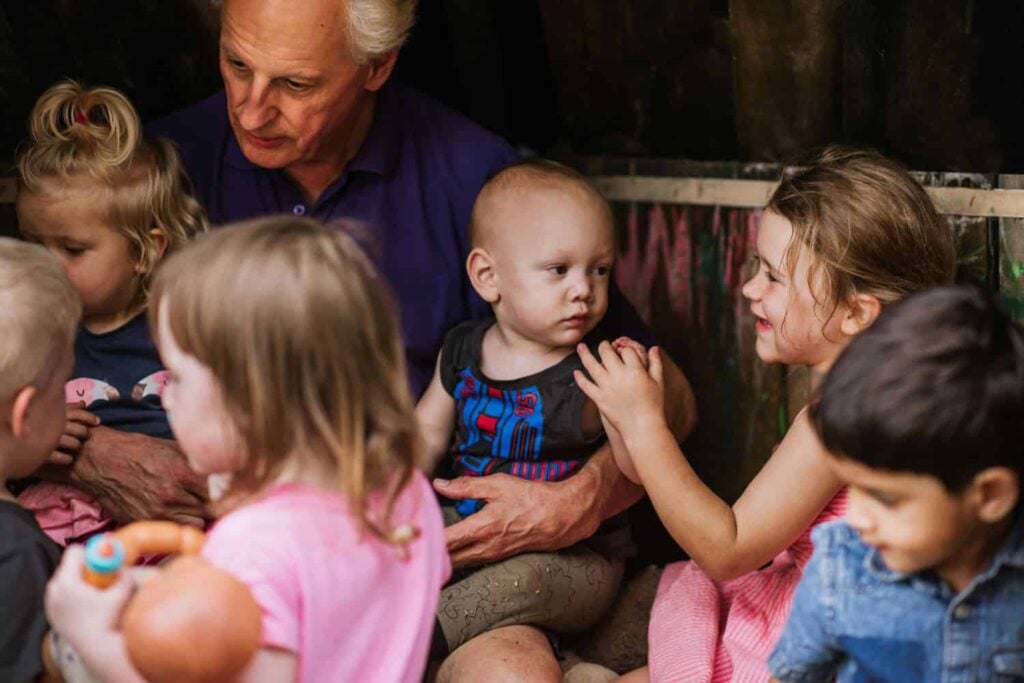
Quality early childhood education is not babysitting – it is a highly skilled, play‑based, curriculum‑driven profession led by ECE‑qualified teachers. The photo above is a perfect example of what real teaching in early childhood looks like.
It shows a qualified early childhood teacher – who previously worked as a truck driver – sharing his knowledge and passion for trucks with a group of kindergarten children. What matters here is not the truck itself, but the intentional teaching happening through play, curiosity, and real‑world experience.
The children’s learning is being stimulated, extended, and challenged because the teacher is:
- drawing on his personal interests
- connecting learning to real‑life experiences
- responding to children’s curiosity
- using hands‑on exploration to deepen understanding
Back at the kindergarten, he continued the learning by involving children in fixing broken bits and pieces, exploring mechanics, and encouraging problem‑solving. This is play‑based learning at its best – rich, meaningful, and guided by a qualified teacher who knows how to turn everyday experiences into powerful learning opportunities.
This example shows why ECE‑qualified teachers matter. They bring:
- deep knowledge of child development
- skill in noticing and extending learning
- understanding of Te Whāriki
- ability to create safe, stimulating environments
- professional judgement about when and how to scaffold learning
Quality early childhood education is built on expertise, intentionality, and relationships – not worksheets, drills, or unqualified supervision.
Quality is in the Eye of the Beholder
At an individual level not all early childhood services can be “quality” for every child and family because children and families are not all the same. Differences include:
- gender
- ethnicity and cultural heritage
- socio‑economic background
- special educational needs
- giftedness
- language background
- values, preferences, and prior experiences
Quality is subjective when seen through the lens of what each child needs, benefits from, and what each family values and their culture and expectations.
Children also grow and change. A service that suits a child at age one may no longer be right at age three. Family circumstances shift too and quality must be understood in relation to these changes.
Even centres with identical buildings, equipment, policies, and management will vary in quality because people vary. Teachers differ. Children differ. Interactions differ.
And while a service may comply perfectly with regulations, this does not guarantee that the experience will be beneficial, meaningful, or remarkable for the child.
Three Dimensions of Quality Early Childhood Education
Quality in ECE has at least three dimensions:
1. Compliance with external requirements
This includes curriculum, staff qualifications, teacher registration, ratios, activities, and regulations. All services must meet these to be licensed.
2. Characteristics of the service type
This includes the philosophy and structure of the service, for example, Montessori, Kindergarten, Kōhanga Reo, or home‑based care. It also includes management style: a national chain, a local owner‑operator, or a community‑run centre.
3. Quality early childhood education from the perspective of children and families
Quality is lived, not stamped on a licence. A service may meet every regulation, display a glowing ERO report, and promote itself as “quality ECE”, yet still fail children and families. What matters most is the day‑to‑day experience of the child.
Quality from the child and family perspective can be compromised when:
- Teachers are present but not engaged: the number of adults at the service may meet ratio requirements but lack emotional connection, curiosity, or responsiveness.
- The environment lacks challenge or relevance, for example, a child with a strong interest in nature or animals may find no opportunities to explore these passions.
- Programmes expect children to “fit in” instead of adapting to each child’s needs, culture, temperament, and learning style.
- Services expect families to be grateful rather than working in genuine partnership with parents in the care and education of their child.
This dimension of quality, the lived experience of children and families, is the one that matters most after a service has met external requirements for minimum regulated standards. It determines whether a child feels safe, known, challenged, and joyful, and whether a family feels respected, welcomed, and confident in the care their child receives.
Why Choice Matters
Families need real choices. No one should feel obliged to enrol or stay enrolled in a “quality early childhood education” service if it does not meet expectations or does not feel right.
No child should have to fit into the programme – this is not quality ECE for the child. The programme and staff should fit the child – meeting their needs, interests, culture, identity, and more.
Quality is not a slogan. It is a lived experience shaped by ECE-qualified teachers, responsive environments, family values, and children’s individuality.
See further discussions on Quality Early Childhood Education
- What is early childhood education?
- The 5 structural indicators of quality
- Six signs of quality early childhood education – this article is useful for professional reflection or a good conversation starter with parents
- The production of worthwhile knowledge about ‘Quality’ – a philosophical discussion’
- Best Evidence Synthesis on the quality teaching in the early years
Comments received
Quality as a concept in early childhood education is a worthy target, in terms of licensing requirements. There is, however, a balance in my mind between meeting these concepts through ensuring that all criteria are met to the utmost and actually identifying and CELEBRATING what makes the life-force of each centre very unique. (Bronwyn)
I do believe that there are many quality early childhood education services, however I do not believe that all that claim they are quality are in fact quality. I also get fed up seeing and hearing the word quality attached to NZ ECE and in particular coming from the Government and MP’s who have done nothing but erode the components that help us achieve quality. I also agree that parents should have choices and are mostly able to make choices based on their own needs. However this is not always the case and parents don’t always have the ability to choose and if all they have a sub-standard minimum requirements service available and the Government now says they must all be in some form of ECE, the choice is no longer clear for all. I guess this all sits on where you live and the choices you have. (Heather)