Pay Parity Explainer, 2027
Pay parity means qualified and certificated ECE teachers are paid the same as school teachers with equivalent qualifications, experience, and responsibilities.
Pay parity is about
- achieving equal recognition for ECE teachers within New Zealand’s education system;
- ensuring teachers are paid fairly, regardless of the age of the children they teach;
- attracting and retaining ECE-qualified teachers in the sector;
- building a high-quality ECE workforce for New Zealand’s children and families.
.
Pay Equity is not Pay Parity
In July 2019, the Office of Early Childhood Education (OECE) launched a campaign for pay parity for all ECE teachers. At the time, NZEI was focused on pay equity. Although the terms are often used interchangeably, they have different goals:
- Pay parity is about ECE teachers receiving the same pay as school teachers with equivalent qualifications, experience, and responsibilities.
- Pay equity aims to ensure female-dominated occupations are paid fairly compared with occupations requiring similar skills, responsibilities, and qualifications that have traditionally been male-dominated.
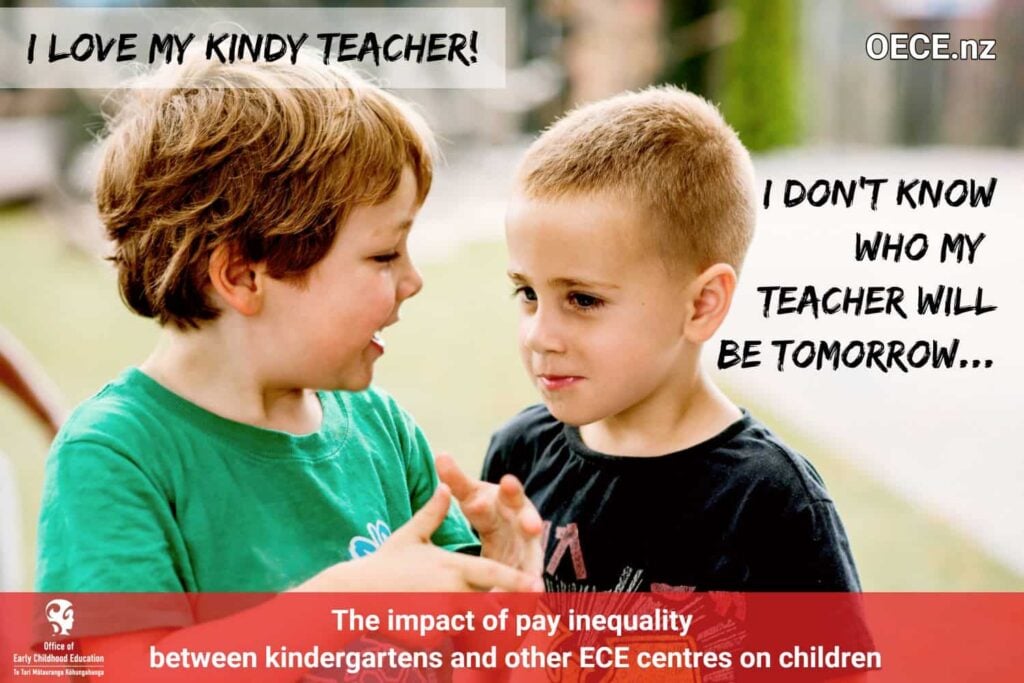
Currently, only ECE teachers employed in free kindergartens receive salaries fully aligned with school teacher pay rates through their collective agreement.
Rule Changes
Recent changes mean fewer teachers must be paid on the pay parity scales, while employers have more flexibility in how they apply pay parity funding.
From October 2024
- Services could count unqualified staff for up to 80 hours per funding period, without showing they had tried to recruit a qualified teacher.
- Relief teachers, casual employees, and teachers not employed on permanent contracts were excluded from pay parity requirements.
From 1 July 2025
- Newly certificated teachers and teachers new to working in the NZ ECE sector could be placed on salary Step 1 regardless of their previous experience or higher qualifications.
- Services could choose to move to lower pay parity funding bands, but not higher ones.
Pay Rate Differences
The highest “Full Pay Parity” salary rates set by the Ministry of Education are now well below the salaries paid to school and free kindergarten teachers.
The pay scales for non-kindergarten ECE teachers have remained unchanged since 1 December 2023, while school and free kindergarten teacher salaries have continued to increase. The table below compares:
- ECE pay parity attestation rates (from 1/12/2023); and
- School teacher salary rates (from 28/01/2027) and kindergarten from 6/04/2027)
Teacher Pay Scales – Full Pay Parity
| Pay Step | ECE | School & Free Kindergarten | Percentage Increase (change) |
| 1 | $57,358 | $64,119 | 11.8% |
| 2 | $59,544 | $66,999 | 12.5% |
| 3 | $61,948 | $69,616 | 12.4% |
| 4 | $64,133 | $73,999 | 15.4% |
| 5 | $67,794 | $78,768 | 16.2% |
| 6 | $71,869 | $83,874 | 16.7% |
| 7 | $76,261 | $90,042 | 18.1% |
| 8 | $81,566 | $95,099 | 16.6% |
| 9 | $85,915 | $102,475 | 19.3% |
| 10 | $92,175 | $107,886 | 17.0% |
| 11 | $96,820 |
School and free kindergarten teachers can also reach the top of their salary scale more quickly. Their pay scale was reduced from 11 steps to 10. This means many ECE teachers now take longer to reach the top salary rate and, when they do, they can still be paid less than their school and free kindergarten counterparts.
Manager/Leader – Full Pay Parity
| Position | ECE | Free Kindergarten | Percentage Increase |
| Relieving Head Teacher | Min wage as not permanent | $114,226 | |
| K2 Head Teacher/ Centre Manager | $101,120 | $116,226 | 14.9% |
| K3 Senior Teacher | $106,427 | $122,139 | 14.8% |
| K4 | $115,123 | $132,827 | 15.4% |
Current Pay Parity Opt-In Salary Scales for Higher Funding
| STEP | Step 1 only | Steps 1-6 | “Extended” Parity | “Full” Parity |
| 1 | $57,358 or $27.58 hr | $57,358 or $27.58 hr | $57,358 or $27.58 hr | $57,358 or $27.58 hr |
| 2 | $59,544 or $28.63 hr | $59,544 or $28.63 hr | $59,544 or $28.63 hr | |
| 3 | $61,948 or $29.78 hr | $61,948 or $29.78 hr | $61,948 or $29.78 hr | |
| 4 | $64,133 or $30.83 hr | $64,133 or $30.83 hr | $64,133 or $30.83 hr | |
| 5 | $67,794 or $32.59 hr | $67,794 or $32.59 hr | $67,794 or $32.59 hr | |
| 6 | $71,869 or $34.55 hr | $71,869 or $34.55 hr | $71,869 or $34.55 hr | |
| 7 | $74,152 or $35.65 hr | $76,261 or $36.66 hr | ||
| 8 | $76,403 or $36.73 hr | $81,566 or $39.21 hr | ||
| 9 | $78,715 or $37.84 hr | $85,915 or $41.31 hr | ||
| 10 | $81,112 or $39.00 hr | $92,175 or $44.31 hr | ||
| 11 | $85,457 or $41.09 hr | $96,820 or $46.55 hr | ||
| K2 (Head teacher – centre manager) | $85,457 or $41.09 hr | $101,120 or $48.62 hr | ||
| K3 (Senior teacher, more than 1 centre) | $106,427 or $51.17 hr | |||
| K4 (Manager of K2 & K3) | $115,123 or $55.35 hr | |||
An indicative hourly rate can be found by dividing the minimum salary level by 2080 (40 hours x 52 weeks)
Myths and Misinformation
Myth 1: Pay parity discriminates against experienced teachers
Reality: Pay parity funding does not prevent services from employing or paying experienced teachers. It was introduced to ensure teachers are paid according to recognised qualification and experience-based salary scales. Before pay parity, many experienced ECE teachers, particularly in some privately owned services, earned little more than the minimum wage despite years of experience.
The real issue is not the pay scales themselves, but whether employers choose to recruit and retain experienced teachers. Pay parity funding recognises experience through higher salary steps. The challenge is ensuring employers use the funding to support and retain experienced teachers, rather than relying primarily on lower-paid staff at the beginning of the salary scale.
Why this myth is harmful: It wrongly blames the pay parity system for workforce challenges and shifts attention away from employer attitudes and decisions about recruiting, retaining, and rewarding experienced teachers. The myth was formed to justify weakening protections that help ensure public funding intended for teacher salaries reaches teachers and recognises their qualifications and experience.
Myth 2: Pay parity is causing ECE service closures
Reality: There is no evidence that services receiving pay parity funding are more likely to close than other services. Some service-provider representatives told the Ministry of Education and the media that pay parity was creating significant financial pressure and contributing to service closures. However, OECE analysis found no evidence that pay parity-funded services faced a greater risk of closure.
A more likely explanation for financial pressure is the declining real value of ECE funding. The Ministry of Education has acknowledged that, by 2022, the real value of the 20 Hours ECE subsidy had fallen by 18 percent compared with 2010. Services operating below capacity because of local competition may also struggle financially. The evidence points to funding, enrolment pressures and other causes, not pay parity.
Why this myth is harmful: It turns teachers into scapegoats for financial pressures caused by other factors. By blaming pay parity, it reinforces the idea that teachers should accept lower pay and poorer conditions to protect service budgets and provider financial interests.
Q&A Pay Parity Explainer
How do I determine my initial pay step?
Go to the official ministry guidance: Calculating pay parity salary steps
Where I can find out which pay parity funding band my centre is on?
See the list of the names of education and care and hospital-based services showing the funding band they have chosen and the minimum salary scales they have committed to paying eligible teachers
If I’m paid a salary but regularly work more than 40 hours should I be paid more?
Yes you should be paid more. The stated salary minimum applies to someone working up to 40 hours, not more than 40 hours. For example, Step 1 minimum pay rate is a salary of $57,358 or $27.58 hour. If a teacher is working 42 hours a week, then for the purpose of salary attestation the employer must be able to show they have paid both the minimum salary amount and $24.69 per hour for any hours above 40. So, someone who works 42 hours a week should be earning a minimum of $57,358.00 + $27.58 +$27.58 = $57,413.16.
My centre is not paying the correct amount or has put me on a lower pay step compared with what I should be on. What can and should I do about this?
Teachers who are not satisfied with what pay step their employer has placed them on can Email: ECE.PayParity@education.govt.nz
A service that is not paying its certificated teachers correctly may be breaching the conditions of the funding it receives. In other words – it is fraudulently claiming funding. To check and report a service email: ECE.funding@education.govt.nz In your email you can ask to be anonymous or to make a protected disclosure.
To check what level of pay parity funding your service may have signed up to receive view: Names of ECE Centres Providing Pay Parity (note that this can change because between pay parity funding rounds a service may choose to drop to a lower level of funding and therefore not be obligated to pay extended or full pay parity).
Are Teachers Allowed to Negotiate for Better Pay than the Minimum Amounts in the Pay Scales?
Yes, and many teachers do negotiate and are paid above their pay step amount. Read: How to ask for more pay and negotiate a pay increase with your employer
Related Information and Resources
ECE Pay Rates & Benefits: Teachers and Centre Managers, Home-Based Educators, Hospital-Play Specialists, and Kōhanga Kaiako
Pay Parity: A Quick History of Achievements (Key Milestones) and Resistance (Opposition)
Teacher Facebook group: Pay Parity and Working Conditions ECE Action Network
Funding: ECE Service Funding Rate Tables
Pay Parity Calculator: Calculating Pay Parity Salary Steps (ministry guidance)
Myth that Pay Parity Causes Centres to Close: Correcting the Record on Pay Parity with the Minister and Ministry
Kindergarten Teacher Pay Parity: Free Kindergarten Teachers Mark Quarter of a Century of Pay Parity with School Teachers