
MoE Guide to Opting-In to Pay Parity and Determining Initial Pay Steps

Search Entire Website
Ministry of Education Pay Parity Guide

Ministry of Education Resources for Pay Parity.
Commentary and Analysis by Dr Sarah Alexander.

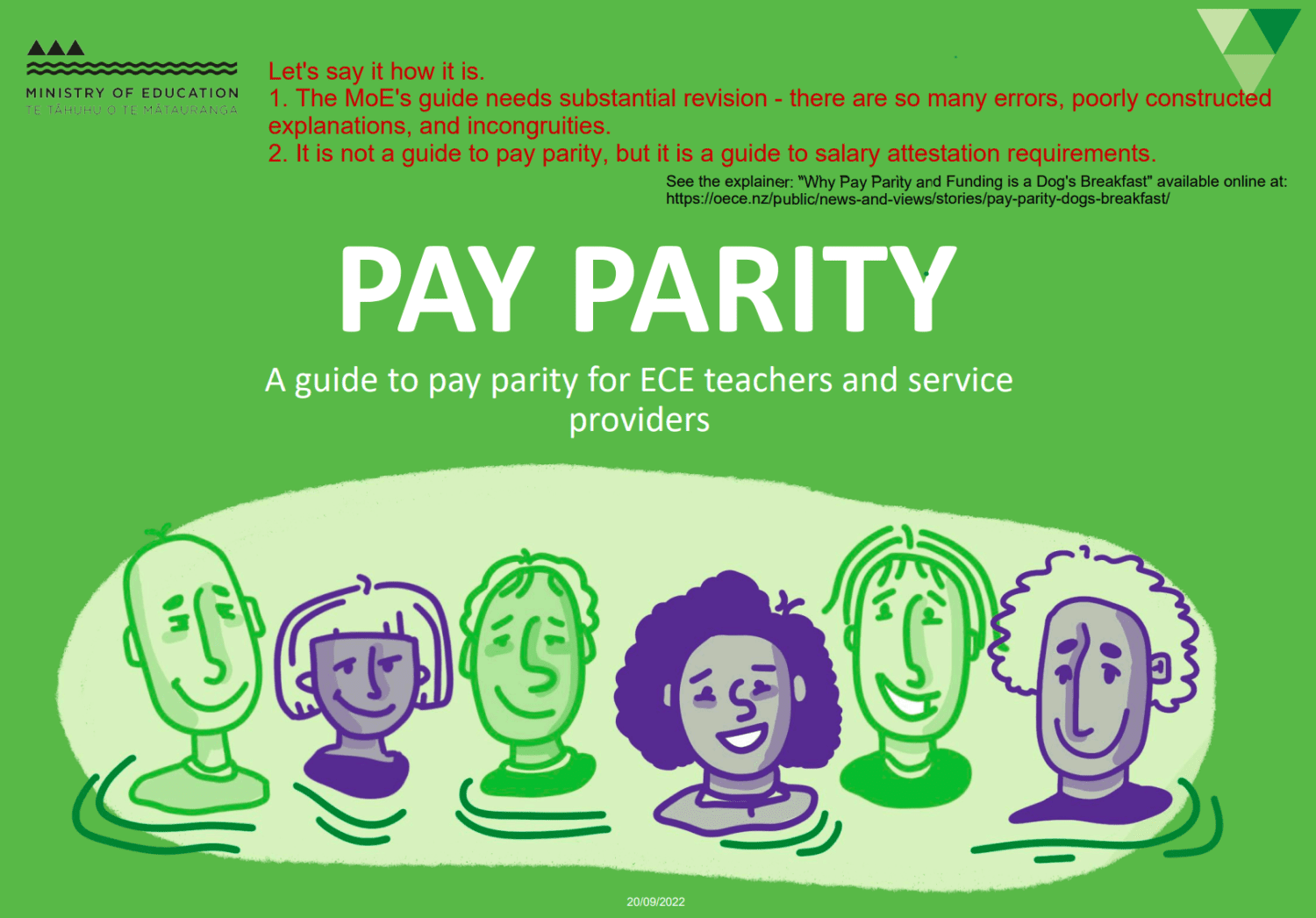
The Ministry of Education has developed a guide to the requirements for opting-in to pay parity and a form to help employers and teachers determine initial salary steps. These resources are shown below (original copies are available from the MoE).

By the ministry’s own admission, the requirements are difficult to navigate. This is not fair on teachers and services. The scheme is messy, confusing, and administratively complex.

A warning before use – the resources have errors, incongruities, and poorly constructed explanations. For example, on page 2 of the teacher salary assessment form, it states:

Note: Steps 7‐11 + management positions is only for people in management positions who have opted‐in to extend parity funding rates.” 

This wrongly implies that only staff in management positions may progress above the ministry’s pay step 6, that the funding rates are parity funding rates, and that funding extends or is higher than the top rate it provides exclusively to Kindergartens Associations.

Below is a copy of the ministry’s guide.  See my doodles on the form above and the guide below for additional insights, thinking points, and for help to spot errors.  

As intelligent reflective practitioners and/or business operators I encourage you to look at the ministry’s materials with critical eyes, know exactly what you are getting into or not, and form your own thoughts and views.

If the ministry had advised the Minister properly as we requested it to, such a messy scheme may not now be in place.  

The ministry followed our advice on using salary attestation as the mechanism for accountability (in the absence of collective employment agreements).  But we also asked the ministry to restore the funding rates that it now only makes available to kindergarten associations back to being ‘teacher-led centre’ funding rates. Service providers had signed agreements in principle to indicate they were willing and ready to provide pay parity using the unified base salary scale for teachers in return for access to the same funding as kindergarten associations.  Should the funding for teacher-led centres not be sufficient for pay parity with schoolteachers then the funding should be revised for all teacher-led centres and not just those owned by Kindergarten Associations. The same funding and the same salary scale for teacher-led centres would help keep it simple and certainly be fairer compared to the dog’s breakfast that the Ministry have created.

PS:  At centres currently paying their teachers at least at the Step 1-5 amounts, teachers who should be above Step 5 do not have to complete 2080 hours of being physically present at work before assessment and placement on the pay step appropriate to their qualifications and experience when Step 6 comes in next year and the option for Step 1–11.

You might also like

Interview ECE Teacher.

Guidance for teachers on asking for more pay, negotiating an increase, how to prepare, and what to expect

Guidance for employers on why, when, and how to do a pay review

How to do performance review appraisals and links to the Teaching Council Standards (this will assist you in meeting salary attestation requirements for deciding whether or not a teacher can progress up a pay step)


Has this been useful?  Give us your feedback.

You are welcome to add a link to this page on your website. Copyright belongs to the OECE so please do not copy any content without our written permission.

Information provided is of a general nature. It is provided ‘as is’, and we accept no liability for its accuracy or completeness. See our Terms and Conditions.

Related Posts

teacher wages, pay scales, in childcare and early childhood education

What ECE Teachers and Workers Earn: Pay, Benefits and Conditions

Anyone thinking about getting a job in ECE working in ECE or thinking about moving to a different service will find clear, practical information in this article about pay rates, employment conditions, and what to expect in different roles. It explains everything from starting salaries and pay‑step calculations to workplace rights, benefits, and how to recognise a supportive, professional environment.

Read More »
early childhood research journal online

Formal Warning Letter and Expressing Concern Letter

Here are templates for a letter ‘of concern’ and a letter giving an early childhood employee a formal first or second warning.

EXAMPLE LETTER OF CONCERN

Private and Confidential

DATE

Dear <Name>

Letter of Concern

This letter is to formally raise our concerns around <insert a general description of the concern, i.e. inapp

This is a member/subscriber only post. To access it, please see the message below for details on access and joining.

Read More »
Resources for early childhood services, professional support, and business help for quality improvement

Building the Real Quality of Your ECE Service

Beyond Regulatory Standards and Expectations to Building Quality.

There seems to be so much to do in trying to provide a quality service, does there not?

Is all your work worth it or could a change in focus and method achieve better results?

To help you to think critically on this consider the following:

Who defines what quality is? A

This is a member/subscriber only post. To access it, please see the message below for details on access and joining.

Read More »
Colours Happy Child

Seven Tips to Ease Back into Work After the Holidays

Going Back to Work.

Here are 7 of the best tips for easing back to work after a holiday or other break away – smoothing the transition for children and others around you.    

Tip 1: Don’t worry, be happy

Children need to see their teachers and carers relaxed, positive and cheerful at the start of a new day and especially at the star

This is a member/subscriber only post. To access it, please see the message below for details on access and joining.

Read More »
NZ International Research in Early Childhood Education journal

Effective Transition to School: Integrating Philosophy, Pedagogy and Curriculum

Research on how primary school classrooms can support children’s transition from early childhood education to the school setting.

FULL REFERENCE: Postlewaight, G. (2018). Effective transition to school: Integrating philosophy, pedagogy and curriculum. NZ International Research in Early Childhood Education Journal, 21(1), 62 – 75.  

Log-in to read the full research paper below. Or order a pdf copy of the article from the main NZIRECE Journal page.

ABSTRACT: Successful transition from early childhood settings to primary school involves a triadic process between children and their families and whānau, the early childhood setting and the school. This case study examines the self-review and subsequent commitment to philosophical and pedagogical changes within one primary school’s transition classrooms, undertaken to ensure the most effective outcomes for children at the school during their time of change and uncertainty. It offers an overview of the metamorphosis from reflecting on transition to a wider vision for growth and development. A focus on learning through play and discovery as a key value led the school to envisage a framework of possibilities for future school-wide reflection and self-review. Research of family and whānau experiences of transition to the school and/ or teacher reflections on their learning and transformation would offer relevant feedback to the self-review.

KEY WORDS: Transition, relationships, learning through play, continuity, communities of learning.

BACKGROUND:

Nelson Park School is a primary school catering for years 1 – 6 (5 to 11 years old) children. The school is situated in Napier, Hawke’s Bay, Aotearoa New Zealand. The Nelson Park School Curriculum [NPSC] (2011) identifies ongoing reflection on pedagogical practice and the implementation of child-centred learning as being key aspects that enhance effective transitions for children. The school promotes continuous learning beginning with a strong focus on successful transition to school from early childhood education settings. The values and beliefs that underpin the culture of learning and teaching at the school encompass a holistic, inclusive approach that enables children to contribute as members of the learning community (NPSC, 2011).

This is a member/subscriber only post. To access it, please see the message below for details on access and joining.

Read More »
The Office of ECE

Share This Information

Table of Contents

Table of Contents

The Office of ECE Login

Take Action!

Help spread this vital ECE information, join our free social and email groups and become a member of OECE.

pay parity funding policy

1. Share This Information

2. Follow Our Social Pages

3. Get Regular Updates

Sign up to our free newsletters.

4. Become a Member

Public Area Categories
Categories