Public-Professional Barriers to Breastfeeding
Drawing on lived experience within the ECE sector, this reflection shows how public‑professional attitudes can undermine breastfeeding despite strong developmental and equity benefits. It’s essential reading for anyone shaping research, policy, or system‑level change in early childhood education.
Public‑Professional Barriers to Breastfeeding, by Sarah Alexander. Published in J. Hicks (Ed.) (2006). Hirkani’s Daughters: Women Who Scale Mountains to Combine Breastfeeding and Working (pp. 252-255). United States: La Leche League International. ISBN 0-976869-2-3.
Introduction
The good thing about being a woman today is that there are fewer obstacles to participation in the world of work. New Zealand was the first country in the world to give women the right to vote. Today all the top government positions in the country are held by women, including a female prime minister.
It is not such a good thing for young children, however, because this usually means reduced opportunity to be breastfed and cuddled by their mothers, especially since there is no widespread support for breastfeeding in New Zealand early childhood services.
One would think that people with knowledge of child development, working in a profession that exists to support families with child care and early education, would be strong advocates of breastfeeding for young children. One would think people in this field would actively support mothers in developing this nurturing bond with their children. Unfortunately that is not the case.
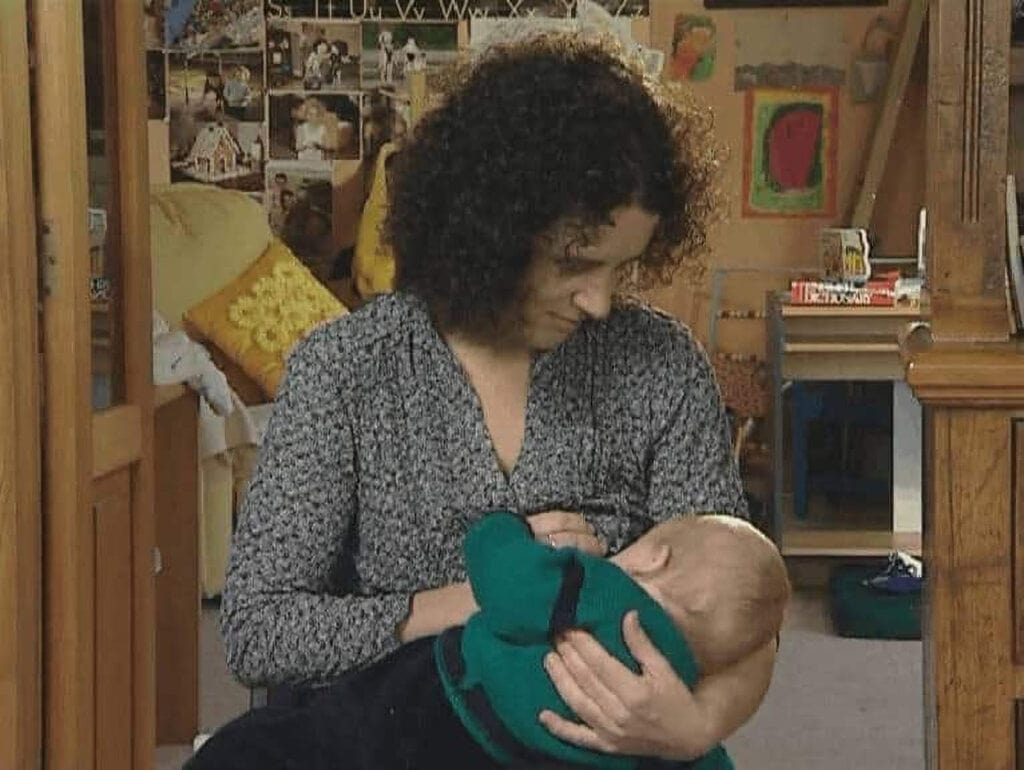
Barriers to Breastfeeding
I have seen the barriers first hand while trying to breastfeed my own children and working in the field of early childhood education.
Of particular surprise were the negative reactions I received to having my baby with me at an early childhood research conference. I was disappointed when I read these comments on feedback forms:
- I would have appreciated it if you could have organised support/child care so that the baby wasn’t at centre-stage.
- Found having a baby on stage distracting. Apart from that, great.
- Creche? (daycare). Difficult to focus when baby is in front of audience.
- I would prefer not have babies, very distracting—also seems unhelpful for the presenter.
I quickly put the comments into perspective with the following thinking:
- If it wasn’t for me, the conference would not have happened in the first place.
- My baby had sat on my hip and been delightful in the two or so hours prior to the opening of the conference when I was running around and organizing. At the end of the day as I put her in her car seat, she gave me a great smile and I knew she had enjoyed it. I felt great about having had her with me.
Because my baby was used to being breastfed on demand, when she wanted to nurse, I fed her. She preferred to fall asleep at the breast. I would not have considered introducing her to artificial formula and feeding from a bottle, not to mention learning to sleep on her own, just so she would be out-of-sight at a conference.
I think some were likely disturbed because I was publicly breastfeeding. Out of an audience of 180, only a small number stated that they had a problem with my baby’s presence.
I also gain perspective by remembering how my feelings about breastfeeding have evolved over time. When I reflect on the 23 years I have been working with young children, teaching the teachers, and researching early childhood education, I feel ashamed of my own lack of recognition of breastfeeding support as a fundamental issue for young children.
It was not until after carrying out a small research study for Dr. Judith Galtry, who was researching breastfeeding and employer support, that I even realised breastfeeding support was an issue in the quality of childcare services.
I assumed that the lack of recognition for breastfeeding support in early childhood education policy was an unintentional oversight. However, I have come to realise that perhaps it’s not.
You see, the history of the growth of the child care movement in New Zealand mirrors the growth of the women’s movement. Any official promotion that required early childhood services to implement supportive breastfeeding policies could be interpreted as a negative blow to the feminist, political, and economic interest in women’s labour market participation.
In other words, if the Ministry of Education or Government came out and said to all early childhood services that they should put in place policies to support mothers’ breastfeeding – or if anyone suggests the possibility that perhaps there should be caution in the recommendation to place young infants in childcare because of issues such as breastfeeding support – it would likely come under heavy criticism. It would be perceived as reinforcing traditional social ideology that women’s role is in the home with baby, and infringing on her right to participate in the labour market. But I’m not in favour of women giving up breastfeeding because they are returning to work. They are unlikely to have support from their childcare service to continue breastfeeding and they do not know that they could be asking that the childcare service be breastfeeding-friendly.
Because of the prevailing cultural beliefs inNew Zealand, encouraging exclusive breastfeeding could be interpreted as a challenge to the political mantra that says good-quality childcare provided by trained professionals can only be helpful and beneficial to children. However, we are not recognizing or acknowledging that a more cautious approach to promoting childcare participation is needed, especially for infants.
We know it is best for infant development and learning to receive one-to-one care, close parental contact, and to be breastfed. Breastfeeding is a major health concern and is a legitimate reason for families to have a genuine choice as to where and by whom their child will be cared for.
Going forward, I would like to see frank and honest discussion of biases surrounding breastfeeding.
About 12 years ago, before having my children, I worked in a position as an early childhood lecturer at a teachers’ college. A female student asked the college director to be allowed to continue her studies and bring her baby to class when it was born. There was a staff meeting to discuss this. The student was considered to be unreasonable in making this request because babies did not belong in class and it was assumed that it would be a disadvantage to other students whose learning would be distracted by the baby’s presence. I sat in silence listening to the discussion and thinking that I needed to find a job somewhere else if I wanted to start a family (I did find a job somewhere else). But I wish I had spoken up and challenged the bias.
I continue to notice at early childhood conferences and other meetings that I go to that it is rare for a young child to be present, and if there is a child it’s usually mine. I still hear people saying things like, “It’s too distracting and not fair on others who attend and want to be able to listen.”
But when I went to a La Leche League Conference last year, I was delighted to see many babies and noted that indeed participants can still have serious discussions. One mother was breastfeeding twins – one on each breast-and she was asking very thoughtful intelligent questions of the presenter.
So to my early childhood colleagues, to education officials, and to the world. I say, “Please recognize that we can and must support breastfeeding for working women.”
Source
For a copy of the original 2007 article go to: J. Hicks (Ed.), Hirkani’s Daughters: Women Who Scale Mountains to Combine Breastfeeding and Working (pp. 252-255). United States: La Leche League International. ISBN 0-976869-2-3.