
Pet Lamb – What You Need to Know

Search in Teacher
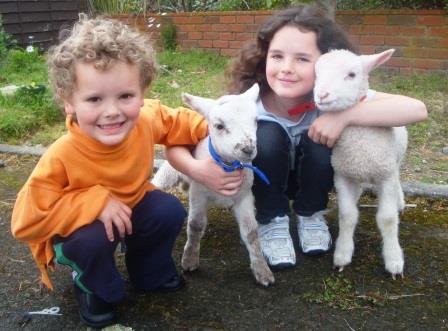
Lambs and young children

TITLE: Pet Lamb – fostering agreements, day-to-care care, benefits for children’s play and learning, and regulatory requirements

Some lambs are sadly orphaned at birth or there may be another reason why a farmer may decide the lamb would be better off to be hand-reared (such as in the case of multiple births and the mum having only one teat).   

Your service could offer to help to hand-rear the lamb.

A lamb gives children a new responsibility.

A lamb is a new playmate and a friend that will love them unconditionally.

A lamb is gentle. It delights in playing but also at times needs to stop and drink or sit down and rest.

This is a pet that is dependent on care for survival and that will teach children to nurture. 

Introducing a pet lamb to your early childhood service is an excellent way to naturally support children to spend more time outdoors running, jumping and skipping and enjoying the spring weather. 

Below we cover aspects of
– How to get a lamb
– Agreements with the farmer and with your children for fostering the lamb
– Preparing for the lamb and what you need

This is a member/subscriber only post. To access it, please see the message below for details on access and joining.
Already a Teacher Member?

Are you teaching and caring for children or studying for an ECE qualification?

If you are, that’s great!   Join us now, and become a teacher member.

Five Reasons to Join Us
1. Professional recognition

It is prestigious to belong to the OECE – you can skite about it! 

Ask us for an OECE Member Certificate, to include in your professional portfolio as proof you are engaged in reading and professional learning that advances your understanding of the relationship between practice and outcomes for children.

2. Extra benefits

No need to pay a subscription fee for access to NZ’s specialist ECE Newsroom – your member login will let you view everything in the ECE Newsroom. 

No need to pay to access the best NZ and international research – your member login gives you free access to the Research Library and support. 

3. Professional growth and no-judgement help

Teaching resources and advice on probably everything you can think of, including what to wear as a teacher, how to ask for a pay raise, identifying child behaviour causes and responding to needs, new play activity ideas, etc., etc.  all of this is at your finger-tips 24/7 whenever you need help or advice – login to view. 

4. Representation

Did you know that the OECE meets personally and regularly with the Ministry of Education national team, and the regulations committee and other forums? 

Political leaders and journalists are able to use the OECE to gain deeper knowledge on a topic or issue, and we provide a sounding board for ideas and feedback.

The OECE promotes safe working environments for teachers.  We also promote the absolute need for full pay parity with school teachers for all certificated teaching staff working in teacher-led centres and in home-based, and whether permanently or casually employed. 

5. Value for Money

We are committed to keeping membership prices affordable and providing value for money. 

Teacher membership is just $89 for a full year, or save by joining for 2 years.

Has this been useful?  Give us your feedback.

You are welcome to add a link to this page on your website. Copyright belongs to the OECE so please do not copy any content without our written permission.

Information provided is of a general nature. It is provided ‘as is’, and we accept no liability for its accuracy or completeness. See our Terms and Conditions.

Related Posts

employment job benefits wages pay

Staff Benefits and Wages Guide

The Staff Benefits and Wages Guide for Employers.

We provide data on usual and common benefits provided to staff, such as discounted childcare, and by which services. Data on pay rates at different services, for staff in different positions and regional variations is also shown below. Because data on pay rates can become dated as soon as it

This is a member/subscriber only post. To access it, please see the message below for details on access and joining.

Read More »
Hands of two toddlers meet as they share blocks.

Pikler and Gerber Theories in Practice

A close look at how well the theories of Pikler and Gerber can be merged with Te Whariki and the models of infant care and education in Aotearoa New Zealand.

Concepts such as ‘self-soothing’ (allowing babies to settle by themselves) and leaving babies to develop in their own time rather than pushing them to meet milestones cause much debate among parents and early childhood educators.

These debates include such things as whether babies should be allowed to cry it out and whether parents or educators should help children to achieve milestones such as sitting by propping them up.

One proponent of allowing a child to develop at their own pace is Emmi Pikler, a Hungarian paediatrician who worked with children aged from birth to six in her role as Director of the Loczy Orphanage from 1946 until her death in 1979.

Pikler believed that infants’ emotional well-being was paramount, and she restructured then entire staff to ensure that all those working at the orphanage not only met the children’s physical needs, but also would ‘love’ these unwanted children and attend to them with consistent and thoughtful care.

This is a member/subscriber only post. To access it, please see the message below for details on access and joining.

Read More »
the importance of touch as part of caregiving and teaching children

Touch in Early Childhood Education: Do No‑Touch Policies Belong?

The article explores how no‑touch policies in ECE emerged and why they continue to shape teacher behaviour, raising important questions about what kinds of touch are appropriate, safe, and developmentally necessary for young children. It’s a thought‑provoking read on how fear and policy can influence caring relationships at the heart of ECE.

Read More »

Share This Information

Table of Contents

Table of Contents

The Office of ECE Login

Take Action!

Help spread this vital ECE information, join our free social and email groups and become a member of OECE.

pay parity funding policy

1. Share This Information

2. Follow Our Social Pages

3. Get Regular Updates

Sign up to our free newsletters.

4. Become a Member