Making Books and Reading Fun

Search in Teacher
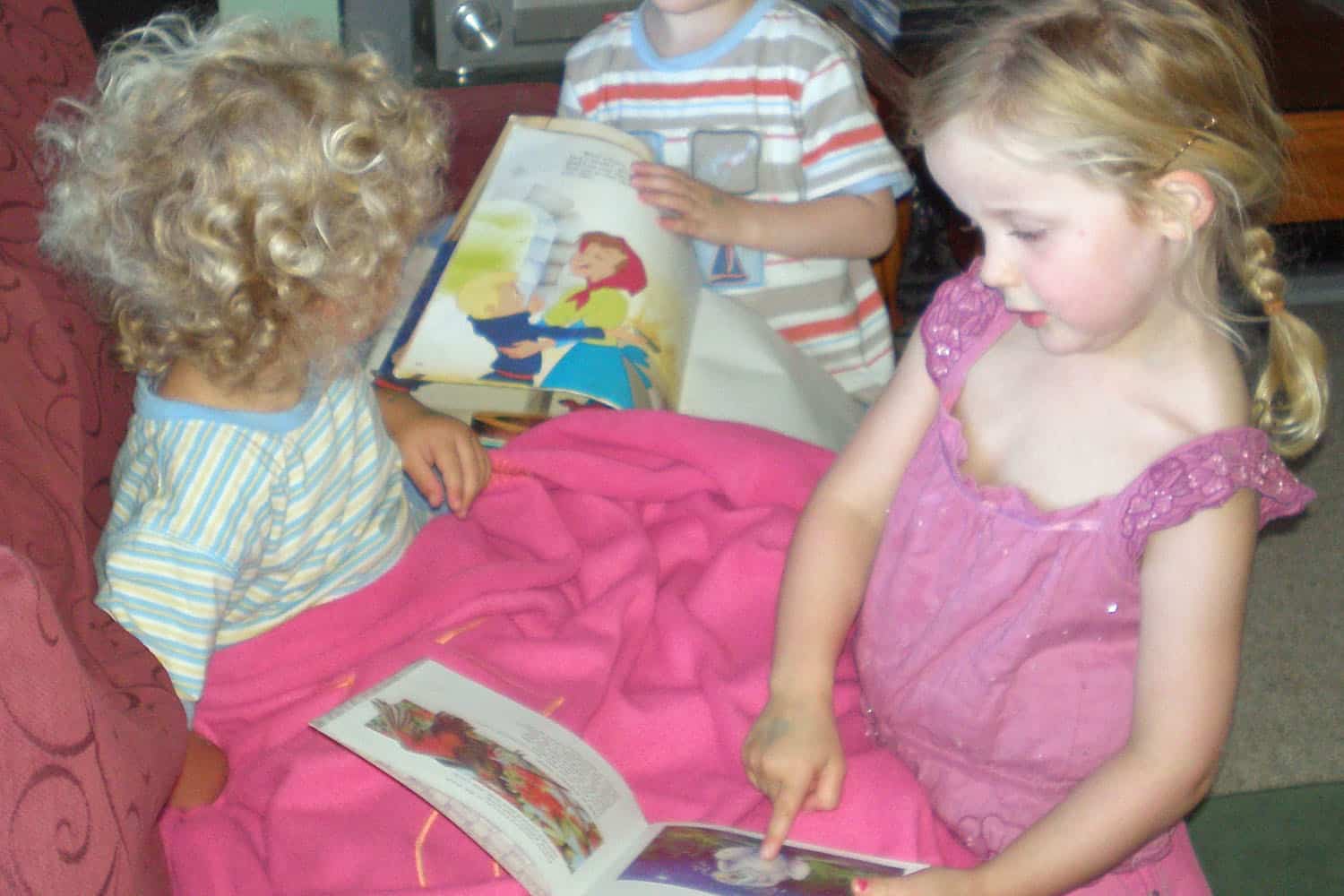
books children reading to each other

Books and Reading Fun. By Barb Morris.

We learn best when we are playing and having fun especially if we are rewarded with smiles, positive comments and cuddles. Children are no exception! So how do they learn? When it comes to reading it is mainly by copying and you, as educators are the most powerful role models that children copy.

This is a member/subscriber only post. To access it, please see the message below for details on access and joining.
Already a Teacher Member?

Are you teaching and caring for children or studying for an ECE qualification?

If you are, that’s great!   Join us now, and become a teacher member.

Five Reasons to Join Us
1. Professional recognition

It is prestigious to belong to the OECE – you can skite about it! 

Ask us for an OECE Member Certificate, to include in your professional portfolio as proof you are engaged in reading and professional learning that advances your understanding of the relationship between practice and outcomes for children.

2. Extra benefits

No need to pay a subscription fee for access to NZ’s specialist ECE Newsroom – your member login will let you view everything in the ECE Newsroom. 

No need to pay to access the best NZ and international research – your member login gives you free access to the Research Library and support. 

3. Professional growth and no-judgement help

Teaching resources and advice on probably everything you can think of, including what to wear as a teacher, how to ask for a pay raise, identifying child behaviour causes and responding to needs, new play activity ideas, etc., etc.  all of this is at your finger-tips 24/7 whenever you need help or advice – login to view. 

4. Representation

Did you know that the OECE meets personally and regularly with the Ministry of Education national team, and the regulations committee and other forums? 

Political leaders and journalists are able to use the OECE to gain deeper knowledge on a topic or issue, and we provide a sounding board for ideas and feedback.

The OECE promotes safe working environments for teachers.  We also promote the absolute need for full pay parity with school teachers for all certificated teaching staff working in teacher-led centres and in home-based, and whether permanently or casually employed. 

5. Value for Money

We are committed to keeping membership prices affordable and providing value for money. 

Teacher membership is just $89 for a full year, or save by joining for 2 years.

Has this been useful?  Give us your feedback.

You are welcome to add a link to this page on your website. Copyright belongs to the OECE so please do not copy any content without our written permission.

Information provided is of a general nature. It is provided ‘as is’, and we accept no liability for its accuracy or completeness. See our Terms and Conditions.

Related Posts

NZ International Research in Early Childhood Education journal

Communities of Learning: Promoting Equity in ECE Policy and Practice

FULL REFERENCE: Hohaia-Rollinson, F., Jena-Crottet, A., Illston, K., Malcolm, J., Purdue, K. and Tate, A. (2021). Communities of learning: Promoting equity in ECE policy and practice.  NZ International Research in Early Childhood Education Journal, 23(1), 39 – 51.

Log-in to read the full research paper below. Or order a pdf copy of the article from the main NZIRECE Journal page.

ABSTRACT: Aotearoa New Zealand’s He Taonga te Tamaiti, Every Child a Taonga: Early Learning Action Plan 2019–2029 emphasises the right of every child to a high-quality, inclusive early childhood education. However, Education Review Office reports and research show that many children from a variety of diverse backgrounds are still not experiencing high-quality early childhood education (ECE) teaching and learning environments, which puts them at increased risk of poor educational and life outcomes. The role that initial teacher education and early childhood services play in preparing and supporting ECE teachers and kaiako to honour diversity, inclusion, equity and social justice in their pedagogy is therefore vitally important. In these communities, as in other education communities, the success of that role relies on the sharing of research, knowledge, exemplars, and resources. This article offers several equity-related discussion points and ideas for members of those communities as they work together to advance equitable educational opportunities for all tamariki/children.

Key words: Equity, He Taonga te Tamaiti, advocacy, initial teacher education.

This is a member/subscriber only post. To access it, please see the message below for details on access and joining.

Read More »
early childhood teacher with infants

Men in ECE Invitation Award

The Men in ECE Invitation Award invites men to discover a rewarding career in early childhood teaching. If you enjoy working with children, want a meaningful job that makes a real difference, and are curious about teaching, this award can help you start your training and join a supportive, professional community.

Read More »
NZ International Research in Early Childhood Education journal

Field-Based Early Childhood Student Teachers – Who Are They and What Challenges Do They Face?

This research examines the demographic characteristics of students who choose to do field-based early childhood education teacher training and identifies challenges they face in relation to gender, career choice and academic expectations.

FULL REFERENCE: Dunham, N. (2017).  Field-based early childhood student teachers – who are they and what challenges do they face? NZ International Research in Early Childhood Education Journal, Special Issue: Early Childhood Teachers and their Work, 20(2), 50-65.

Log-in to read the full research paper below. Or order a pdf copy of the article from the main NZIRECE Journal page.

ABSTRACT: In Aotearoa New Zealand, early childhood teachers practice within a contestable landscape in which their value and worth is regularly questioned. Early childhood education (ECE) is associated with discourses of women’s work, quality and career choice. The perception within such discourses being that ECE is a female dominated field, with few men entering the work force as early childhood teachers. In addition, changes in the credentialing of early childhood teachers in New Zealand is associated with issues of quality and professionalisation, which have been significantly influenced by calls for pay parity with primary school counterparts, and associated challenges in minimal qualification requirements. Finally, as a career choice, ECE is associated with rates of high attrition and poor working conditions, which impact on quality provision. This paper draws on the findings from PhD research into student academic identity. The paper specifically focuses on the student demographic and associated challenges facing students of early childhood field-based initial teacher education. Using an interpretive qualitative research design, data was collected from students, teacher educators and associate teachers involved in early childhood field-based initial teacher education. Data from open-ended surveys, focus groups and individual interviews was analysed using thematic analysis informed by the principles of grounded theory. Documentary analysis associated with the wider socio-political context of early childhood education in Aotearoa New Zealand was also undertaken. The findings highlight challenges in relation to gender, career choice and academic expectations in early childhood education. 

KEY WORDS: Field-based; early childhood; academic identity; credentials; characteristics.

INTRODUCTION

The credentialing of teachers in the early childhood sector in Aotearoa New Zealand has faced a turbulent history, which remains unsettled. Participation in quality early childhood education is politically regarded as critical to building firm foundations for children’s later learning and development (Ministry of Education, 2002). Credentialing of early childhood teachers is seen as a contributing factor to this quality provision (Ministry of Education, 2002). However, this credentialing remains open to the whim of Governmental preferences. The aim of this paper is to discuss the student teacher demographic and associated challenges facing the field of early childhood education. Attention will be given to teacher credentials, with particular attention to field-based programmes of study and student academic identities.

This is a member/subscriber only post. To access it, please see the message below for details on access and joining.

Read More »
NZ International Research in Early Childhood Education journal

Pedagogical Development in Long Day Care Centres

The results of an investigation into the efficacy of a suite of different learning options for teachers and leaders/ directors intended to improve preschool programme quality.

FULL REFERENCE: McInnes, E., Whitington, V., Colmer, K., Sisson, J. & Scales, M. (2017). A multi-dimensional approach to pedagogical development in long day care centres. NZ International Research in Early Childhood Education Journal, 20(1), 46-58.

Log-in to read the full research paper below. Or order a pdf copy of the article from the main NZIRECE Journal page.

ABSTRACT: Since 2013 Australian Long Day Care Centres have offered universal access to four year olds to a preschool programme for fifteen hours per week, led by a four year early childhood degree qualified teacher. The South Australian Department for Education and Child Development funded research and consultancy to strengthen universal access to preschool programmes in child care centres. This study reports on a project developed by Gowrie SA and the University of South Australia. The aim of the research reported in this paper was to investigate the efficacy of the suite of learning options intended to improve preschool programme quality. The project used an action research approach with multiple learning options offered to directors, teachers and other educators to establish site-based Professional Learning Communities. The University of South Australia investigated the suite of learning options using both qualitative and quantitative data with the aim of determining their efficacy. This paper reports on that investigation. The engagement of directors in pedagogical leadership was found to be vital to creating teamwork and enabling early childhood teachers to work in collaboration with a group of educators. Teachers and directors engaged in critical reflective practices, resulting in curriculum innovations that were integrated into preschool programmes. This paper argues that both centre leadership, and educators’ extended engagement in professional learning communities are central to transforming Long Day Care Centres to become effective providers of universal access to preschool programmes.

Key words: Preschool programmes; leadership; professional learning; action research.

INTRODUCTION

In 2014-15 early childhood professional learning provider, Gowrie SA, and the University of South Australia were funded by the Department for Education and Child Development to develop a capacity-building project to support the implementation of early childhood degree qualified teacher-led preschool programmes in UA settings. This article reports on an evaluation of a multi-faceted strategy to support Long Day Care Centres’ (LDCC) integration of ECTs following the establishment of preschool programmes in these sites. The federal Universal Access (UA) preschool programme funds state education departments to provide all four year olds with access to 15 hours preschool programme, 41 weeks per year, regardless of whether children attend stand-alone preschool sites or long day care centres operated by private or community sector providers. The policy requires that programmes be led by a four year bachelor qualified early childhood teacher (ECT), working with LDCC directors and other Diploma and Certificate qualified educators to implement the preschool programme. In South Australia the Department for Education and Child Development (DECD) has carriage of implementing the UA programme..

This is a member/subscriber only post. To access it, please see the message below for details on access and joining.

Read More »

Share This Information

Table of Contents

Table of Contents

The Office of ECE Login

Take Action!

Help spread this vital ECE information, join our free social and email groups and become a member of OECE.

pay parity funding policy

1. Share This Information

2. Follow Our Social Pages

3. Get Regular Updates

Sign up to our free newsletters.

4. Become a Member