COVID-19’s Effect on Child Participation in ECE

Search Newsroom Posts
Ministry of Education graph

December 16, 2020.

This week the Ministry of Education released a report on Covid-19 ECE participation.

It shows that parents and the ECE services from which data was used in the analysis (namely teacher-led centres, playcentres, and home-based ECE) in general followed the rules and did what the government told them to do in respect of ECE usage at each of the COVID-19 Alert Levels. 

Participation in these service types was found to have returned to normal levels for most children over Alert Level 1.Ministry of Education graph
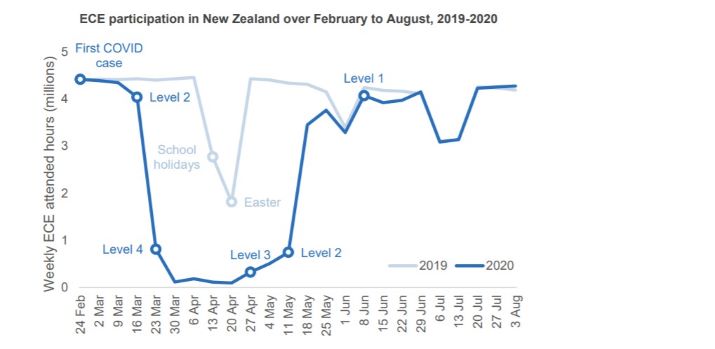
The number of children attending ECE this year marginally decreased because fewer new children have entered.  But overall, the children who were in ECE before the March lockdown have not dropped out.

The participation of Pacific and Māori children was lower due to COVID-19 and participation rates at low EQI services were most affected. Attendance rates for Pasifika children in Auckland took longest to recover compared to Asian, Pākehā and Māori children.

The report states:

“There is an indication that recovery in participation is taking longer for Pacific and Māori children, as well as children in low EQI services. These differences are far larger in Auckland than non-Auckland regions, and apply to three- and four-year olds, as well as younger children. This provides ample evidence that the educational effects of this pandemic are not borne equally across society.

However, the report then cautions against jumping to conclusions:

“Data available at the time of writing do not yet give us a reliable picture of participation in Auckland since the recent transition to Level 1, so it is possible that many of these concerning findings will have already improved.”

Puzzling is why the Graph does not show a flat weekly attendance rate when all ECE services across the country were compulsorily closed – from March 26th to April 28th.

The report provides no evidence to substantiate its claim that reduced participation due to COVID-19 negatively impact on children’s learning or on their longer-term educational outcomes. 

To the contrary it could be argued, for example, that:

  • child health outcomes were better – children get sicker when attending ECE – take the recent norovirus outbreak in a number of Auckland ECE centres for example.
  • learning opportunities continued and were different for children. We know from child development research that children’s learning is strengthened when parents are involved. Children whose parents were not essential workers, had an increase in time to spend with their parents to do activities, games, go for walks, and do activities they might ordinarily not do when in ECE like helping to paint the shed or cooking at the stove with their Dad.
  • restricting child numbers in services at Alert Level 3 benefited children educationally. When services could re-open but attendance was limited to those parents who needed to use ECE, the small classes or bubble sizes were loved by teachers and children alike – resulting in having time to form relationships, and strengthening teaching and learning.

The rules imposed on child attendance

Until 23rd March there was no Covid-19 ECE participation restrictions – apart from general advice to stay home if unwell.

On Tues 24 & Wed 25 March, only the children of essential workers were permitted to attend ECE.  The lockdown took effect from midnight on Wed 25 March.

From Thurs 26th March all ECE services were shut and no child could attend ECE.

From 28th April under Alert Level 3 all ECE services were permitted to begin re-opening except for Playcentres.

  • Parents were however advised to use ECE only if they needed to. 
  • Parents who used two ECE services for their child (e.g., a combination of kindergarten and home-based ECE) could use only one.
  • ECE services with limited space and/or staffing had to restrict the number of children who could attend at any time due to an increase in the minimum space requirement per child and a new requirement for children to be cared for in group bubble or class sizes of no more than 10 children for the first week and then increasing to a maximum of 20 children.

You can still find the ECE Covid-19 alert page here if you would like to take a read down memory lane.

Already subscribed?
ECE Newsroom

NZ’s own specialist ECE newsroom. 
Access national and local stories, in-depth analysis, & original commentaries.  

Membership Support for Teachers & Educators

(Comes with free Newsroom and Research access)

Membership Support for ECE Service Owners, Managers, & Community Organisations

(Comes with free Newsroom and Research access)

Researchers & Tertiary Education Libraries

Full access to over 25 years of ECE academic research articles – NZIRECE Journal.
Plus, guidance and resources on doing and publishing research

Has this been useful?  Give us your feedback.

You are welcome to add a link to this page on your website. Copyright belongs to the OECE so please do not copy any content without our written permission.

Information provided is of a general nature. It is provided ‘as is’, and we accept no liability for its accuracy or completeness. See our Terms and Conditions.

Related Posts

teacher wages, pay scales, in childcare and early childhood education

What ECE Teachers and Workers Earn: Pay, Benefits and Conditions

Anyone thinking about getting a job in ECE working in ECE or thinking about moving to a different service will find clear, practical information in this article about pay rates, employment conditions, and what to expect in different roles. It explains everything from starting salaries and pay‑step calculations to workplace rights, benefits, and how to recognise a supportive, professional environment.

Read More »
early childhood research journal online

Whiteness Scholarship in Early Childhood Education

Research on how racism and ‘whiteness’ operates within the early childhood research site and research processes. It shows ways that researchers and educators reinforce, rather than reduce the impacts of whiteness and racism, despite the best of intentions.

FULL REFERENCE: Miller, M.G. (2016). Whiteness scholarship in early childhood education. NZ Research in Early Childhood Education Journal, Special Issue: Equality and Diversity, 19, 61 – 77.

ABSTRACT: This paper explores how whiteness scholarship can support deep engagement with both historical and contemporary forms of whiteness and racism in early childhood education. To this point, the uptake of whiteness scholarship in the field of early childhood has focussed predominantly on autobiographical narratives. These narratives recount white educators’ stories of ‘becoming aware’ or ‘unmasking’ their whiteness. In colonising contexts including Australia, New Zealand and Canada, understanding how whiteness operates in different ways and what this means for educational research and practice, can support researchers and educators to identify and describe more fully the impacts of subtle forms of racism in their everyday practices. In this paper, whiteness is explored in a broader sense as: a form of property; an organising principle for institutional behaviours and practices; and as a fluid identity or subject position. These three intersecting elements of whiteness are drawn on to analyse data from a doctoral study about embedding Aboriginal and Torres Strait Islander perspectives in early childhood education curricula in two Australian urban childcare settings. Analysis is focussed on how whiteness operated within the research site and research processes, along with the actions, inaction and talk of two educators engaged in embedding work. Findings show that both the researcher and educators reinforced, rather than reduced the impacts of whiteness and racism, despite the best of intentions.

Key words: Aboriginal and Torres Strait Islander; early childhood; racism; whiteness.

Introduction

Whiteness scholarship is an interdisciplinary field aimed at examining whiteness as a social construction. Influenced by critical race theory, cultural studies and postcolonial studies, whiteness scholarship examines interconnected issues of identity, ethnicity, race, colonialism, power, and subjectivity (Apple, 2004; Ryden & Marshall, 2012). The central tenet of whiteness scholarship is disputing a scientific basis of ‘race’. Instead, whiteness is described as an assemblage of social effects and discursive processes that are historically located and socially contingent (Apple, 2004; Moreton-Robinson, 2008; Ryden & Marshall, 2012). Put another way, whiteness operates on social, institutional and individual levels, and is flexible and adaptable dependent on time frames and geographic locations.

This is a member/subscriber only post. To access it, please see the message below for details on access and joining.

Read More »
Resources for early childhood services, professional support, and business help for quality improvement

Building the Real Quality of Your ECE Service

Beyond Regulatory Standards and Expectations to Building Quality.

There seems to be so much to do in trying to provide a quality service, does there not?

Is all your work worth it or could a change in focus and method achieve better results?

To help you to think critically on this consider the following:

Who defines what quality is? A

This is a member/subscriber only post. To access it, please see the message below for details on access and joining.

Read More »
take children to visit the library

Library Trip

Library Trip with Children.

Going to the library is a great activity to do either on your own with a child or small group of children, or as a group visit with your early childhood service.

Maybe you will walk there. Or take the bus? It might be something that you do weekly or monthly to take out and return books.

The most obvious thing y

This is a member/subscriber only post. To access it, please see the message below for details on access and joining.

Read More »
The Office of ECE

Share This Information

Table of Contents

Table of Contents

The Office of ECE Login

Take Action!

Help spread this vital ECE information, join our free social and email groups and become a member of OECE.

pay parity funding policy

1. Share This Information

2. Follow Our Social Pages

3. Get Regular Updates

Sign up to our free newsletters.

4. Become a Member