Why the Early Childhood Council is Causing Anxiety in the Sector

Search Newsroom Posts
bullying sign

Why the ECC is Causing Anxiety in the Sector

Tuesday, 17 Sept 2024. (UPDATE: On 18 Sept the ECC released its submission)

The Early Childhood Council (ECC) is causing anxiety in the early childhood sector as details of its submission to the Ministry for Regulation are emerging (Radio NZ’s news report).  These details include a request by its approximately 900 centre owners or providers to:

  • Restrict subsidy amounts paid to centres to a six-hour day because they believe it doesn’t matter if children attending different hours receive sub-standard care.
  • Drop adult-child ratio rules because they believe it is inefficient to have staff cover for teacher breaks and they can breach minimum ratios without the Ministry of Education finding out.
  • Not allow families, staff, and members of the public who alert the Ministry of Education to problems within centres to have anonymity and make protected disclosures.
  • Remove kindergartens from the Education Service, which would mean that their collective employment agreement would become null and void.
  • Remove funding that’s in place to support progress toward delivering pay parity with kindergarten and school teachers so employers would not be obligated to pay any higher than the minimum adult wage to qualified teachers with a current practising certificate.  
  • Be supported by government to offer cheap poor-quality care – large numbers of children, less qualified teachers, few adults for child supervision.

Anxiety about the Early Childhood Council’s submission is understandable because the ECC has successfully lobbied Minster Seymour already for reductions in regulations and teacher pay.

Why isn’t the ECC sharing its submission?

The Early Childhood Council is bound by its constitution to promote the interests of privately-owned centres and their owners. It has kept its submission secret from the sector (and according to some of its members they haven’t seen the full submission either).

Until the ECC makes its full submission available it’s not possible for the Office of ECE to critique it.

For now, it falls on the shoulders of the ECC’s members, and the teachers employed by them, to speak up if they are not comfortable with what the ECC says they want.

What we at the Office of ECE have called for

We argue that that regulation is important for all hours that children attend an ECE.  Deregulating the ECE sector would place children at significant risk. 

The Office of ECE has called for regulations and requirements to be strengthened including for ratios, improved support for ECE qualified teachers, and the introduction of regulations for group or class size to reduce overcrowding and improve educational, mental health and physical health outcomes.

The OECE submission titled the: “Economics of Early Childhood Education Regulations” can be found online here.

Fund and forget is not an appropriate strategy for NZ’s ECE sector. Funding services but leaving the setting and monitoring of standards up to ECE providers whose main focus is maximising revenue will not work for children and families or benefit the economy.

A baby farming scandal and crisis over the care of young vulnerable children led to the promulgation of the Child Care Centre Regulations on the 7th November 1960. 

Stripping out regulations and returning to the days of back-yard quality of care will risk children’s safety, success in education, and lives. 

It will also cost our country millions of dollars more in the end in health, corrections, and economic productivity.

See: Economics of our Early Childhood Education Regulations – What you need to know


Additional information from Minister Seymour and Early Childhood Council

Early Childhood Council political lobbying with Minister David Seymour
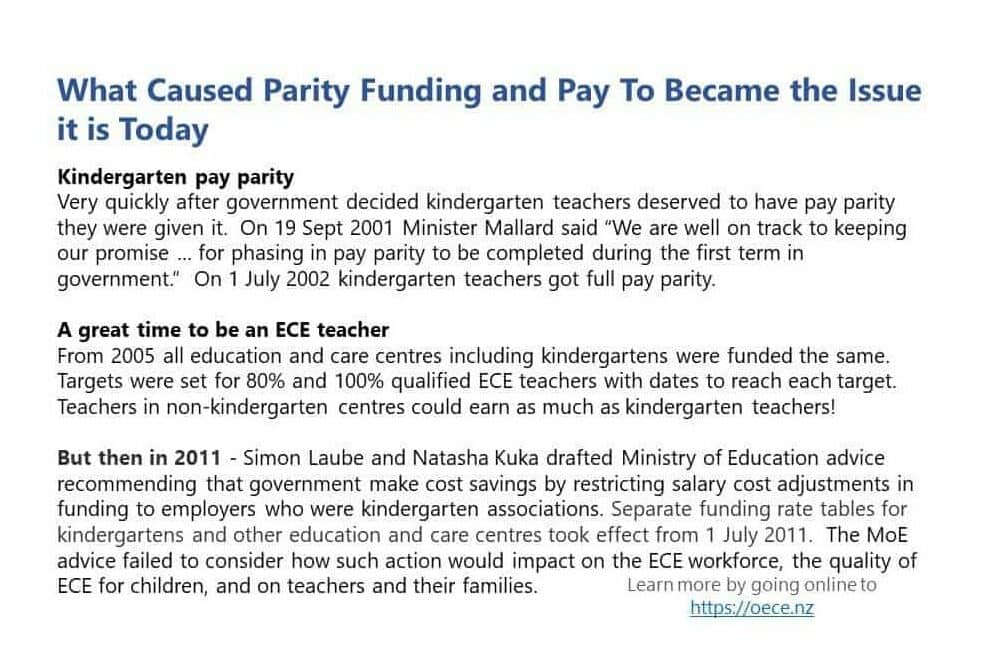
Early Childhood Council opposes pay parity for teachers employed by its members. Simon Laube, the ECC's chief executive, advised government back in 2011 to stop making salary cost adjustments in funding to employers of ECE teachers in education and care centres.
Today Simon Laube is CEO of the Early Childhood Council, that opposes pay parity
Already subscribed?
ECE Newsroom

NZ’s own specialist ECE newsroom. 
Access national and local stories, in-depth analysis, & original commentaries.  

Membership Support for Teachers & Educators

(Comes with free Newsroom and Research access)

Membership Support for ECE Service Owners, Managers, & Community Organisations

(Comes with free Newsroom and Research access)

Researchers & Tertiary Education Libraries

Full access to over 25 years of ECE academic research articles – NZIRECE Journal.
Plus, guidance and resources on doing and publishing research

Has this been useful?  Give us your feedback.

You are welcome to add a link to this page on your website. Copyright belongs to the OECE so please do not copy any content without our written permission.

Information provided is of a general nature. It is provided ‘as is’, and we accept no liability for its accuracy or completeness. See our Terms and Conditions.

Related Posts

The OECE is celebrating high quality NZ early childhood education services.

Ways to Be the Best – Paths to Quality

Five Paths to Quality Improvement.

Do you want to grow and develop a service that is unique?

Would you like to see parents shouting from the rooftops about how great your service is?

Would you like to future-proof your service to help it continue to be one of the best in your local community, or even in the whole of NZ?

Aim for

This is a member/subscriber only post. To access it, please see the message below for details on access and joining.

Read More »
children writing drawing homebased

‘Learning Notes’ – An Alternative to Doing Learning Stories

Learning Notes.

In most early childhood education (ECE) settings children’s learning is assessed using the Learning Story technique. 

Dr Ken Blaiklock

However there has been criticism of this form of assessment with some people arguing it does not give an adequate picture of a child’s development.

In contrast to Learning Stor

This is a member/subscriber only post. To access it, please see the message below for details on access and joining.

Read More »

Picky Eaters and Managing Children’s Eating Habits

Picky eaters? Some children may display anxiety and unhealthy eating habits when they begin early childhood education, others may display behaviours at different times that you are wondering if these are normal, and what to say, do and change.  

This article covers:

The adult’s role in providing for children’s food preferences and eating b

This is a member/subscriber only post. To access it, please see the message below for details on access and joining.

Read More »
Children with steering wheel and fire engine in the early childhood centre playground.

Making Signs as Part of Play

Making signs enriches play and learning.

All around us are signs – what ones can you see?

Signs can be used to tell us what to do like “stop” and “give way” on the road.

They can be used to let us know about dangers (e.g. “wet floor”) and to make announcements (e.g. “cooking at 2pm today”).

Signs can also be used to labe

This is a member/subscriber only post. To access it, please see the message below for details on access and joining.

Read More »
The Office of ECE

Share This Information

Table of Contents

Table of Contents

The Office of ECE Login

Take Action!

Help spread this vital ECE information, join our free social and email groups and become a member of OECE.

pay parity funding policy

1. Share This Information

2. Follow Our Social Pages

3. Get Regular Updates

Sign up to our free newsletters.

4. Become a Member