

Full Pay Parity Salary Scales at Last! How to Make the Funding Work
22 August 2023.
There are new pay scales for full pay parity. Services that opt into the kindergarten funding rate must attest to paying their teachers the full kindergarten pay scale.
Other funding options linked to no salary attestation requirement (base funding), and ersatz or fake pay parity (oddly given the names by the MoE of “parity” and “extended pay parity funding”) rates will continue to be offered.
Go to:
- Funding rates – Appendix 1 of the Funding Handbook
- Salary scales – Appendix 4 of the Funding Handbook
Cabinet promised (Budget 2023 announcement) from 1 November 2023 the same funding that kindergartens are paid for full pay parity will also be paid to all centres that opt-in to pay their teachers on the full kindergarten scale.
But in the Funding Handbook we see that most rates are not identical, although in many cases the difference is only one cent it is still a difference.
Kindergarten teachers have yet to have their pay scales adjusted to reflect the new pay agreement for Secondary teachers (See the next section on base salary scale).
We would like to see all qualified teachers who work in ECE have pay parity with their primary school counterparts, and not just those lucky to be employed by a centre that has chosen to opt in to provide full pay parity.
Regarding whether centres can make the funding work, or not, and pay their teachers on the full teacher pay scale:
- Funding allows ratios to include 100% qualified and certificated teachers.
- Centres that choose to employ more qualified teachers over the ratio requirement and outside of the number of teachers needed to cover staff breaks and lunch-times may find they are still better off particularly if they have a mix of newly qualified and experienced teachers. This is because the funding amount paid to centres is the same for every centre whether they have a teacher on the bottom or the top of the pay scale.
- The complaints we hear are mainly from for-profit centre owners who have high overheads, and often have leases that are adjusted annually for inflation plus an additional one or two percent. The challenge is to adjust their financial operations – that is the nature of businesses.
Talking with four different private owner operators who have opted into the current extended pay parity scheme and have above minimum adult-child ratios for staffing, they have each been surprised to find that for the first time for quite a few years they are no longer just scrapping by and now actually have some money to spare. They have told us they are glad they made the move to extended pay parity funding.
We encourage all teacher-led ECE centres to sign-up for full pay parity funding. Managers and owners may be too busy to make the decision now, but that disadvantages your teachers, and ultimately leads to retention and recruitment issues that impact on the quality of education provided to children.
Looking Back to Understand the Current Context
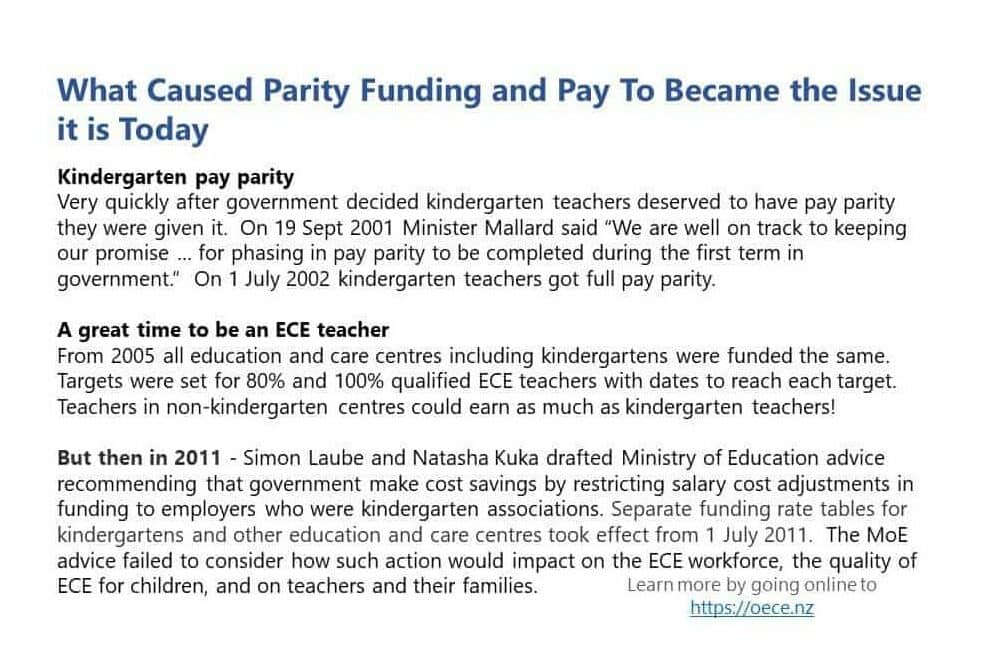
After so many years of not having funded adjusted for salary increases and being treated as ‘daycare’ or ‘early learning’ and not as ‘education’ the government knows that not every centre will be able to make the move, be bold, and say “yes” to being funded at the same level.
Those centres that opt-in are very likely to find themselves financially better off under the higher kindergarten funding rates.










9 Responses
Hi, I have a query/dilemma that other small centres have as well. How are we supposed to apply the pay scales in a distributed leadership model……management pay scale would be totally unaffordable
Having a distributed leadership model is lovely and something you may want to keep.
With a distributed leadership model, how do you currently work it out to meet the ‘person responsible’ requirement as you need to have a designated PR?
Could the management salary be paid for a set number of hours per week/fortnight to each staff who are leaders that also have management responsibility? E.g. on Mondays one staff is ‘the manager’ in terms of wage rate, on Tuesday another staff is the ‘manager’ for wage rate … Each get a proportion of the higher salary (management rate) in recognition of their higher responsibilities for a proportion of their work hours across the week/fortnight ??
Sounds like a fair idea….but do you think that would legally justify ticking the ‘full parity’ box in the upcoming R7? So far I have been the designated PR when I am here but when I went on an extended holiday recently one of my colleagues took on that role…..or another teacher when she was absent. When I talk about distributed leadership here I actually also include a longstanding, skilled and very valued kaiako who happens to be un-certificated….and thus can’t be a designated PR. By the way, we have a very high ratio and operate with 100% qualified.
I am happy for any further suggestions….especially as I am planning to retire (as in reducing my hours of being actively in the environment but still managing the overall running of the centre, financial, budgeting etc) and maintain my role as director. Hope this makes sense.
Perhaps Gundula, if you can I suggest keeping it as simple/ uncomplicated as you can. Decide who (if it is you) is the designated centre manager. When the centre manager is not in the centre for say or a day or a few hours, any certificated teacher can act as the PR, and I suggest (though not legally required) that you give an extra payment to staff for the periods of time that they take on responsibility. When you or whomever the centre manager goes on leave or extended absence, then have a relieving manager who is paid at least at the pay parity amount.
Hi Gundula, I am not sure if its ok for me to comment or not, but I thought as I also own a small centre operating a distributed leadership approach I might be able to help.
We have a person Responsible policy and guidelines, which those who qualify and want to, have signed. in my absence they take turns at being person responsible and in return are paid an extra $2 per hour on those days.
It seems to be working well, and I am now able to see clearly where the leadership strengths are in my team, for example having just been on holiday for a couple of weeks, I left the centre in the hands of the teacher I felt most comfortable to make the big decisions in my absence. ANd everything ran smoothly.
I work from home two days a week also, and this means the team have plenty of opportunities to experience this leadership model, with my support and guidance on the end of the phone.
It works really well for us, and while I haven’t had a detailed look into these new rates yet, at this stage, I cant see why we couldn’t keep with this system.
I too am a small nonprofit centre. We are 100% qualified. Something I don’t understand is full pay parity with kindergartens who are 100% qualified yet ECE centres have no such requirement. This will favour those big multi-centred ECE’s who have a minimum of qualified, experienced teachers yet they will receive full funding. Once again, not fair to hard working small centres. I would have thought in order to receive full pay parity any centre should have 100% qualified teachers just like kindergartens!!! Now the government seems to be reversing that discrimination and requiring kindergartens to be fully qualified but not ECE’s who receive the exact same funding.
Hi Laurie, I checked and there are kindergartens in kindergarten associations funded for less than 100% qualified because in a funding period they have not met the funding rules for 100% qualified. There is no legal requirement for kindergartens that are licensed as all-day centres to have 100% qualified teachers. Back in the day kindergartens licensed as sessional centres were legally required to have 100% ECE qualified teachers. But as all kindergarten associations relicensed their kindergartens as all-day centres to get the higher funding compared to sessional rates, they don’t legally have to have 100% qualified and it is a choice of kindergarten associations as to whether or not they employ (or can find enough teachers) to have 100%.
Because the management scales are based on a Kindergarten model it is quite difficult to figure out how to apply it to our own community-based centre. My role as manager is hard to figure out, I am person responsible and Manage 14 staff, one is our pedagogical leader who supports the teachers PGC, responsible for all admin/finance and report to the board of trustees. So, my question would that make me a K4? and my Pedagogical leader a K3? Even tho she doesn’t support any K2 managers just teachers. Not sure how we would afford this.
K2 in the kindergarten model is the ‘head teacher’ who is the person responsible at their kindergarten, they are certificated teachers and head of all staff in their kindergarten. In centres not in the kindergarten model, K2 is whoever is the person managing the centre and is a certificated teacher.
K3 and K4 positions do not apply to non-kindergarten associations, unless you have 2 or more centres and have a certificated teacher who manages the 2 or more centres and the managers of the centres. The professional leader works across centres in the association. It’s not a specific position within a kindergarten/centre.
Does this make sense? I hope it helps