NZEI Te Riu Roa – Who Joins, Their Experiences, and the Benefits of Membership
We are the union for early childhood teachers and support staff working in early childhood services including centres, kindergartens, kōhanga reo, language nests, home based services, and Te Kura (the Correspondence School). By joining NZEI you will become a member of an active and vibrant union which works with you to ensure New Zealand children continue to get the high-quality education they deserve.
(Source: NZEI’s website, Feb 2017, on why you should join NZEI).
We negotiate a range of collective agreements covering around 6,000 ECE teachers and support staff, and assist other members with individual agreements and issues.
Overview
A question asking people who were employed in the early childhood sector whether they were members or not of the union that represents early childhood staff in NZ (NZEI Te Riu Roa), and if not then why were they not a member, was included in our 2014 ECE Quality, Safety, and Workforce Survey.
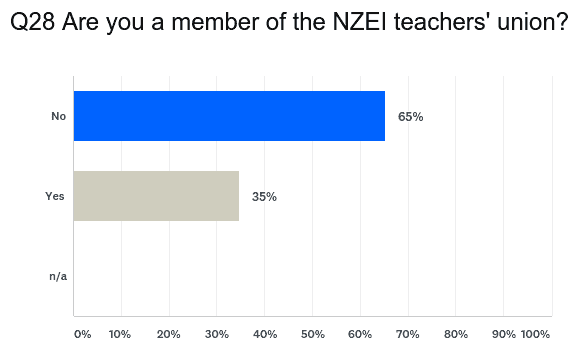
Of 762 respondents who were ECE employees and responded to this question, 65% were not members of NZEI Te Riu Roa and 35% were members.
It was found that being a union member or not made no difference when it came to:
- Being happy in their workplace.
- Whether they wanted to leave their current position or were seeking a change of job.
- How often they felt stressed at work.
- Whether or not they experienced a work-place related injury, mental health or physical problem.
- Their employer paying the costs of teacher registration for them.
But the data showed that those who were members of NZEI Te Riu Roa had a much higher probability of:
- Being well paid – according to their own perception of what this meant.
- Having a greater number of hours of non-contact time per week.
- Being given more days paid study or professional development leave.
- Having the cost of first-aid training covered by their employer.
- Working in a service where the adult-child ratios are at least at legal minimum (as opposed to below legal minimum).
- Having a workload that they rate as ‘fine” (not just “bearable” or alternatively “excessive”).
These benefits can come from their ECE service being party to a Collective Agreement with the Union.
Details
Differences between what early childhood staff actually want of a union and NZEI’s perception of its role
The role of the union was perceived by early childhood staff to be one of providing support to them when dealing with difficult relationship issues in the workplace. Their comments focused on what the union could or could not do for them personally and did not reflect the union’s perception of its social and political role in advocacy for quality early childhood education. This is also reflected in the finding that those who have joined the union are significantly more likely to report bullying at their current workplace and have a boss who does not treat them at all respectfully.
Ability to represent staff at privately-owned ECE services
NZEI’s focus on supporting public education is reflected in the higher proportion of workers in this survey at community-run services who said they were union members (54%) compared to privately-run services (15%); and at kindergartens (85%) compared to childcare centres (25%).
NZEI’s claim to provide “a strong voice” may be weakened by it not having a united voice due to having a lower representation of workers from privately-run services and not well distributed across different types of ECE services.
- I understood from talking with other teachers that the union isn’t particularly helpful to teachers who work for a private service (Childcare centre worker).
Relevance to people employed at different types of services
Many respondents who were not NZEI members did not think NZEI would welcome their membership because of the type of ECE service they worked for and / or they believed NZEI was a union only for kindergarten teachers and teachers whose service had negotiated a collective agreement with the union.
- I was told they will only support you if 80% of teachers at your centre are members and we are a too big a centre to make that feasible (Childcare centre worker).
- We don’t belong to the collective agreement (Childcare centre worker).
- They are not useful in my context (Home-based ECE coordinator).
- They don’t support Playcentre and I can’t afford to join on Playcentre wages (Playcentre worker).
- I was when primary teaching but no longer belong to the union (Playcentre worker).
- NZEI is not our union. I belong to the Public Service Association (Hospital-based ECE specialist).
- I’m a member of the PSA (Kohanga Reo worker).
- I belong to the Tertiary Education Union (Playgroup worker).
- I work in a Rudolf Steiner kindergarten. I don’t see how it can benefit me (Childcare centre worker).
- I was a member but being the only member at the private Montessori centre had no benefits for me so I am a lapsed member (Childcare centre worker).
- I am a member of PPTA and manager of centre at a public High School (Childcare centre worker).
Relevance to people employed in casual and permanent teaching positions, students, and management positions
Most respondents who were NZEI union members held qualified teacher and head teaching positions – they were not students or managers.
- As management there was no support for me when an issue arose so I am not a member now (Childcare centre worker).
- I am not a member because I am not a qualified teacher (Playcentre worker).
- I am a student, and I will join when I’m qualified (Childcare centre worker).
Being a casual or permanent worker made a difference to whether a worker belonged to the union – a significantly greater proportion of casual workers were not union members compared to permanent staff.
- I was when I was a full- time teacher. With relief teaching sometimes you don’t even get 20 hours of work per week (Childcare centre worker)
Does the union attract early childhood staff who are younger, middle-aged, or older?
Workers in the 45 to 64 age band were significantly more likely to hold union membership (47%) compared to other age groups (25% of workers under 25 years and 27% of workers aged 25-44 years).
Older staff tend to see union membership as more relevant, professionally worthwhile and/ or as more necessary.
Younger workers are the group that is less likely to know about the union and how to join – and this was the group that was also least likely to feel a need or urgency to join.
Why people didn’t want to join NZEI
a) Personal political views
- I don’t believe in unicorns (sic unions).
- Never been a union person.
- My choice.
- I’m happy to pay for a lawyer if required.
b) A need for an ‘ambulance’ should things go wrong in their employment situation
- I am now a member, but this only happened after it was recommended to me by another teacher after going through the disciplinary hearing and the unfounded acquisitions made against me, I am treating the union membership as a secondary defence (hopefully I will never need to use them but this has taught me a very expensive and heart-breaking lesson).
c) Perception of the union’s effectiveness
- I was a member, but I didn’t get timely help from them when I needed it.
- A friend was forced to resign, and the union did not seem to do much for her. I decided I would prefer to only work for places that treated me well without needing the might of the union behind me.
- I was a member for over 20 years and cancelled this last month. Disappointment regarding advocacy around the funding cuts and post-quake.
d) Relevancy to their current employment situation
- The union does not cover my individual contract.
- I have not needed it as I have been with the same employer for 16 years.
e) Having colleagues who were also members and not being afraid of their employer’s reactions to their membership
- No one at my workplace is a member.
- I would be the only one to be at my centre if I were.
- It is frowned upon by management.
- I am the only member at my workplace and my manager/owner is very negative when I receive magazines, etc.
f) Motivation
- Haven’t ever seriously looked into the benefits of belonging.
- I just have not re-joined after having to leave because I was not working.
e) Affordability
- I only work part-time so the union fee is a bit high
- Cost as I am the sole provider for my whanau. Am planning on joining though.
- It’s expensive! The cost doesn’t outweigh the benefits. My memberships at two sports clubs are cheaper and fun!
- I have researched it and I do not see any direct benefits to me, and unfortunately I am unable to commit to giving such a large amount of money in fees per year, as much good as NZEI does.
- Fees too costly. After paying student loan and kiwi saver there’s just enough to live.
Summary
Why Join NZEI
Early childhood education workers who belong to NZEI Te Riu Roa are significantly more likely to experience better pay and working conditions than those who are not part of the union. These benefits come from working in a service that is party to a collective agreement.
Reasons not to join NZEI
Workers in supervision and management positions and workers in private, parent-led, home and hospital-based services struggled to see that the union had interest in supporting them. The union was viewed principally as providing an ‘ambulance’ to support the individual in employment disputes and not also as being important to join to be part of a collective voice to advocate for the profession and higher quality ECE. The main reasons staff gave for not joining the union were cost, not knowing about it or how to join, and fear of how their boss could react to them joining. Workers were more likely to feel comfortable to belong to the union when they had colleagues at their workplace who were members – safety in numbers.