ECE Teacher Supply and Workforce Strategy – Briefing Paper to Minister Stanford and Associate Education Minister David Seymour
BRIEFING PAPER
June 6, 2024.
Table of Contents
- The Purpose of this Briefing Paper
- Summary
- Background
- Data
4.1 Staff qualification
4.2 Student teacher enrolments and course completion rates
4.3 Growth in licensed child places and pressure on staff supply
4.4 Diversity (teacher gender and culture) - Teacher Retention
5.1 Teacher survey results
5.2 Employment practices
5.3 Wages and salaries
5.4 Valuing early childhood trained and qualified teachers - Teacher Supply Initiatives
6.1 Scholarships
6.2 Fully funding the teacher education refresh course
6.3 Overseas finder’s fee (OFF)
6.4 Overseas relocation grant (ORG) - Recommendations
- Examples of Overseas ECE Workforce Strategies
- Concluding Comment
1. Purpose of this Briefing Paper
This paper outlines the current challenges facing the early childhood education (ECE) workforce in New Zealand, with a particular focus on teacher supply and retention. It provides insight, analysis, and recommendations for developing a comprehensive ECE workforce strategy.
2. Summary
All parties in the 2023 government coalition committed to making decisions that “lift educational achievement so that every child has the opportunity to receive a world-class education.”
The foundation of a world-class education is a workforce of appropriately skilled and knowledgeable qualified teachers. Research consistently shows that teachers are a key lever for improving children’s achievement and social outcomes in both school and early childhood education settings (Alton-Lee, 2003; Farquhar, 2003).
ECE services must be adequately staffed to ensure children’s safety, support their mental health, foster trust and partnership with parents and caregivers, and deliver high-quality education. However, the sector constantly faces a “lack of fully certificated teachers” (Seymour, April 16, 2024).
In early 2024, a subcommittee of our early childhood advisory committee undertook a work programme to examine what needs to change to address workforce supply and retention challenges. This paper presents our findings and recommendations, including an overview of the current state of knowledge, actions taken to date, and an analysis of their effectiveness.
We found that New Zealand lacks a national ECE workforce strategy to build a sustainable, skilled, and knowledgeable pool of qualified teachers. In addition, there is insufficient data to inform decision-making around teacher supply, recruitment, and retention.
Current teacher supply initiatives are not effectively addressing the shortage. Recruitment and retention challenges remain largely unresolved.
Policy settings do not adequately recognise ECE-trained and qualified staff as ‘knowledgeable teachers’—despite their critical role in working with infants, toddlers, young children, and their families.
There are no mechanisms in place to identify high staff turnover in teacher-led services or to address underlying causes such as workplace culture, safety, and employment practices.
Prospective early childhood teachers can clearly see that there is no guarantee of earning a salary aligned with government-recognised teacher value unless employed by a kindergarten association offering state-funded pay parity—even though they perform the same role and meet identical education and certification requirements.
This paper puts forward a set of recommendations for an ECE workforce strategy focused on supply, recruitment, and retention.
A multi-pronged approach is essential, as focusing solely on teacher supply (such as funding more training or recruiting teachers from overseas) can be costly and ineffective if workplace recruitment and retention challenges are not also addressed.
The recommendations made in this paper are to:
- Review current teacher supply initiatives.
- Review the Overseas Teachers Finder’s Fee available to ECE service providers, as questions remain about its use and effectiveness.
- Review Ministry of Education scholarships (Initial Teacher Education and Career Change) for ECE students, and ensure more are targeted to meet specific workforce needs, such as attracting ECE-qualified teachers to hard-to-staff geographic areas.
- Introduce fully funded scholarships for ECE students who have completed a Level 4 to 6 teaching qualification within the past five years, enabling them to upgrade to a Level 7 qualification recognised by the Teaching Council. A one-year bonded service requirement could be attached to the scholarship.
- Improve workforce representation
- Launch a public campaign to attract more men into early childhood teaching, supported by ITE providers and ECE services, and developed with input from Dr Sarah Alexander, New Zealand’s leading expert in this area.
- Launch a public campaign to increase the number of Māori teaching staff in teacher-led services, developed in consultation with the Kōhanga Reo National Trust and the Office of Early Childhood Education (OECE).
- Implement policy, regulation, and practice changes to improve retention and keep qualified, skilled, and knowledgeable teachers in the ECE workforce
- Acknowledge and publicly discuss the impact of workplace culture, safety, and employment practices on teacher retention.
- Introduce policy requiring all service providers to complete training and demonstrate understanding of sustainable and ethical employment practices.
- Secure funding to maintain teacher pay improvements and continue progress toward full pay parity with primary school teachers across all teacher-led services. (Currently, pay parity is only funded for teachers employed by kindergarten associations.)
- Regulate for at least 50% ECE-qualified and certificated teachers within the minimum adult-to-child ratio, and work toward achieving 80–100% in teacher-led centres. (This would not prevent centres from employing additional staff who are not ECE-qualified or are teachers-in-training.)
- Restore the regulatory requirement that the Person Responsible in teacher-led centres must be ECE-qualified and certificated.
- Retain the recent law change requiring the Person Responsible to hold a full practising certificate.
- From 2025 onward, require all newly employed primary-trained teachers in teacher-led services to complete an induction and ECE-specific guidance programme—or alternatively, remove the policy that allows primary-trained teachers to be counted for funding purposes in ECE.
- Require the Ministry of Education to collect and publicly report more comprehensive data on the ECE workforce, including:
- Retention rates of overseas teachers in services that receive the Overseas Finder’s Fee.
- Proportion of newly qualified teachers still employed in ECE one and three years after course completion.
- Proportion of ECE-qualified teachers employed as permanent staff (including fixed-term, full-time, and part-time) versus relievers or casual employees.
- Number of ECE-qualified teaching staff in each group of teacher-led services, broken down by years of recognised teaching experience.
- Turnover rates of ECE-qualified teachers by service group and ownership type (e.g. company, sole trader, incorporated society, city council, charitable trust).
- Annual number of teaching staff holding an ECE teaching qualification (Education Counts currently includes primary-trained teachers in its qualified staff statistics).
- Annual number of teaching staff holding a current practising certificate and ECE qualification (Education Counts currently reports registered teachers across ECE, primary, and secondary sectors without distinction).
3. Background
This report focuses on the teacher-led part of the ECE sector and does not concern staffing in the ECE whānau and parent-led sector. (The issues for Kōhanga and Playcentre are not necessarily the same as for teacher-led ECE e.g. how to find enough kaiako with te reo which is the main driver of Kōhanga and how to make it possible for parents to have time in Kōhanga and Playcentre to help).
For many years now an ECE teacher shortage has been in the news. It was a matter of concern to the Minister of Education as far back as 2009 (Education Report: Tackling ECE Teacher Shortages, 30 July 2009, Metis Number 362593). The Ministry of Education Teacher Demand and Supply Planning Projection result reports from 2018 to 2023 have not included ECE. A proposal for a “Future Focused Education Workforce Strategy” was given Cabinet approval in 2018. Following this the Ministry of Education formed an Education Workforce Strategy Governance Group (EWSG) and it released a vision for the Education Workforce in 2019. Nothing more seems to have come from this group since.
A Government Early Learning Action Plan (ELAP) released in 2019 included a commitment to the following objectives relevant to the ECE workforce:
- Regulate for 80% qualified teachers in teacher-led centres, leading to regulation for 100%
- Improve Initial Teacher Education (ITE) to ensure that teachers are well qualified to implement the curriculum in collaboration with other professionals.
- Develop a sustained and planned approach to professional learning and development (PLD).
- Improve the levels and consistency of teachers’ salaries and conditions across the sector.
- Support the workforce to integrate Te Reo Māori into all ECE services.
- Develop an ECE teaching supply strategy that aligns with the wider education workforce strategy.
The ELAP also saw the need to improve standards such as adult:child ratios and group size. Improving standards would not only facilitate higher quality ECE for children but also improve the teachers’ work environment and therefore their retention. However, little to no action on most of these objectives has been taken.
The International Commission on the Futures of Education (2021) notes that teachers hold a transformative role in shaping the future of education but that to move forward in education there is a need to:
- Reimagine teaching and the teaching profession.
- Recast teaching as a collaborative profession.
- Recognise professional development as a lifelong learning journey.
- Mobilise solidarity to improve teachers working conditions and their status.
- Promote teachers’ engagement in decision making and public debate on education.
In New Zealand, policy settings have largely been shaped in response to lobbying from service providers around teacher supply and the so-called ‘teacher shortage.’ This has led to decisions that undervalue ECE-trained and qualified teaching staff as ‘knowledgeable teachers’—despite their critical role in educating children during the most formative years of life (Gunn & Hedges, 2022).
One example is the broadening of the ‘Person Responsible’ role to include teachers who are not qualified in ECE. Another is the government’s last-minute decision not to proceed with a regulation requiring 80% of teaching staff to be qualified.
For over a year, it was expected that by August 2024, any teacher holding the role of ‘Person Responsible’ would be required to hold a full practising certificate. However, current legislation still allows service operators to assign this role to beginning teachers who have not yet completed their provisional certification induction and mentoring. These new teachers may feel unprepared for the responsibilities and risks involved, both personally and professionally, should something go wrong under their supervision.
Abandoning the planned regulation improvement may reduce costs for ECE business operators. However, it comes at a cost to the quality of children’s education, as centres may rely on relatively inexperienced staff. Furthermore, not requiring a full practising certificate for the ‘Person Responsible’ role may contribute to high staff turnover, exacerbating pressure on teacher supply across the sector..
4. Data
The data presented here was obtained from the last six years of the Ministry of Education annual census of ECE services (June 2018 – June 2023).
4.1 Staff qualification
Between 2018 and 2023 the percentage of qualified teachers (primary school and ECE qualified) in teacher-led services increased by one percentage point from 68.3% to 69.2% in teacher-led ECE services (see Table 1).
Statistics on teaching staff with an ECE teaching qualification are not publicly available from the Ministry’s Education Counts website. This is a data reporting limitation.
The statistics on qualified teachers reported by the Ministry of Education include those with primary school teacher qualifications since the Ministry allowed centres to count staff who held this qualification as qualified for funding purposes in ECE in 2010. This was a temporary provision to support centres to increase their proportion of qualified teachers, but its temporary nature was forgotten, and it has been left to continue.
Table 1. Number of qualified teaching staff in teacher-led centres
| Qualified | Unqualified | Percentage Qualified | |
| 2018 | 21,467 | 9,851 | 68.3% |
| 2023 | 23,328 | 10,396 | 69.2% |
Table 2 shows that the percentage of qualified teachers in education and care centres increased from 63% in 2019 to 67% in 2020 and 66% in 2021. This increase may have in part been due to the provision of a financial incentive in the form of confirmation in the May 2020 Budget that the 100% qualified teacher funding band would be restored with eligible centres receiving increased payments in November 2020 with advance funding to cover January and February 2021.
Table 2. Percentage of teaching staff with a primary and/or ECE teaching qualification by teacher-led ECE service (June 2018 – June 2023)
| Education & Care | Kindergarten | Home-based | |
| 2018 | 64.0 | 90.7 | 96.6 |
| 2019 | 63.2 | 94.0 | 100. |
| 2020 | 67.3 | 93.2 | 99.8 |
| 2021 | 65.6 | 93.9 | 99.9 |
| 2022 | 65.0 | 93.3 | 99.9 |
| 2023 | 64.9 | 94.0 | 100. |
Education and care centres (that are not funded as kindergartens) employ a much lower proportion of qualified teaching staff in relation to their total teaching staff number compared with kindergarten and home-based ECE (see Table 2). Home-based networks are required under regulation to employ staff for each licensed service who are teacher qualified to oversee the care and education provided by educators. All kindergarten associations are funded to provide full pay parity for their teaching staff with teachers in the primary school sector and have a tradition of valuing a professionalised fully qualified teacher workforce.
It is worth noting that in the data “Education and Care” is categorised separately to “Kindergarten” by the Ministry of Education not because the services are different, they are not, but because the government chooses to provide preferential levels of funding to “Kindergartens”. “Education and Care” centres and “Kindergartens” must both meet the same regulatory standards, follow the same curriculum, and deliver the same outputs.
4.2 Student teacher enrolments and course completion rates
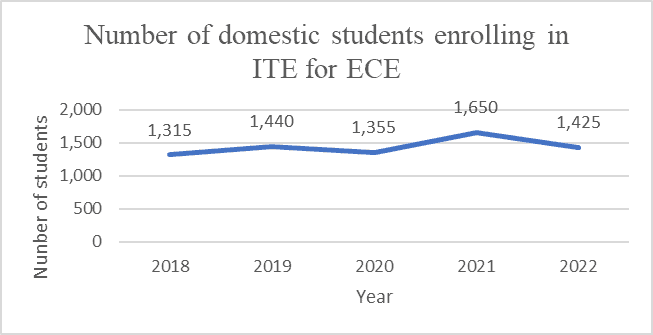
Over recent years there has been no large-scale advertising campaign to promote ECE teaching as a profession. We see this reflected in the fact that there has been no sizeable, sustained increase in the number of domestic students enrolled in Initial Teacher Education (ITE). More students are dropping out or not completing their ECE teacher training. In 2022, 68 percent of ECE graduates completed an ITE bachelor’s degree, compared with 84 percent in 2016. Data is needed on why this is occurring.
Figure 1 shows that there was a significant rise in student enrolments in 2021. This may have been related to the impact of the COVID-19 pandemic and many people in other sectors losing their jobs and looking for new career opportunities. In 2022 the number of enrolments decreased to be just a little lower than the 2019 enrolment number. (Note that data for the 2023 year was not available from the Ministry of Education at the time of writing this paper.)
Figure 1. Number of domestic students enrolling in Initial Teacher Education for ECE (2018 – 2022)
The Ministry of Education notes that universities continue to produce the vast majority of first-time graduates in primary and secondary ITE but not in ECE. In 2022, 56 percent of ECE graduates were from PTEs, compared with 22 percent from universities and 21 percent from Te Pūkenga. This reinforces polarisation and hierarchisation between sectors, within the teaching profession.
“While research and professional institutions (e.g. Universities, the Teaching Council of Aotearoa) publicly speak about the need for ‘supporting the development of a research base for the professional practices of teaching that is home-grown, fit-for-purpose and intentionally designed to address urgent questions for [Aotearoa] education and society’ (Gunn et al., 2021, p. 3), the current state of ECE ITE may make the pursuit of research-informed ITE more difficult.” (Kamenarac, Gould & Tadi, 2023, p.7)
4.3 Growth in licensed child places and pressure on staff supply
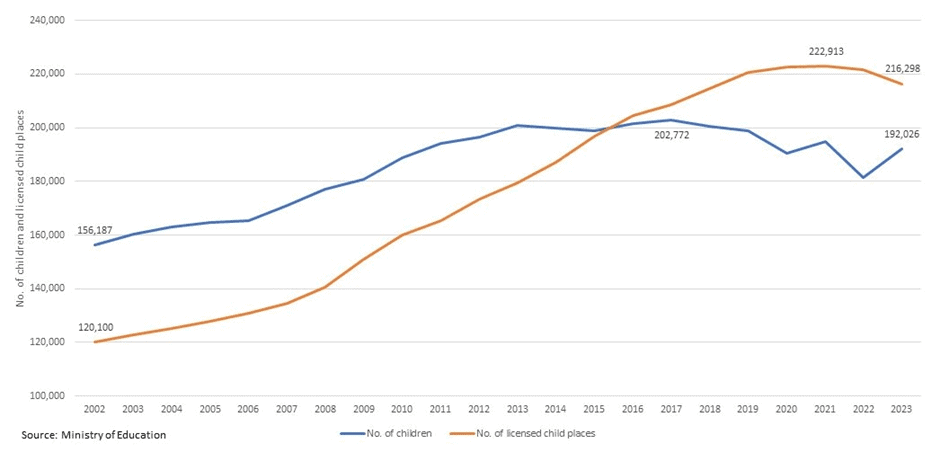
Cost efficiency is maximised when the number of children provided with ECE is greater than the number of licensed child places, as was the case prior to 2016 (see Figure 2). However, when there are more ECE services there is a need for more staff which puts pressure on staff supply. When the number of licensed child places in the ECE sector exceeds the number of child enrolments there is more capacity in the system, but the services still need to be staffed.
Figure 2. Growth in licensed child places in all ECEs (including parent and teacher-led) and number of children served June 2002 – June 2023.
The amount of time children are enrolled in ECE in teacher-led services has changed minimally over the past six years. Table 3 shows that children were enrolled in education and care centres an average of 1 hour more per week in 2023 compared with 2018; 0.7 hours more in kindergartens and no increase in home-based ECE (see Table 3).
Table 3. The average number of hours of child enrolment by service type
| Education & Care* | Kindergarten | Home-based | |
| 2018 | 23.2 | 17.4 | 24.7 |
| 2019 | 23.3 | 17.4 | 24.8 |
| 2020 | 23.3 | 17.5 | 24.6 |
| 2021 | 22.7 | 17.1 | 24.3 |
| 2022 | 23.3 | 17.3 | 24.5 |
| 2023 | 24.1 | 18.1 | 24.7 |
In 2023, child enrolments in teacher-led ECE services were down by 7,982 from 2018 (see Table 4).
Table 4. The number of child enrolments in teacher-led ECE services
| Education & Care* | Kindergarten | Home-based | Total | |
| 2018 | 134,701 | 29,048 | 18,267 | 182,016 |
| 2019 | 135,237 | 28,238 | 17,196 | 180,665 |
| 2020 | 130,908 | 27,483 | 15,022 | 173,413 |
| 2021 | 135,341 | 27,638 | 13,879 | 176,858 |
| 2022 | 128,436 | 25,099 | 11,326 | 164,861 |
| 2023 | 136,777 | 26,743 | 10,514 | 174,034 |
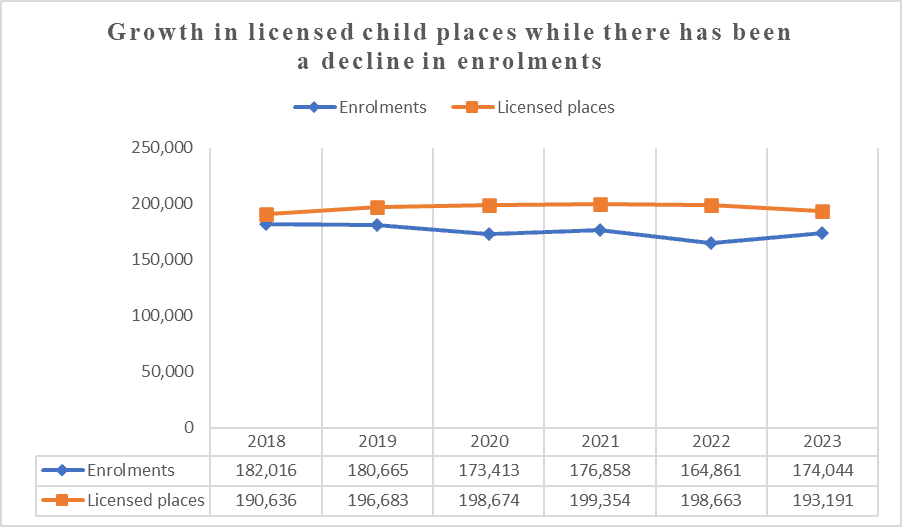
Table 5 below shows the number of licensed child places in teacher led services (June 2018 – June 2023). Licensed child places can be defined as the number of children that a licensed ECE service can have attending at any one time – so for example a centre with 30 licensed child places can provide care and education to up to 30 children at a time. It does not mean the number of children enrolled as the number of enrolments can exceed the number of licensed spaces should some children attend part-time.
As shown in Figure 3 the size of the gap between the number of licensed child places and enrolments narrowed for the first time for many years in 2023. What could have caused this? One hypothesis is that the ECE market had reached saturation point prior to Covid lockdowns, with centres competing for children and offering price reductions and special deals. Investing in the sector had become less attractive but there was still growth in the number of licensed child places in 2020 and 2021.
ECE service provider knowledge of the impending introduction of Network Management may have had a dampening effect in 2022/3 on the number of licensed child places. Network Management was delayed for two years following the passing of the Education and Training Act 2020 and was scheduled to take effect from 1 August 2022. Government decided to further delay implementation until 1 February 2023.
Table 5. The number of licensed child places in teacher-led ECE service
| Education & Care | Kindergarten | Home-based | Total | |
| 2018 | 133,089 | 25,871 | 31,676 | 190,636 |
| 2019 | 139,984 | 25,821 | 30,878 | 196,683 |
| 2020 | 144,089 | 25,866 | 28,719 | 198,674 |
| 2021 | 147,300 | 26,309 | 25,645 | 199,354 |
| 2022 | 149,454 | 26,369 | 22,840 | 198,663 |
| 2023 | 149,217 | 26,659 | 17,315 | 193,191 |
Figure 3. How the number of licensed child places in teacher-led ECE services has tracked with the number of children enrolled over the past 6 years (June 2018-June 2023)
4.4 Diversity
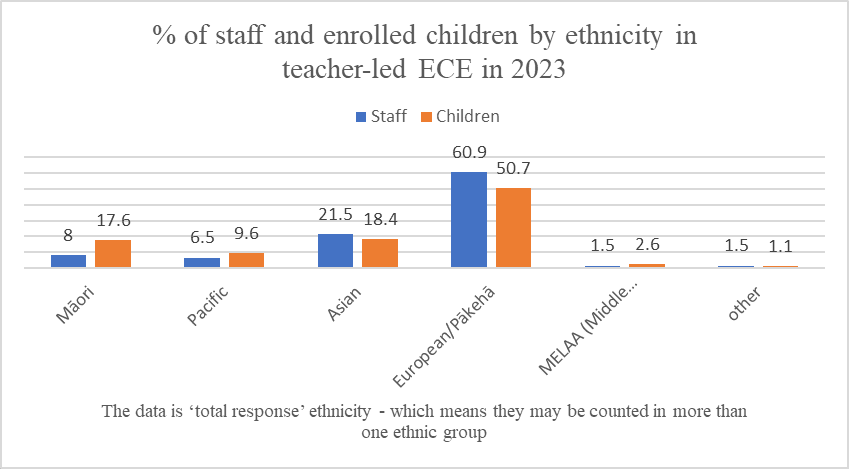
Men and Māori are two groups under-represented in the ECE teaching workforce.
The presence of a low proportion of teaching staff who are Māori (8%) in relation to children (18%) may not support good learning and cultural outcomes for children (see Figure 4)
Figure 4. Percentages of teaching staff and children by ethnicity in teacher-led ECE
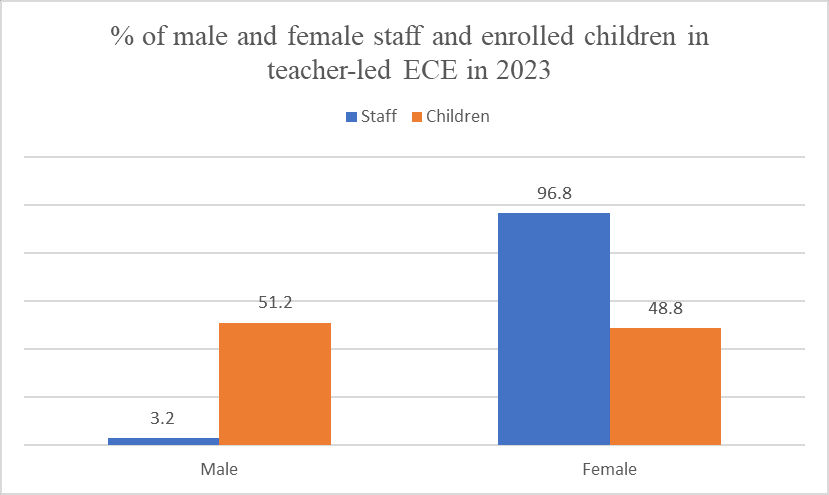
Men formed only 3.2% of staff who identified their gender, yet 51% of the children enrolled in teacher-led ECE are male (See Figure 5). An ECE workforce strategy needs to target men as a significant untapped source of supply of workers in NZ Aotearoa. ECE teacher recruitment and retention clearly favours women.
Figure 5. Percentages of teaching staff and children by gender in teacher-led ECE
5. Teacher Retention
A teacher shortage has been spoken about in the ECE sector for many years and acknowledged by successive Ministers of Education, but the Ministry of Education has not collected data on ECE teacher retention and turnover in services. It has not provided/ published analysis of what the problems are and for which service types.
There is a lack of data on teacher retention and turnover however one thing is certain – and that is that a teacher shortage, real or perceived, will not be solved by taking a demand and supply approach alone to increase teacher numbers. Trying to increase teacher supply will end up being an expensive endeavour if there is little or no focus on teacher retention.
In response to service provider claims of a teacher shortage, teachers have claimed that there is not a shortage of teachers but there is “a shortage of teachers willing to work in ECE’. Some service providers may have more difficulty than others in retaining teaching staff. Teachers’ have reported leaving the ECE sector and the work they love doing for good because of problems such as low pay, physical and mental burnout, and toxic workplaces (see the next section below). This impacts on the total size of the pool of teachers available for work in the ECE sector.
In practice, there are no strategies in place to support ECE teacher retention by addressing workplace culture, safety, and employment practices. The Education (Early Services) Regulations 2008 place no obligation on service operators to provide evidence of being a good employer or demonstrate they know and understand sustainable and ethical employment practices.
Service providers can establish new ECE services without considering if they have the necessary staffing resources available locally. For example, a press release issued by the Early Childhood Council service provider lobby group on 22 March 2021, included a statement by its President that he intended to open a new centre later in the year (creating 125 new licensed child places) and wanted government support to bring in 15 foreign teachers to staff it.
5.1 Teacher survey results
To understand more about what is going on within workplaces for ECE teaching staff the OECE surveys teachers from across the country every three years. The results from the latest 2023 survey (results published in 2024) show teachers are under stress mentally, physically, and professionally due to employment conditions and workplace practices:
- One quarter of the respondents (25.7%) had experienced bullying or harassment at work over the previous 12 months.
- Just over one quarter of the respondents (28.6%) had been injured at work.
- More than one-third of the respondents (35%) held concerns for children’s learning because of issues such as there being a constant flow of relievers who can’t plan and support children’s learning and a lack of resources to support children.
- A third of the respondents (30%) did not have time to develop individual relationships with the children in their care.
- Nearly half (45.5%) of the respondents from education and care centres reported that adult-to-child ratios were breached – 5% reported this happened “all the time”, 7% “often”, 14 % “sometimes” and 19.5% “rarely”.
NZEI also surveyed ECE teachers in 2023 and its findings support those of the OECE’s three-yearly survey. Additionally, NZEI asked teachers if they were thinking about leaving the ECE sector – 38% of respondents said that they frequently thought about leaving, 30% said they occasionally thought about leaving, while just 16% said they had never thought about it.
Thinking about leaving is one thing, while doing it is another. The OECE asked respondents to its survey if they had changed jobs in the last year, and why.
Twenty-four percent of the respondents had changed their job at least once in the last year to work for a new ECE service employer. The top three reasons for leaving their last ECE workplace were:
- A toxic work environment (51.4%).
- Low pay (30.9%).
- Lack of support for professional growth and learning (22.4%).
Te Pūkenga and Te Rito Maioha researchers asked ECE centre staff about their experience of racism, discrimination, and bullying. Their findings on culturally safe and inclusive early childhood work environments, reported in the NZ International Research in ECE Journal suggest work is needed to ensure early childhood workplaces are more culturally inclusive and supportive of diversity.
5.2 Employment practices
The Labour Inspectorate conducted a scan of ECE business practices after the Ministry of Business, Innovation and Employment (MBIE) received many complaints from ECE staff concerning bad employment practices. In 2023 the Labour Inspectorate did an initial round of “Operation Brace ECE checks” involving 33 ECE centres in Auckland represented by the Early Childhood Council group. The intelligence report produced from the scan and the findings from the initial round of checks have not been released – but the information from these could help to inform strategies that would work to improve teacher retention through ensuring employment practices do not breach employment law, are sustainable, and ethical.
5.3 Wages and salaries
In 2019, the Hon Nicola Willis accepted the petition for ECE teacher pay parity signed by more 15,000 people and presented it to the House of Representatives. The National Party recognised that low teacher pay was a problem, making the ECE profession unattractive as a career, and causing degree-qualified teachers who continued to be paid little more than the minimum adult wage (even after several years of teaching) to seek out teaching jobs overseas or leave the ECE sector for better wages and less stressful work.
Over the last few years, the exodus of teachers from ECE teaching has been slowed by the government taking steps toward providing pay parity and using the mechanism of salary attestation to require employers to pay their teachers at least at specified salary amounts in return for receiving higher funding rates.
Changes in the delivery and rules for obtaining pay parity funding are needed to strengthen the benefits of it. Currently, employers can choose to opt-in or out of various levels of ‘pay parity’, so staff are still vulnerable to low pay, and to pay cuts or redundancy. The salary attestation rules allow service providers not to recognise the years of early childhood teaching experience obtained by NZ ECE qualified teachers working overseas as relevant teaching experience. NZ ECE qualified teachers working overseas can suffer a considerable drop in pay should they return to teach in NZ. NZ ECE qualified teachers overseas do not want to return if it means being paid significantly less. Overseas teaching experience is beneficial in the professional development of ECE teachers. We should be encouraging and not disincentivising teachers from taking overseas sabbaticals.
Beyond the funding allocated in Budget 2023 no appropriation was made by the last Government to ensure that salary attestation rates are kept up with the pay rates of primary and kindergarten teachers. On the 9 April 2024 kindergarten teacher pay rate amounts went up to maintain full pay parity with school teachers but the Ministry of Education did not increase the salary attestation rates to match.
There is high probability that ECE teachers will leave en masse should the government not provide money in Budget 2024 for pay parity, or not take other actions on teacher pay to ensure service providers do not pay their teachers less than what the government has set as the pay rates for teachers employed by public schools and kindergarten associations (private).
5.4 Valuing early childhood trained and qualified teachers
The Teaching Council “Snapshot of the Teaching Profession in Aotearoa New Zealand 2023” reports that ECE teachers feel particularly undervalued in the teaching profession by society (p.8).
Researchers have noted that at policy level there is a lack of recognition of the value of ECE knowledge and training (Gunn & Hedges, 2022).
The first move to devalue the qualification of ECE teaching occurred in 2009. To get more service providers across the line of having 80 percent qualified teachers to meet the government target of 80 percent qualified teachers in centres by 2010 and 100 percent by 2012, the Ministry of Education proposed that primary trained teachers be counted for funding purposes. The Ministry said that within its current teacher supply baselines it would be able to fund “a six-week induction followed by an advice and guidance programme to help primary qualified teachers adapt their knowledge and skills to the ECE context”. This was necessary because “broadening the recognised qualifications to non-ECE qualified teachers may be a risk to the quality of ECE, particularly for young children”. A change in Government, and the 80% and 100% qualified teacher targets were dropped. However, primary school trained teachers are still counted by the Ministry of Education for funding purposes. Further, there is no induction and no advice and guidance programme provided to primary school teachers working in early childhood teaching positions.
On 9 January 2020 a regulation change allowed primary school trained teachers to be a ‘Person Responsible’ for supervising staff and children in early childhood centres – until then a Person Responsible had to be one who was early childhood trained and qualified. Now a licensed teacher-led ECE centre can operate legally with a primary trained teacher in charge and no early childhood trained teachers working with children (for at least some of the day or all day depending on the number of children).
In September 2021, the Ministry of Education consulted on proposals to amend the Education (Early Childhood Services) Regulations 2008 to require 80% qualified teachers in teacher-led centres. One proposal was to ensure that at least 50% of the teaching staff counted in ratio with children were ECE qualified and the remainder could be made up of primary school qualified teachers. The Ministry of Education’s data indicated at the time that “most services are well placed to comply with a new 80% requirement” (p.12 Consultation on Tranche Two). However, in 2023 the government decided against proceeding with any of the Ministry’s proposals that would result in centres being required to ensure that at least one or more of the teaching staff in the minimum regulated adult-to-child ratio were trained and qualified in ECE teaching.
6. Teacher Supply Initiatives
In September 2022 the government announced a multi-million-dollar teacher supply funding package. The bits in the announcement of relevance to teacher supply in the ECE sector were as follows:
- An increase in the number of career change scholarships offered.
- Continuation of funding for the Teacher Education Refresh programme to be fees-free until June 2023 (this has now been extended to June 2024).
- Two teacher supply initiatives previously only available for the compulsory education sectors were made available for the first time to support ECE teacher supply: the overseas finder’s fee (OFF) and the overseas relocation grant (ORG)
“Many centres have successfully recruited overseas ECE teachers, and we encourage you to consider this option if you have any immediate teacher supply needs.” (Iona Holsted, Secretary for Education, email to ECE service providers 15/9/2022).
6.1 Scholarships
For many years the Ministry of Education has offered initial teacher education (ITE) scholarships. In 2023, 143 ITE scholarships were awarded to students studying early childhood education. The Ministry of Education also provides career change scholarships. Approximately 60% of carer change scholarships or 76 out of 169 went to students studying early childhood. This provides an indication that ECE teaching is more likely to be a second choice of career for people compared to primary and secondary teaching which is more likely to be a first choice of career. It supports points made earlier in this paper regarding ECE teachers feeling undervalued in the teaching profession and the qualification of ECE teaching being under-valued in government policy.
The scholarships make it more affordable for students to study for a teaching qualification and some may be targeted at addressing specific needs for teacher supply (such as hard to staff regions). After graduation, students are bonded only to teach for a minimum of 12.5 hours per week for six consecutive weeks or repay the scholarship funds they received, so this does not support improving teacher supply and retention. Students are not bonded to work in the region in which they studied.
Lack of data makes it difficult to know how many scholarships are awarded to ECE students specifically for teacher supply reasons and in what regions.
6.2 Fully funding the teacher education refresh course
In 2023, 389 people were fully funded to start a TER course, 113 of these were in ECE. This teacher-supply initiative has not been evaluated for its cost-effectiveness and benefits for uplifting the supply of ECE qualified and certificated teachers.
It is a Teaching Council requirement for qualified teachers with previous, limited or no teaching experience to undertake a TER course. This applies to teachers applying for a provisional practising certificate who completed their teacher education qualification more than 5 years ago, who last held a provisional practising certificate and have not taught in the last five years, who have held a provisional practising certificate for more than five years and want to renew it, and teachers who are overseas trained and whose education qualification was completed more than five years ago and who have not taught in the last five years.
A teacher who qualified overseas and has taught only overseas is not required to undertake a TER course. These teachers may not be familiar with the ECE Curriculum (Te Whāriki), learning through play, assessment in ECE, and NZ ECE teaching and management practices and rules and regulations. Going back to cabinet correspondence from 2009 and 2010, there was going to be a requirement for overseas teachers to do the equivalent of what became a TER however this intention did not eventuate.
6.3 Overseas finder’s fee (OFF)
Provision of the Overseas Finder’s Fee as a teacher supply initiative needs to be reviewed for its value and effectiveness. The OFF payment of $3,450 per overseas teacher employed was advertised as being available to “licensed early learning centres”. An Official Information Request Act revealed that in 2023 the Overseas Finder’s Fee was paid out to childcare centres only and no other licensed ECE services such as kindergarten association kindergartens or home-based ECEs. There are several reported limitations of the Overseas Finder’s Fee payment.
- Service providers are not required to provide receipts or proof of spending on recruitment of the specific teacher they say they have employed.
- It is not targeted to geographical areas where qualified staff may be harder to find and recruit. (Note that most centres that received the OFF in 2023 were in major urban areas).
- Nearly all centres that received one or more OFF payments in 2023 were operated by private, corporate, or commercial service providers. Questions that could be asked are: Would these business owners still have employed overseas teachers without the OFF? Why has the OFF not worked to support teacher supply in community-operated incorporated society ECE centres?
- There is no welfare check on teachers who are foreign to NZ to ensure that they are paid appropriately, understand NZ employment law, and are not subject to bullying or exploitation.
- There is no follow-up by the Ministry of Education to check if the teacher is retained by the centre after it receives the OFF payment. There is no requirement for a centre to repay the OFF if they have not retained the teacher and provided suitable employment for at least 12 months.
6.4 Overseas relocation grant (ORG)
A relocation payment of up to $10,000 is provided as a government teacher supply initiative to overseas teachers who have not taught in NZ in the last 12 months. Teachers must provide receipts to the Ministry of Education of travel and relocation expenses and are reimbursed for actual costs.
The usefulness of relocation grants to increase teacher supply can be questioned. The grants are not highly competitive with offers made by other countries – other countries can offer greater incentives for relocating, including higher salaries. The ORG is for overseas teachers who have already moved to NZ and may have already been intending to move regardless of the ORG availability.
7. Recommendations
This paper proposes that achieving the Coalition Government’s goal of providing every child with a world-class education will require a clear vision and strategy for the early childhood education (ECE) workforce. That strategy must focus on developing a sustainable, well-trained, and knowledgeable workforce of qualified ECE teachers.
Workforce challenges related to teacher supply, recruitment, and retention are interconnected. Accordingly, the recommendations outlined below address all three areas to support a stronger and more resilient ECE sector.
1) Review current teacher supply initiatives.
- Review the Overseas Teachers Finder’s Fee available to ECE service providers, as questions remain about its use and effectiveness.
- Review Ministry of Education scholarships (Initial Teacher Education and Career Change) for ECE students, and ensure more are targeted to meet specific workforce needs, such as attracting ECE-qualified teachers to hard-to-staff geographic areas.
- Introduce fully funded scholarships for ECE students who have completed a Level 4 to 6 teaching qualification within the past five years, enabling them to upgrade to a Level 7 qualification recognised by the Teaching Council. A one-year bonded service requirement could be attached to the scholarship.
2) Improve Workforce Representation
- Launch a public campaign to attract more men into early childhood teaching, supported by ITE providers and ECE services, and developed with input from Dr Sarah Alexander, New Zealand’s leading expert in this area.
- Launch a public campaign to increase the number of Māori teaching staff in teacher-led services, developed in consultation with the Kōhanga Reo National Trust and the Office of Early Childhood Education (OECE).
3) Strengthen Retention Through Policy, Regulation, and Practice
- Acknowledge and publicly discuss the impact of workplace culture, safety, and employment practices on teacher retention.
- Introduce policy requiring all service providers to complete training and demonstrate understanding of sustainable and ethical employment practices.
- Secure funding to maintain teacher pay improvements and continue progress toward full pay parity with primary school teachers across all teacher-led services. (Currently, pay parity is only funded for teachers employed by kindergarten associations.)
- Regulate for at least 50% ECE-qualified and certificated teachers within the minimum adult-to-child ratio, and work toward achieving 80–100% in teacher-led centres. (This would not prevent centres from employing additional staff who are not ECE-qualified or are teachers-in-training.)
- Restore the regulatory requirement that the Person Responsible in teacher-led centres must be ECE-qualified and certificated.
- Retain the recent law change requiring the Person Responsible to hold a full practising certificate.
- From 2025 onward, require all newly employed primary-trained teachers in teacher-led services to complete an induction and ECE-specific guidance programme—or alternatively, remove the policy that allows primary-trained teachers to be counted for funding purposes in ECE.
4) Improve Data Collection and Transparency
Require the Ministry of Education to collect and publicly report more comprehensive data on the ECE workforce, including:
- Retention rates of overseas teachers in services that receive the Overseas Finder’s Fee.
- Proportion of newly qualified teachers still employed in ECE one and three years after course completion.
- Proportion of ECE-qualified teachers employed as permanent staff (including fixed-term, full-time, and part-time) versus relievers or casual employees.
- Number of ECE-qualified teaching staff in each group of teacher-led services, broken down by years of recognised teaching experience.
- Turnover rates of ECE-qualified teachers by service group and ownership type (e.g. company, sole trader, incorporated society, city council, charitable trust).
- Annual number of teaching staff holding an ECE teaching qualification (Education Counts currently includes primary-trained teachers in its qualified staff statistics).
- Annual number of teaching staff holding a current practising certificate and ECE qualification (Education Counts currently reports registered teachers across ECE, primary, and secondary sectors without distinction).
8. Examples of ECE Workforce Strategies Overseas
Other countries have developed ECE workforce strategies, and action plans to address teacher shortages and quality. For example, in European countries such as Ireland, Finland, Croatia, Austria, Slovakia and France; the European Education Area (EEA) strategic framework outlines statistical data and recommendations provided by the Early Childhood Education and Care Workforce Group (ECEC WG) to inform the European Commission of the state of teacher shortages across Europe by providing 5 pillars presenting the causes and consequences of ECEC staffing shortages internationally.
In the 2023 publication, entitled Staff shortage in ECEC Sector – Policy Brief the importance of ‘having both short term’ measures to address the workforce issues and ‘long term strategy’ to address the root causes of the shortages is argued. (Note that in NZ we have experienced many short-term measures with no long-term evidence for recruitment and retention success of teacher supply).
The ECEC WG recommend the following short term measures and long term strategies;
- Develop strategies at national and/or local level to tackle staff shortages.
- Valuing the profession and its education and socialadded value – including communication campaigns to promote how diverse and rewarding working in ECE can be.
- Diversifying recruitment strategies (e.g. encouraging access to ECE studies within universities, creating clear career ladders for progression accompanied with continuing professional development and support, and addressing the gender imbalance amongst ECEC professionals).
- Offering motivating and dynamic career opportunities to take on different roles in an ECE setting or context accompanied by the adequate renumeration level, and providing support for leaders who play a major role in supporting the whole team.
- Offering continuing professional development opportunities to all staff categories, as well as induction period and/or mentoring for new staff members.
- Improving working conditions: reducing staff/child ratio, increasing salaries and providing additional financial incentives, offering more child-free time to foster professional development and teamwork; offering more stable working hours and contractual status and better working environment.
The Australian Government Department of Education have an ECE workforce strategy called Shaping Our Future. It aims to foster a sustainable and high-quality workforce of early childhood teachers and educators. The strategy outlines 21 short, medium, and long-term actions across 6 focus areas:
- professional recognition
- attraction and retention
- leadership and capability
- wellbeing
- qualifications and career pathways
- data and evidence.
The 2024/25 Federal Budget in Australia included:
- $30.0 million over two years from 2024–25 in IT and payment services to deliver on its commitment to provide funding towards a wage increase for the Early Childhood Education sector.
- $427.4 million over four years from 2024–25 to establish a new Commonwealth Prac Payment of $319.5 per week from 1 July 2025 for tertiary students undertaking supervised ECE mandatory placements as part of their studies.
9. Concluding Comment
We hope the background information, data insights, analysis, and recommendations provided in this paper will serve as a valuable foundation for advancing a clear vision and effective strategy for the ECE workforce in Aotearoa New Zealand.