Kindergartens to Receive Higher Funding While Other ECE Centres Miss Out

Search Newsroom Posts

Kindergartens to Receive Higher Funding While Other ECE Centres Miss Out

NEWS – 20 May 2011

Kindergarten funding rates are set to rise, while comparable increases for other early childhood education and care centres have been halted.

The Ministry of Education has confirmed that Budget 2011 provides for higher funding rates for kindergartens only which are operated by Free Kindergarten Associations – rates that, for the first time in many years, will exceed those for all other education and care centres.

This marks a significant shift from the long‑standing approach in which funding for all education and care centres (kindergartens included) reflected increased costs of teacher salary salaries and conditions.
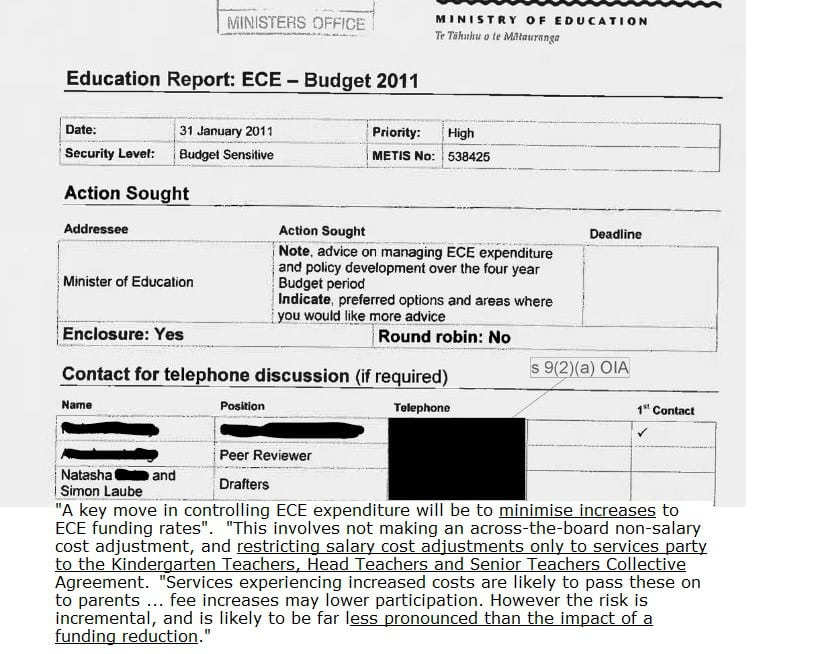
Simon Laube ECC Funding Review
Funding Rates from 1 July 2011Kindergartens run by Free Kindergarten AssociationsAll other Kindergartens and Teacher-led Centres
20 Hours ECE maximum all-day rate$11.40 (per hour per child all-day rate)$11.25 (per hour per child all-day rate)
20 Hours ECE
maximum sessional/part-day rates
$7.70 (per hour per child sessional rate)$6.20 (per hour per child sessional rate)
Non-20 hours ECE subsidy (up to 30 hours) maximum all-day rate over 2-year-old child$6.73 (per hour per child all-day rate)$6.60 (per hour per child all-day rate)
Non-20 hours ECE subsidy maximum sessional/part-day rates over 2-year-old child$6.43 (per hour per child sessional rate)$4.81 (per hour per child sessional rate)
Under 2-year-olds all-day rate maximum$12.09 (per hour per child all-day rate under 2-year-old)$11.93 (per hour per child all-day rate for under 2yr old)

Leave a Reply

Already subscribed?
ECE Newsroom

NZ’s own specialist ECE newsroom. 
Access national and local stories, in-depth analysis, & original commentaries.  

Membership Support for Teachers & Educators

(Comes with free Newsroom and Research access)

Membership Support for ECE Service Owners, Managers, & Community Organisations

(Comes with free Newsroom and Research access)

Researchers & Tertiary Education Libraries

Full access to over 25 years of ECE academic research articles – NZIRECE Journal.
Plus, guidance and resources on doing and publishing research

Has this been useful?  Give us your feedback.

You are welcome to add a link to this page on your website. Copyright belongs to the OECE so please do not copy any content without our written permission.

Information provided is of a general nature. It is provided ‘as is’, and we accept no liability for its accuracy or completeness. See our Terms and Conditions.

Related Posts

teacher wages, pay scales, in childcare and early childhood education

What ECE Teachers and Workers Earn: Pay, Benefits and Conditions

Anyone thinking about getting a job in ECE working in ECE or thinking about moving to a different service will find clear, practical information in this article about pay rates, employment conditions, and what to expect in different roles. It explains everything from starting salaries and pay‑step calculations to workplace rights, benefits, and how to recognise a supportive, professional environment.

Read More »
Early childhood education in practice - this is a child looking at butterfly on buddleia with NZ native ferns in the background.

Moving Beyond the Environment Towards a Multi-Pillared Approach: Early Childhood Teachers Understanding and Practices of Education for Sustainability in Aotearoa NZ

Full reference: Maxwell, A., Hohaia-Rollinson, F, and Woolston, D. (2025).  Moving beyond the environment towards a multi-pillared approach: Early childhood teachers understanding and practices of education for sustainability in Aotearoa New Zealand.  NZ International Research in Early Childhood Education Journal, 27, pp. 69-82.

Login to read the full research paper below. Or order a pdf copy of the article from the main NZIRECE Journal page.

ABSTRACT: The future health, wellbeing and sustainability of our planet and those living upon it is in urgent need of transformational change. Early childhood education (ECE) settings in Aotearoa New Zealand are an important part of the national education infrastructure that can be transformational in bringing about this change. The early childhood curriculum Te Whāriki (Ministry of Education [MoE], 2017), provides an important bicultural and sociocultural framework that can support ECE settings increase the national consciousness when education for sustainability (EfS) knowledge, understanding and pedagogies are embedded in everyday practice and apply a place-based education approach. This article shares findings from a research project that investigated ECE teachers’ current understandings and practices of EfS in Aotearoa New Zealand and the influence of local community and context on EfS practices.  The results discussed in this article contributes to the EfS discourse and critical global conversations in relation to EfS to facilitate with more urgency transformational change.  

Key words: Education for sustainability (EfS), localised curriculum, environmental education (EE), kaitiakitanga/guardianship, pillars of sustainability, place-based education.

Read More »
Early Childhood Code of Conduct for Early Childhood Education Services in NZ

Code of Conduct for ECE Services

The Code of Conduct applies to all licensed early childhood services throughout NZ Aotearoa, including centre-based, home-based, and hospital-based. It sets out the standards that families can right expect of any licensed ECE service.

Read More »
child with binoculars looking out

Financial Sustainability

Early Childhood Service Financial Sustainability.

Unless as much or more money is coming in than is going out, your service could come to be at risk. Here are some strategies for financial sustainability and increasing your revenue stream when necessary. What strategies you agree with and disagree with will depend on your values and the reasons

This is a member/subscriber only post. To access it, please see the message below for details on access and joining.

Read More »
Teacher with girls in outdoor playground feeding baby doll teacher-led centres

Professional Growth Cycle

The Professional Growth Cycle PGC is the new requirement for registered teachers. The Teaching Council have acknowledged that it will continue to be developed and improve over time.

Contents

What does the Professional Growth Cycle (PGC) mean for ECE services? And what should ECE service managers/ leaders do?Does this mean that teachers will n

This is a member/subscriber only post. To access it, please see the message below for details on access and joining.

Read More »
Adults talking about early childhood education and childcare.

An Ethical Guide to Doing, Writing and Disseminating Research

The Ethics of Doing, Writing and Disseminating Research.

By Joy Cullen, Helen Hedges and Jane Bone. Republished by the Office of Early Childhood Education First Published in our NZ Research in ECE Journal, Volume 12, pp. 109-118.

This statement is intended to guide academic researchers, teachers, postgraduate students, managers, licensees

This is a member/subscriber only post. To access it, please see the message below for details on access and joining.

Read More »
The Office of ECE

Share This Information

Table of Contents

Table of Contents

The Office of ECE Login

Take Action!

Help spread this vital ECE information, join our free social and email groups and become a member of OECE.

pay parity funding policy

1. Share This Information

2. Follow Our Social Pages

3. Get Regular Updates

Sign up to our free newsletters.

4. Become a Member