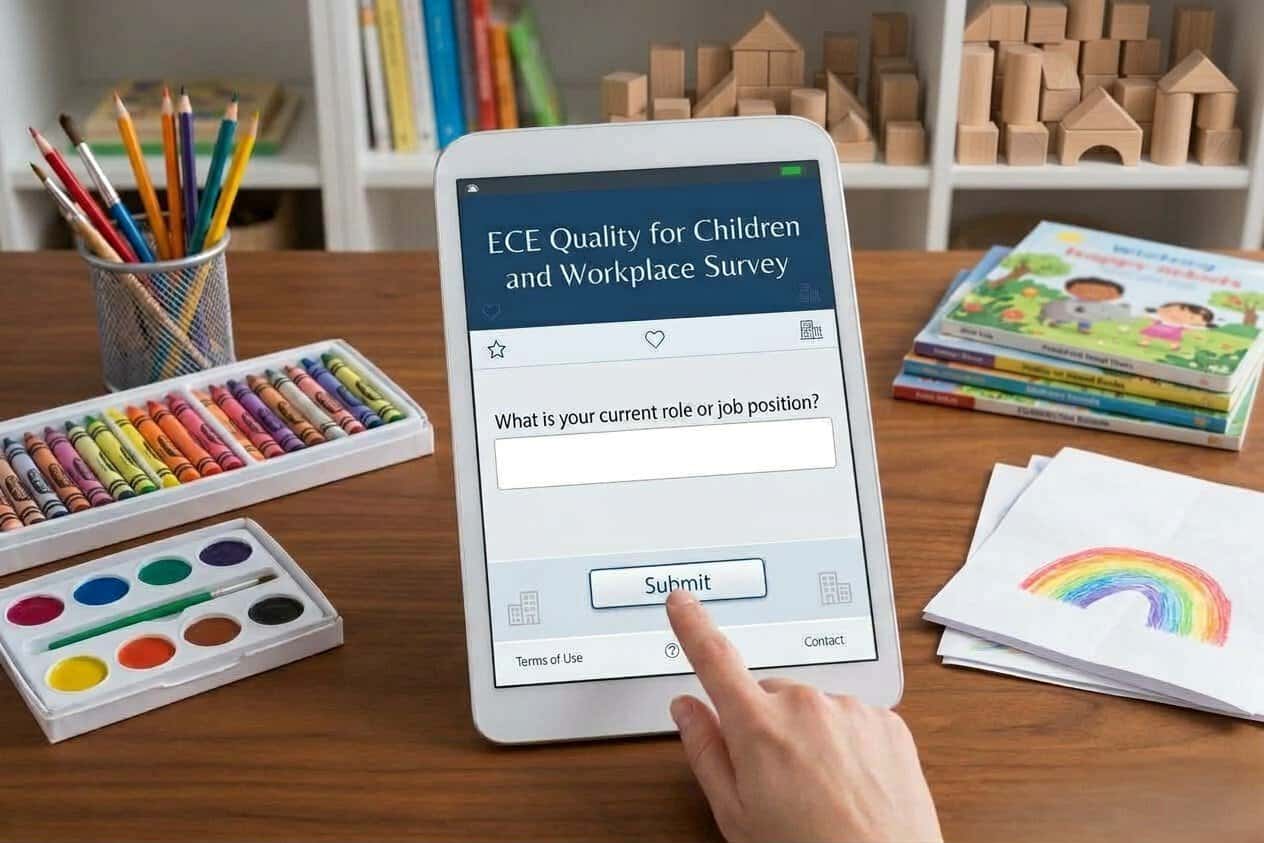
About the ECE Quality for Children and Workplace Survey
The ECE Quality for Children and Workplace Survey is a three-yearly survey conducted by the Office of Early Childhood Education (OECE).
The survey provides a large-scale picture of ECE quality for children from the perspective of staff who see and experience practice first-hand, alongside their experiences of working in the sector.
It asks participants about the quality of ECE provided to children and a range of workplace and employment matters, including pay, workplace safety and wellbeing, and intentions to remain in their current workplace or continue working in the ECE sector.
Conducting the survey every three years enables comparison between survey rounds and helps identify emerging issues, persistent challenges and changes over time.
The survey is open to staff working in licensed early childhood services throughout New Zealand, including relievers. It is conducted online and participation is voluntary. Respondents self-select to take part. The survey is promoted through teacher Facebook groups, social media and the OECE newsletter, and no incentives are offered for participation.
The ECE Quality for Children and Workplace Survey does not include service owners, including owners who work as a teacher or manager in their own service, self-employed home-based educators, or volunteers.
Because participation is voluntary and respondents are self-selected, the findings should not be interpreted as estimates based on a random or nationally representative sample of the ECE workforce. Rather, they provide a large-scale snapshot of the experiences and views reported by participating ECE staff.
The findings inform OECE’s work and contribute evidence to sector discussion and advocacy. Results are published in topic-based reports on the OECE website and made available to the ECE sector, policymakers and the wider public.
Why survey ECE staff?
There are several official sources of information about ECE services and the sector, but they do not provide a complete picture of what staff and children experience day to day.
- The Education Review Office (ERO) independently evaluates the quality of education and reviews early learning services. Its quality evaluations consider the learning and organisational conditions that support outcomes for children. These reviews provide important external oversight, but they are different from asking staff directly about their everyday experiences of practice and working conditions.
- The Ministry of Education’s annual ECE Census provides a valuable statistical picture of the sector. It collects administrative data about services, children’s enrolment and attendance, teaching staff and other aspects of service provision. It provides workforce statistics but is not designed to capture staff members’ personal experiences of workplace conditions, safety or wellbeing.
- OECE’s annual reporting on regulatory action identifies services whose licences have been downgraded, suspended or cancelled for regulatory breaches. This provides information about identified non-compliance and regulatory action but cannot provide a complete picture of the everyday experiences of staff and children inside services.
The ECE Quality for Children and Workplace Survey fills a different information gap: it asks staff directly. Staff are well placed to report on what they see and experience first-hand, both in the education and care provided to children and in their own workplaces. Their perspectives provide information about everyday practices, conditions and experiences that may not be apparent from administrative data, documentation or external review processes.
Ethical considerations
The OECE is committed to protecting the identity of participants and minimising the risk of harm arising from participation in the survey.
Participation is entirely voluntary. Individuals are free to decide whether or not to take part, and no person is compelled to participate.
The ECE Quality for Children and Workplace Survey can be completed anonymously and participants are not asked to provide their names. Where responses contain information that could identify a participant, their service, colleagues or other individuals, identifying details are removed from published results.
Direct quotes from participants’ written responses may be included in reporting the survey findings to illustrate experiences, situations or issues described by respondents. Before publication, names, locations and other identifying details are removed or omitted to protect the identity of the participant, their service and other people referred to in the response.
Survey findings are reported in a way that protects the identity of individual participants and the services and people they refer to.
Background to the ECE Quality for Children and Workplace Survey
The survey was developed by Dr Sarah Alexander, with input from ECE practitioners who advised on the selection and wording of questions. It was tested with teachers working across different types of ECE services, refined following their feedback, and first conducted in 2014.
The survey covers three broad areas:
- Employment and workplace conditions
- The quality of ECE provided to children
- Respondent and workplace characteristics, such as qualifications, gender and service type
Survey questions have developed over time to reflect emerging issues and changes affecting the ECE workforce, while the recurring questions enable results to be compared across survey rounds.
Following the 2019 measles outbreak, a vaccination‑status question was added to the 2020 survey asking respondents to indicate if they were immunised against several well-known vaccine-preventable infectious diseases. Findings were published in the NZ Medical Journal. (Early-childhood-education-staff-are-falling-through-a-vaccination-policy-gap-in-new-zealand.pdf)
ECE Quality for Children and Workplace Survey Reports
2023
- Report 1. ECE Quality for Children: Survey Results 2023
- Report 2. What is it like to work as an early childhood teacher in NZ?
2020
- Report 1. ECE Quality for Children: Survey Results 2020
- Report 2. Private and community early childhood sector differences
- Report 3. Staff pay and retention
- NZ Medical Journal. Early childhood education staff are falling through a vaccination policy gap in New Zealand
2017
- ECE Service Quality for Children
- Bullying in the early childhood sector
- How safe is working in ECE for staff?
2014
- Teachers’ Views on Quality for Children 2014
- NZEI Te Riu Roa – Who Joins, Their Experiences, and the Benefits of Membership
- How Safe are ECE Workplaces? – Survey Results