February 7, 2017.
After all the effort and money spent towards getting 98% participation in early childhood education by 2016, the target has been missed.
It would be strange for any Government to set a target it knew it could not met – so the question is to what extent have Government actions negatively impacted on achievement.
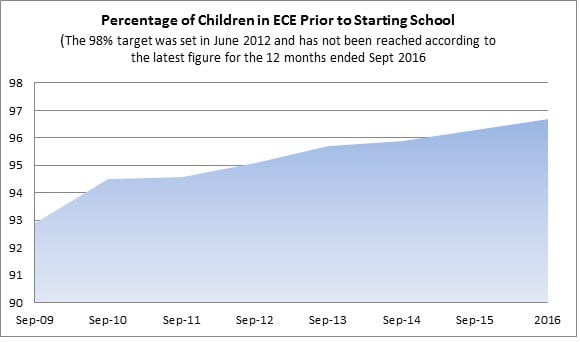
Last year just over 96% of school starters had participated in early childhood education, according to a statement released by Ms Parata last week welcoming children to the start of the school year.
However, 98% of school starters should have been attending early childhood education last year. This was a Better Public Service target that the Government said would be achieved.
Does it really matter?
“Most people would think that even 90% is a high rate when participation in early childhood education is not legally required and does not come free of cost to every family.
“However, the Minister is publicly accountable for achieving the target and so perhaps questions still need to be asked,” says Dr Sarah Alexander
The nuts and bolts – And to what extent has the actions of the Education Minister and her Ministry perhaps prevented the participation rate from rising higher?
The Minister claimed this week that the increase in participation is because of more parents recognising the importance of early childhood education.
However, it seems that at times a coercive approach towards obtaining participation has been taken along with more money being thrown at the problem.
To help reach the target a law change made it a requirement for young children of beneficiaries to attend early childhood education, with the penalty for non-compliance being a loss of 50% of benefit money.
An ‘Early Learning Taskforce’ was established in the Ministry of Education, with its own big budget and a team of staff to engage in promotional campaigning and the targeting of families not using an early childhood service.
The Ministry also paid contractors to recruit children into early childhood education, including through door knocking on family homes.
Large sums of money were made available to service providers successful in tendering to open more services and increase child places, and it did not seem to matter if there were vacancies at other perhaps higher quality services nearby.
At the time the target was set in June 2012, the ECE enrolment rate was 94.9%.
The latest figure for the year to September 2016 shows the numbers were falling short of the target at 96.7% and it seems unlikely that the deficit of 1.3% would have been made up within the final months of 2016.
In the four years since the target was set the rate has risen just under 2%. However, in the three years prior to the target being set the rate rose exactly 2%.
Dr Alexander says therefore that it would seem to be a long stretch to argue that government actions alone have enhanced the upward trend in the participation rate in any meaningful way.
Has it been a worthwhile target to set?
“What we know is that at the time that the target was set in 2012, the participation rate was already naturally rising, more parents were making use of the 20 Hours ECE subsidy, and setting of the target fortuitously coincided with strong job growth in our economy providing parents with an incentive to use childcare and return to work before their child started school.
The Ministry of Education may still have provided projects to introduce the families of Maori and Pacific children to early childhood education in areas of NZ with low ECE participation rates. And, without the pressure of achieving sign-ups, this may have been an even more successful and a more inclusive approach.
“With calls for better funding of the sector overall and many teachers concerned about quality and standards, questions could be raised about whether at least some of the money spent on trying to achieve the target could have been spent elsewhere in the ECE sector and participation levels would still have risen naturally and perhaps even higher than the latest 96.7% figure,” says Dr Sarah Alexander.