
March 1, 2017.
By Dr Sarah Alexander.
Former centre manager Garrett Kett has done what few others have dared to do and that is question the representation of the interests of teachers in workplaces not covered by NZEI Te Riu Roa.
The proposal could see teachers being split between belonging to NZEI Te Riu Roa and a new union entity.
The proposal has come out of growing unrest among teachers, mainly in for-profit centres, over working conditions, employment rights, and declining standards of quality for children.
Mr Kett asked teachers through social media and at meetings what they thought about forming a dedicated union specifically for ECE and the response was mostly positive.
NZEI Te Rui Roa responds
I asked NZEI Te Riu Roa for its comment. The following is a precis.
There has been some discussion on social media about starting up a new union for ECE teachers. Being part of one union makes it more possible for teachers to speak out about pay and conditions, come together to share practice and discuss how things could be different if we combined our teacher power.
A lot of organising by members goes unseen (outside of social media) i.e. on worksites, in communities, local networks and in local and national industrial, political and professional advocacy. These hui are essential to have our voices heard. To have the issues fully understood we need to be at the table.
ECE leaders are out and about with the Better Funding tour calling on the government to address funding issues across the country. This is a five-month campaign involving NZEI Te Riu Roa and PPTA members because having 60,000 members speaking about their under-funding stories with their communities is a powerful way to influence political change.
More voices from across the sector means we can be united on the issues that affect us all and stand together. Together in union we can all target the decision-makers for the change we want.
Do teachers find union membership to be attractive and worthwhile?
Data from our employment 2014 Survey can throw a lot of light on the above question.
Of 762 respondents who were ECE employees, 65% surveyed were not members of NZEI Te Riu Roa and 35% were members.
It was found that being a union member or not made no difference when it came to:
- Being happy in their workplace.
- Whether they wanted to leave their current position or were seeking a change of job.
- How often they felt stressed at work.
- Whether or not they experienced a work-place related injury, mental health or physical problem.
- Their employer paying the costs of teacher registration for them.
But the data showed that those who were members of NZEI Te Riu Roa had a much higher probability of:
- Being well paid – according to their own perception of what this meant.
- Having a greater number of hours of non-contact time per week.
- Being given more days paid study or professional development leave.
- Having the cost of first-aid training covered by their employer.
- Working in a service where the adult-child ratios are at least at legal minimum (as opposed to below legal minimum).
- Having a workload that they rate as ‘fine” (not just “bearable” or alternatively “excessive”).
Go to our research evidence and survey results section online for data on:
1. Differences between what early childhood staff actually want of a union and NZEI’s perception of its role
2. The ability of the NZEI Te Riu Roa to represent staff at privately-owned ECE services
3. Its relevance to staff at different types of services (e.g. home-based, hospital-based, childcare, kindergarten, kohanga reo etc.)
4. Relevance of union membership for staff in casual and permanent teaching positions, students, and management positions
5. Who the union mostly attracts – staff who are younger, middle-aged or older?
6. Why some early childhood staff join NZEI and others don’t.
Historical context and what would be possible and/ or effective today
It is proposed by Mr Kett that the ECE sector has its own dedicated union. This has been the case previously.
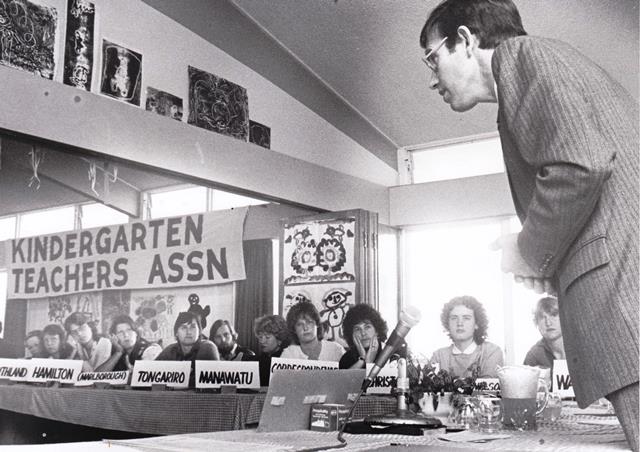
There was the KTA (Kindergarten Teachers’ Association) which represented kindergarten staff exclusively, was hugely vocal and never afraid of any education minister – not even the very tough Hon. Merv Wellington who in 1982 when asked how he could justify cutbacks to kindergarten and preschool services considering the Government’s awareness of the importance of early childhood education, he replied “To save money”.
In 1982 teachers held their first half-day nation-wide stop-work. Kindergarten teachers held a national strike in 1984.
The ECWA (Early Childhood Workers Union) was formed in 1982 and went on to establish the first industrial award for childcare workers.
In 1990 KTA and ECWA were amalgamated into one early childhood union (the Combined Early Childhood Union of Aotearoa, CECUA) in recognition that childcare centres sat alongside kindergarten in also providing education.
In 1994 CECUA joined NZEI an industrial union for primary school teachers.
The cost of joining NZEI is limiting uptake of union membership. It may be worth NZEI considering offering something like a one-off $1.00 membership rate for the first year to ECE teachers not currently covered by a collective agreement. It may make sense if it results in a significant number of teachers signing up, boosting the ability of NZEI to have its voice heard and presence felt and be seen to be representing the views of teachers and their needs. However, it can be the case that the teachers who are paid the least and can least afford to join a union are more likely to experience employment issues and need legal representation, a cost for any union that can only be recouped through membership fees.
Would a new union exclusively for early childhood education (including kindergarten and home-based) be in the best interests of teachers?