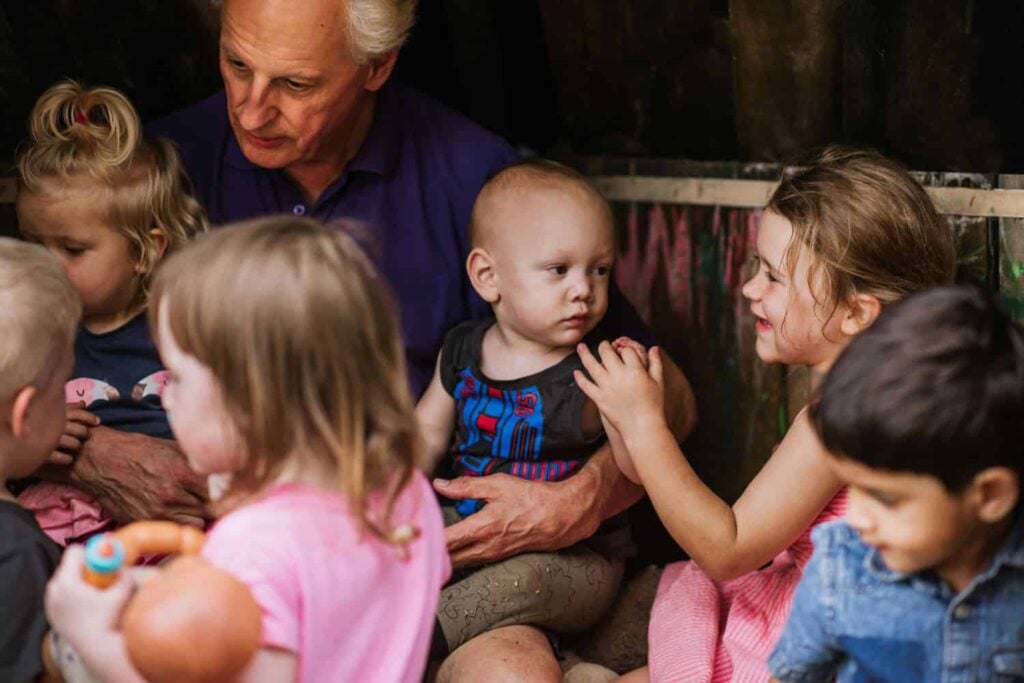
This issue examines emergent literacy across socioeconomic contexts, strengths‑based approaches for supporting vulnerable families, school‑starting age debates, early literacy perspectives for children under three, professional standards in ECE, and inquiry‑driven STEM learning. Together, these articles offer fresh insights into early teaching and learning practices and the diverse factors shaping children’s development and educators’ professional growth.
Below are the titles and abstracts for articles published in the NZ-International Research in ECE Journal, 2018, Volume 21(2). To read any article a member login is needed – join us if you are not already a member. Many libraries subscribe to the journal so you may be able to view articles through your library’s system.
Order a copy of any article
Type in below the year, volume number and author(s) of the article you wish to order. The price per copy is NZ $19. Once you have completed your order it will emailed to you within 24 hours.
Original Research Paper
Exploring early childhood teachers’ beliefs and practices in emergent literacy: Does practice vary by the socioeconomic status of the children?
Amber Dampney, Jayne Newbury and Megan McAuliffe
University of Canterbury NZ
Abstract
There is limited research on the practices that New Zealand early childhood teachers (ECTs) use to facilitate the development of emergent literacy skills. The present study aimed to investigate the practices of ECTs in encouraging emergent literacy. Specifically the study investigated if these practices varied across different socioeconomic levels (SES) and whether there was a statistically significantly relationship between these practices and ECTs’ beliefs about literacy. Eighty seven ECTs from across New Zealand completed a survey about their literacy beliefs and practices. The results indicate that ECTs engage in a range of literacy practices moderately frequently, and that there was no statistically significant relationship between practices used to promote literacy skills and the SES of the early childhood centre in which they were employed. However, there was a statistically significant relationship between the ECTs’ literacy practices and beliefs regarding their role or the role of the centre in promoting literacy. In contrast, the relationship between ECTs’ emergent literacy practices and beliefs about current research was not significant. The present study provides insight into the practices used by ECTs to promote emergent literacy development, and the influence their beliefs have on these practices. Implications for raising achievement in literacy are discussed.
Key words: Emergent literacy, early childhood teachers, beliefs, practices.
Full reference
Dampney, A., Newbury, J., & McAuliffe, M. (2018). Exploring early childhood teachers’ beliefs and practices in emergent literacy: Does practice vary by the socioeconomic status of the children? NZ International Research in Early Childhood Education Journal, 21(2), 1-18.
Original Research Paper
Building early childhood educators’ capacity to apply a strengths approach to working with vulnerable families and children
Angela Fenton and Laura McFarland
Charles Sturt University, Australia
Abstract
This paper investigates the use of a strengths approach by early childhood educators when working with vulnerable children and families. The paper examines existing strengths approach literature and research and draws on findings from an evaluation of a small-scale project to implement a strengths approach to working with children and families within a regional Australian early childhood service. The project included theoretical development aimed to clearly define and introduce the strengths approach and modelling of a range of practical strategies for addressing complex issues. Survey and EView (electronic interview) findings revealed that at this localised level, educators felt positive about using explicit and implicit strengths approach strategies in their work with children and families. Factors reported as being important to implementation were a “mind-shift” about working with families; noticing an implicit strengths approach; and acknowledgement of “human resources” as well as physical resources. Participants reported that continued development and connections with community agencies would help to sustain their use of a strengths approach. The findings from the nuanced study were supported by the wider review of existing literature and together provide positive encouragement for further in-depth research regarding the use of strengths approaches in early childhood contexts.
Key words: Strengths based approach, vulnerable children, teacher practice, evaluation.
Full reference
Fenton, A. & McFarland, L. (2018). Building early childhood educators’ capacity to apply a strengths approach to working with vulnerable families and children. NZ International Research in Early Childhood Education Journal, 21(2), 19-31.
Original Research Paper
Is there an optimum age for starting school in NZ?
John Boereboom* and Peter Tymms**
*University of Canterbury, NZ;
** Durham University, UK
Abstract
Recent changes and reversals in school entry policy in New Zealand are a reflection of the widespread public and political debate about the optimum age for starting school. This raises the question whether there is an optimum age for starting school. The determination of readiness to enter primary school is a complex process. Identifying factors that contribute to a child’s positive transition into school can help parents, teachers and the wider support network make a sound decision of whether or not a child is ready to commence primary school. This paper investigates the relationship between age, cognitive development and school readiness and concludes that at the national level there is no optimum age for starting school. The decision of when to start school is individual to each child.
Key words: Starting school, school readiness, optimum age, entrance testing.
Full reference
Boereboom, J. & Tymms, P. (2018). Is there an optimum age for starting school in New Zealand?. NZ International Research in Early Childhood Education Journal, 21(2), 32-44.
Original Research Paper
Early childhood educators’ and parents’ perspectives of literacy for children under three: An exploratory study
Laura McFarland, Noella Mackenzie and Natalie Thompson
Charles Sturt University, Australia
Abstract
There has been little empirical focus on practices to promote literacy for children under three years. Using a qualitative case study approach, this pilot study investigated the understandings and practices of parents and early childhood educators in relation to literacy for children birth to two years. The study took place in regional New South Wales, Australia. Telephone interviews with 13 parents and two educators were conducted to explore their perspectives on what literacy for children birth to two years “looks like” and how it is enacted. Results indicate that parents tended to understand early literacy in terms of print based book reading, rather than as also including drawing, talking, viewing and singing. Educators’ understanding of literacy included book reading, drawing and talking to children throughout caregiving routines. Meeting the physical needs of children was reported as a barrier to literacy promotion by parents and educators. Implications for future research and practice for the promotion of literacy in young children are discussed.
Key words: Early childhood, literacy, birth-two, early writing, reading.
Full reference
McFarlard, L., Mackenzie, N. & Thompson, N. (2018). Early childhood educators’ and parents’ perspectives of literacy for children under three: An exploratory study. NZ International Research in Early Childhood Education Journal, 21(2), 45-58.
Original Research Paper
Generic or specific? Deciphering the NZ approach to professional standards for early childhood
Qilong Zhang
Toi Ohomai Institute of Technology, NZ
Abstract
Internationally, there exist two disparate and contested approaches to professional standards for early childhood teachers: relying solely on generic professional standards that are shared across early childhood, primary, and secondary school sectors, and introducing standards specifically for early childhood teachers. Given the different effect of the two approaches and the inconsistency between jurisdictions in their approach, it is pertinent to examine why New Zealand (NZ) has chosen the generic approach. Data are collected through ‘dilemmatic expert interview’ with 15 experts from eight early childhood initial teacher education providers across NZ. Analysis of the data generates seven themes concerning reasons for the NZ approach: commonality, applicability, autonomy, remediableness, pay parity, status parity, and policy direction. These themes mirror the complex historical, social, and political roots of the generic approach that has long been preferred in NZ regardless of its limitations.
Key words: Professional standards, early childhood teacher, New Zealand.
Full reference
Zhang, Q. (2018). Generic or specific? Deciphering the New Zealand approach to professional standards for early childhood. NZ International Research in Early Childhood Education Journal, 21(2), 59-70.
Original Commentary Paper
STEM in Early Childhood Education: Using the Inquiry approach to Scaffold Learning
Pauline Roberts & Marianne Knaus
Edith Cowan University, Perth, Australia, UK
Abstract
STEM education is gaining worldwide attention due to its perceived links with economic growth and prosperity of developed countries. Research also indicates the significance of integrating the four disciplines of science, technology, engineering and mathematics as beneficial in enhancing children’s knowledge, skills and dispositions. Although the focus on these areas is usually targeted at the primary and high school years, this commentary paper argues that not only is it important to start STEM education in early childhood settings but that it is a natural connection. STEM aligns closely with early childhood pedagogy of hands-on exploration and the integration of learning across areas using an inquiry approach. Outlined in this paper are ways that STEM and the inquiry-based process can be successfully implemented into early childhood settings. It also identifies how early childhood educators can perhaps position themselves in the current debate.
Key words: STEM, inquiry-based, pedagogy, maths, science, technology, engineering.
Full reference
Roberts, P. & Knaus, M. (2018). STEM in Early Childhood Education: Using the inquiry approach to scaffold learning. NZ International Research in Early Childhood Education Journal, 21(2), 71-84.