FULL REFERENCE: Postlewaight, G. (2024). Early childhood teacher engagement with place-based education: Professional learning at the Ōtātara Outdoor Learning Centre. NZ International Research in Early Childhood Education Journal, 26, pp. 69-83.
Log-in to read the full research paper below. Or order a pdf copy of the article from the main NZIRECE Journal page.
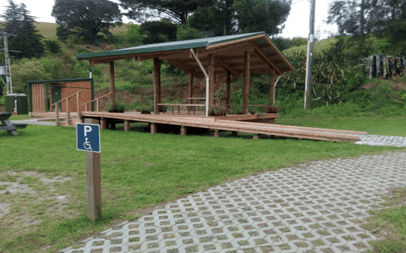
ABSTRACT: This article explores the second cycle of an action research project, undertaken to determine how to support local early childhood education [ECE] settings to utilise the nature-based education space, the Ōtātara Outdoor Learning Centre [ŌOLC], at Te Aho a Māui Eastern Institute of Technology [EIT] in the Hawke’s Bay (NZ). The first cycle of the research involved a focus group to introduce local early childhood kaiako (teachers) to the space and to ascertain the possibilities and opportunities for them to make use of the location with tamariki (children) to facilitate place-based education (PBE). This second cycle examined the professional learning experiences provided to the focus group to increase their knowledge and confidence to facilitate appropriate and inclusive nature and place-based experiences with tamariki. Two professional learning workshops enabled participant kaiako to familiarise themselves with the ŌOLC space through the sharing of whakapapa (genealogy) and pūrākau (historical stories) of the rohe (region), and to experience possible approaches for place- based teaching and learning. Although this is a small-scale research project, the value of the experiential learning about PBE, and the need for kaiako professional learning is evident from the participant discussion, reflection and feedback. Participants recognised this pedagogical approach and its relationship to bicultural practice, honouring Te Tiriti o Waitangi and building local curriculum as a foundation of authentic practice.
KEY WORDS: Kaiako, action-research, professional learning, place-based education, kaupapa Māori (customary practice, approaches), pūrākau, learning in nature, play.
INTRODUCTION
The whakataukī (significant traditional saying) above aligns with the intent of Te Whāriki: He whāriki mātauranga mō ngā mokopuna o Aotearoa, Aotearoa, New Zealand’s early childhood education curriculum(Ministry of Education [MOE], 2017). Te Whāriki (2017) articulates how tamariki learn in a holistic way that encompasses each of the contexts identified in Bronfenbrenner’s (1979) ecological model: whānau (adults in the life of the tamaiti, (the child), local and wider community, and national and global contexts. Such learning occurs when their whakapapa (genealogy), identity, mana (prestige) and mauri (life force) are nurtured within learning experiences and teaching approaches that value, respect and affirm their connection with papatūānuku (mother earth), place, language and culture. The teaching approaches include; place-based education (PBE), which offers tamariki opportunities to: connect with: taiao (nature), papatūānuku, local pūrākau and to experience te ao Māori (Māori world view) kaupapa. Williams, et al. (2023) describe te ao Māori further, as ngā aronga, identifying that this acknowledges that there are multiple world views that are iwi and hapū (tribe) based. Embedding kaupapa Māori pedagogies of learning and teaching, as described above promotes, respects and protects Te Tiriti o Waitangi (The Treaty of Waitangi) (University of Auckland, n.d.). Embodied within place-based experiences is a rich local holistic curriculum that includes; te reo and tikanga Māori(language, values, philosophies, and cultural customs), literacies, mathematics, science, the Arts, history – both Māori and Pākeha (New Zealander of European descent). These experiences also foster social and emotional competency, education for kaitiakitanga (guardianship and sustainable approaches), utilising play and child initiated experiential learning approaches.